Hybrid training—the strategic fusion of calisthenics and weighted exercises—is rapidly becoming the gold standard for building well-rounded strength, muscle, and athleticism.
For those who’ve spent years mastering bodyweight skills but feel progress plateauing, or lifters seeking functional movement quality, this approach offers the best of both worlds.
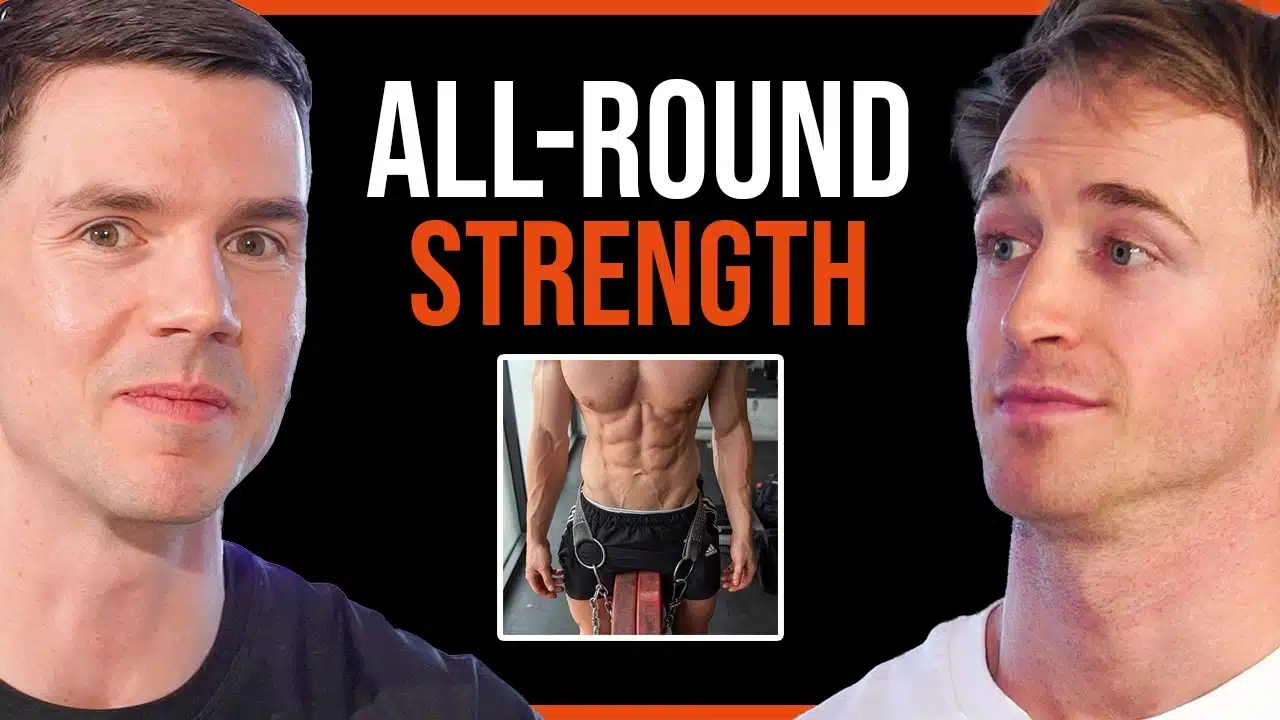
In a recent conversation, calisthenics experts Daniel Vadnal of FitnessFAQs and Jake Williams dissected exactly why mixing rings, bars, barbells, and dumbbells creates better athletes than sticking to one modality alone.
Their insights reveal how to structure training for maximum strength gains, muscle growth, and long-term progress—without the limitations that come from being dogmatic about training methods.
Jump to:
Why Hybrid Training Is the Future
Both athletes arrived at hybrid training through similar paths: initial obsession with pure calisthenics, followed by the realization that endless high-rep sets weren’t the most efficient route to their goals.
Hybrid training is a hedge against AI and you’ll be well-rounded. It’s the future.
Vadnal noted that while calisthenics progressions feel exciting—moving from regular push-ups to planche variations—the lack of quantifiable tracking becomes problematic. When every progression involves a different exercise with subjective form standards, measuring week-to-week improvements becomes nearly impossible.
Williams agreed, explaining how weighted calisthenics became his gateway into hybrid training.
I think I’ve been using the term hybrid to describe what I’ve been doing since I started making the jump from just pure calisthenics stuff to weighted calisthenics.
Adding weight to dips and pull-ups provided the numerical feedback missing from bodyweight variations. This allowed for precise progressive overload without the guesswork of “was my lean angle better this week?”
The Progressive Overload Problem With Pure Bodyweight Training
Once athletes reach 20+ pull-ups or 30+ dips, progressive overload options narrow considerably. Adding more reps pushes training into endurance territory rather than building maximal strength or optimal hypertrophy.
The research shows muscle growth occurs across a wide rep range—roughly 5 to 50 reps per set—as long as sets approach muscular failure. This seemingly validates high-rep calisthenics training.
But Williams highlighted a critical flaw in applying this research practically.
At that 30 reps, it’s you stop because the pump, the fatigue, the metabolites, the lactic acid, all those ions floating through you is what is causing you to stop.
Unlike a true 5-rep max where another rep is physically impossible, high-rep sets typically end due to cardiovascular fatigue, burning sensations, and mental discomfort—not genuine muscular failure. Athletes often have 5-10 reps remaining but experience overwhelming systemic fatigue that convinces them to stop.
Why Lower Rep Ranges Win for Most Goals
Vadnal keeps approximately 95% of his training in the 3-8 rep range. This constraint forces progressive overload through added weight rather than endless volume accumulation.
The advantages of this approach include:
- Superior strength gains: Heavy loads build maximal force production
- Reliable proximity to failure: Easier to gauge true muscular failure at lower reps
- Better fatigue management: Low-rep sets cause less systemic stress per set
- Enhanced connective tissue adaptation: Tendons and joints strengthen better under load
- Improved motor unit recruitment: Heavy weights activate high-threshold muscle fibers more effectively
Perhaps most importantly, strength built in low rep ranges transfers remarkably well to endurance tasks, but the reverse isn’t true.
Real-World Evidence of Strength Transfer
Williams recounted attending a spontaneous competition in Bondi featuring max-rep pull-ups, ring dips, and muscle-ups—classic endurance tests.
Me and them and a couple other guys who performed the best on some of these ring dips and some of these high rep pull-ups, we were all the low rep strength guys and still came out with decent high reps.
Despite rarely training endurance, the strength-focused athletes cracked 30+ pull-ups and 40+ ring dips. Meanwhile, athletes who specialized in high-rep training couldn’t reciprocate by moving heavy loads.
Vadnal experienced similar results, going six months without bodyweight dips while focusing on heavy weighted variations around 60+ kilograms. When he tested max reps after a full push workout, he easily hit 30 repetitions.
Strategic Exercise Selection: Pairing Calisthenics With Weights
The magic of hybrid training lies not in abandoning calisthenics but in strategically supplementing skills with stable, progressible weighted exercises.
Handstand Push-Ups and Overhead Press
Handstand push-ups demand significant skill—balance, body awareness, and coordination. These elements require dedicated practice but make measuring pure strength difficult.
The overhead press removes instability variables, allowing athletes to reliably overload the shoulders, upper chest, and triceps with quantifiable progression.
The combo of those two is just the perfect example of why you might want to bring in something that’s more stable, something that’s more progressible, something that has a weighted component to it.
Williams pointed to an extreme example: powerlifter Larry Wheels, despite abysmal handstand balance, banged out 90-degree push-ups within days of trying them due to overwhelming raw pressing strength.
For practical application, Vadnal recommends overhead pressing twice weekly for 1-2 sets of 3-5 reps after skill work. This minimal volume—performed on a Smith machine or seated with back support—provides maximal stability for building strength without interfering with handstand practice.
Pull-Ups and Lat Pulldowns
Even dedicated calisthenics practitioners benefit from machine-based pulling.
Vadnal incorporates lat pulldowns as accessories after weighted pull-ups, using the machine’s stability to accumulate back volume without the technique demands of free-hanging work.
With a lat pull down, you can really change the angle, lock in the multitude of grips that you can use in there. You can really push it quite close to failure.
Benefits include:
- Locked-in positioning eliminates compensatory movement patterns
- Grip variations target back musculature differently than standard pull-up grips
- Unilateral work addresses strength asymmetries
- Ability to train beyond failure with drop sets and partials
For home-based athletes, front lever raises serve as an excellent bodyweight lat isolation alternative, removing elbow flexors from the equation.
Horizontal Pulling: Rows and Inverted Rows
Chest-supported dumbbell rows provide stable horizontal pulling that complements front lever rows and inverted rows.
The chest support eliminates lower back fatigue—crucial for athletes already taxing their spinal erectors with squats, deadlifts, and other compound movements.
Vadnal emphasizes maximizing range of motion, pulling the elbow well past the torso to target the often-neglected end range where rear delts and long head triceps contribute significantly—exactly what’s needed for slow muscle-up transitions.
Making that closing at the part of the transition where you had to get body close to the bar, elbows pulled back. That was where my weak point, my sticking point was for a long time.
Dips and Bench Press
Unlike most hybrid pairings where exercises closely mirror each other, bench press and dips differ significantly in arm path and muscle emphasis.
Bench pressing emphasizes horizontal adduction with elbows flared, targeting middle and upper chest fibers rarely stressed in dips, planche work, or handstand push-ups—all of which keep elbows tucked.
This makes bench press uniquely valuable for filling muscular gaps rather than directly boosting dip performance.
Williams demonstrated impressive strength transfer despite minimal bench pressing, hitting 100 kilograms for three reps after six months away from the movement—testament to his consistent low-rep dip and push-up training building general pressing strength.
The Case for Isolation Work
Compound movements form the foundation, but strategic isolation exercises accelerate progress by targeting weak links.
Biceps: Preacher Curls
Using an incline bench as a makeshift preacher station provides exceptional bicep isolation with built-in safety—the dumbbell size limits dangerous elbow hyperextension.
Unilateral training increases neural drive compared to bilateral work, allowing athletes to push closer to true failure. When a bilateral curl reaches failure, dropping one dumbbell often reveals 1-2 remaining reps in each arm.
Triceps: Skull Crushers
The triceps’ long head crosses the shoulder joint, making overhead movements essential for complete development. Standard dips and push-ups primarily stress the lateral and medial heads.
You don’t train a muscle when you train a muscle. You train fibers when you target fibers.
Williams demonstrated impressive skull crusher strength, working up to 50 kilograms for 10 reps by treating the exercise with the same respect as main lifts—staying in 4-8 rep ranges and progressively overloading.
For both isolation movements, two quality sets performed 1-2 times weekly provides sufficient stimulus without creating excessive fatigue that interferes with compound work.
Programming Principles for Hybrid Training
Successful hybrid programming requires thoughtful exercise sequencing and volume management.
Prioritize Skills First
Calisthenics skills demanding fresh nervous systems—handstands, planches, levers—should open training sessions when coordination and focus peak.
Weighted accessories follow, capitalizing on stable exercises that tolerate accumulated fatigue better than technical movements.
Manage Front Delt Volume
Nearly every calisthenics pushing movement—dips, handstand push-ups, planche work—heavily taxes front delts. Adding excessive pressing volume risks overuse injuries.
Vadnal strategically uses flat bench pressing with close grip and tucked elbows when 90-degree push-ups are on maintenance, ensuring continued strength development in specific ranges without redundant front delt stress.
Use Double Progression
Select target rep ranges (e.g., 4-8 reps) and progress by adding reps before increasing load:
- Start at range bottom (4 reps) with given weight
- Add reps across sessions until hitting range top (8 reps)
- Increase weight, dropping back to range bottom
- Repeat indefinitely
This creates built-in progressive overload with clear success metrics.
Keep Accessory Volume Low
The most stimulating sets are always the first 1-2 in a weekly volume landmark. For accessories addressing specific gaps, minimal effective dose principles apply.
Two hard sets weekly of an accessory provides 80% of possible benefits with 20% of the fatigue cost.
The Practical Hybrid Training Template
A sample weekly structure might look like:
Day 1: Push Focus
- Handstand skill work
- Weighted dips: 4 sets x 4-8 reps
- Overhead press (Smith machine): 2 sets x 3-5 reps
- Skull crushers: 2 sets x 5-8 reps
Day 2: Pull Focus
- Front lever skill work
- Weighted pull-ups: 4 sets x 4-8 reps
- Chest-supported dumbbell rows: 3 sets x 6-10 reps
- Preacher curls: 2 sets x 6-10 reps
Day 3: Skill and Accessories
- Planche progressions
- Muscle-up practice
- Lat pulldowns: 3 sets x 8-12 reps
- Lateral raises: 2 sets x 10-15 reps
Total weekly volume remains manageable while addressing strength, skill, and hypertrophy across all movement patterns.
The Bottom Line
Hybrid training isn’t about abandoning calisthenics or becoming a powerlifter. It’s about using the right tools for specific jobs.
Bodyweight movements provide unmatched skill development, movement quality, and relative strength. Weighted exercises offer superior progressive overload tracking, isolated muscle targeting, and efficient strength building.
Combined intelligently, they create athletes who move beautifully, lift impressively, and avoid the plateaus that come from dogmatic adherence to single training methodologies.
As Williams succinctly put it, focusing on low-rep strength work with both calisthenics and weights creates a foundation where “the rest takes care of itself”—less pain, more versatility, and the raw building blocks to master any movement goal.