
Visceral fat, the dangerous kind packed deep around your organs—has been notoriously hard to target with any intervention short of major lifestyle overhaul or bariatric surgery.
But tesamorelin, a synthetic peptide that mimics growth hormone-releasing hormone (GHRH), has done something rare: it proved in large-scale human trials that it can selectively melt visceral fat by 15 to 20% without touching the subcutaneous layer.
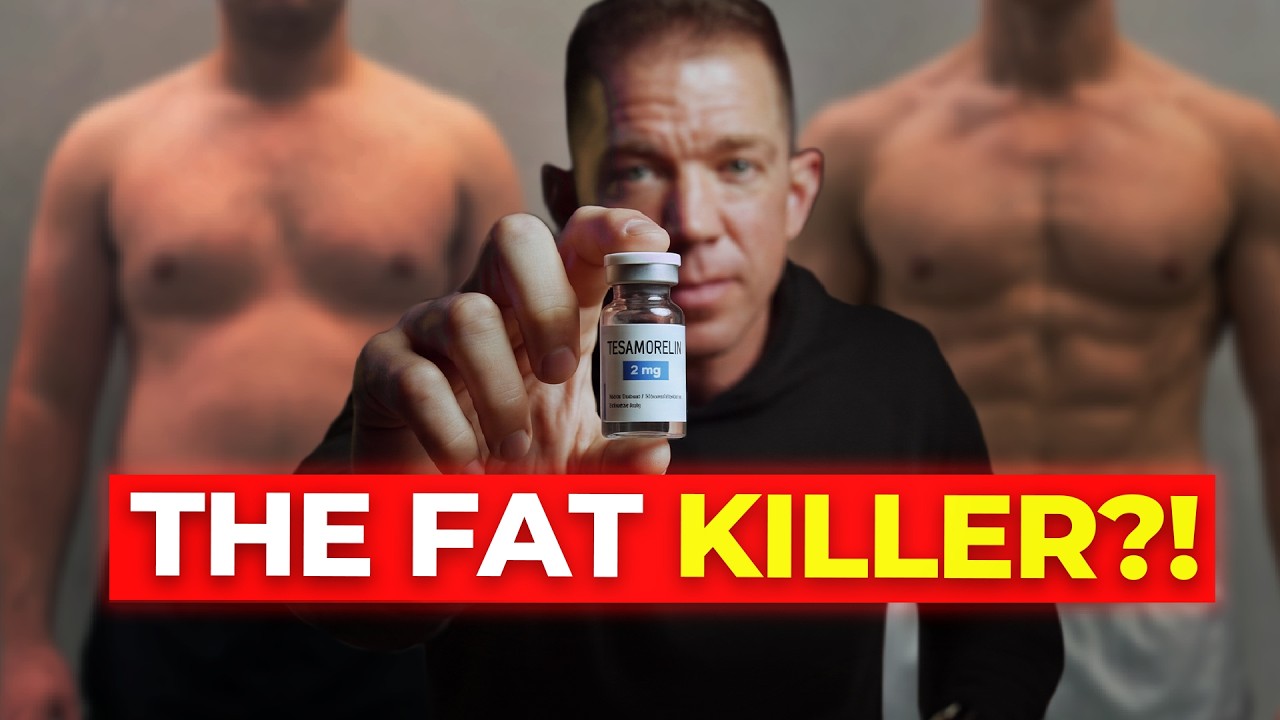
It earned FDA approval over a decade ago, has been tested in more than 800 patients across two Phase 3 trials, and comes with CT scan evidence showing actual reduction in belly fat cross-sectional area.
Yet despite all that data, most people—including many doctors—have never heard of it, and those who have can’t afford it.
Jump to:
- What Tesamorelin Actually Is
- The Origin Story: Paul Brazeau and the Growth Hormone Axis
- The Clinical Trials That Proved It Works
- Does Tesamorelin Build Muscle?
- Sleep, Recovery, and the GHRH Receptor
- Liver Fat: The Underappreciated Benefit
- Cognition: Mixed and Preliminary
- Side Effects: Mostly Fluid and Reversible
- Why Tesamorelin Costs $11,000 a Month
- How Tesamorelin Compares to Sermorelin and CJC-1295
- What People Are Actually Doing
- Who Should Actually Consider Tesamorelin?
- The Bottom Line
- Sources
What Tesamorelin Actually Is
Tesamorelin is a 44-amino-acid peptide, essentially the full sequence of natural GHRH with one critical modification: a six-carbon fatty acid cap on the front end.
That cap protects the peptide from rapid breakdown by dipeptidyl peptidase-4 (DPP-4), the same enzyme that degrades GLP-1 agonists like semaglutide.
Without the cap, native GHRH gets chopped up within minutes. With it, tesamorelin survives long enough to deliver a full signal to the pituitary gland, which then releases growth hormone in natural, pulsatile bursts—mostly at night.
Because tesamorelin works through your body’s own feedback loops rather than forcing a pharmacologic override, it keeps the brakes intact. Somatostatin and IGF-1 still regulate the system, so growth hormone doesn’t spiral out of control the way it can with direct GH injections.
The Origin Story: Paul Brazeau and the Growth Hormone Axis
The science behind tesamorelin begins with Paul Brazeau, a researcher whose name appears on both foundational discoveries in the growth hormone axis.
In 1973, Brazeau was first author on the paper that identified somatostatin—the hormone that suppresses growth hormone release.
Then in 1982, he co-authored the landmark paper describing GHRH itself, isolated from a pancreatic tumor that was causing uncontrolled growth hormone secretion and acromegaly.
Fast forward to the mid-1990s. Brazeau and colleagues at Canadian biotech Theratechnologies filed a patent on the fatty acid modification that would become tesamorelin.
The compound, internally labeled TH9507, was designed specifically for HIV patients suffering from lipodystrophy—a side effect of antiretroviral therapy that caused dangerous accumulation of visceral fat even while patients remained thin elsewhere.
Doctors had been trying to treat this with high-dose recombinant growth hormone, which worked on fat but wrecked insulin sensitivity. Tesamorelin offered a more elegant alternative: stimulate the patient’s own GH release at physiologic levels, preserving glucose control.
The Clinical Trials That Proved It Works
Tesamorelin didn’t just scrape through FDA approval on a technicality. It crushed two Phase 3 randomized, placebo-controlled trials involving 806 HIV patients with excess abdominal fat.
Participants received 2 mg of tesamorelin injected subcutaneously every night, or placebo, for 26 weeks. The primary endpoint wasn’t body weight or even a DEXA scan—it was a CT slice at the L4-L5 vertebrae, directly measuring visceral adipose tissue.
In the first trial, visceral fat dropped about 15% in the tesamorelin group while it increased 5% in placebo. The second trial showed an 11.9% reduction versus 0.6% increase on placebo.
Across both studies, the treatment effect ranged from 12% to 20%, depending on the timepoint. Roughly 70% of participants hit the responder threshold, defined as an 8% or greater reduction in visceral fat.
Patients who stayed on tesamorelin for a full year saw visceral fat drop 18% and waist circumference shrink by about 3.5 cm. Triglycerides fell roughly 50 points, and IGF-1 climbed about 81%.
But the Scale Didn’t Move
Here’s where things get interesting—and where tesamorelin separates itself from typical “weight loss” drugs.
Total body weight in the trials either stayed flat or changed by less than half a kilogram. One trial reported a slight decrease (-0.4 kg), the other a slight increase (+0.5 kg). Statistically, no change.
Meanwhile, trunk fat (measured by DEXA) dropped about 1 kg, and lean mass increased by roughly 1.3 kg. So patients were losing fat and gaining lean tissue in nearly equal measure—hence the stable weight.
That lean mass wasn’t pure muscle, though. Much of it was water retention—a well-known side effect of growth hormone—plus connective tissue and collagen synthesis stimulated by IGF-1.
The trade-off? You shed a kilo of the most metabolically toxic fat in your body and replace it with fluid, scaffolding, and maybe a small amount of muscle. Your scale says nothing happened. Your CT scan and triglycerides tell a very different story.
Does Tesamorelin Build Muscle?
Short answer: a little, but don’t expect much.
CT imaging in the trials allowed researchers to measure cross-sectional area of muscles like the psoas and rectus abdominis. Both grew slightly—about 0.46 cm² and 0.44 cm², respectively—over six months in responders.
That’s roughly the diameter of a pencil eraser. Muscle density did improve, meaning less intramuscular fat, which is metabolically meaningful. But in terms of raw size or functional strength, the gains were minimal.
One study using high-dose native GHRH in older men found modest improvements in stair-climbing speed, but no change in lower-body strength. No tesamorelin trial has ever measured grip strength, one-rep maxes, or any other direct functional outcome.
So while tesamorelin might help with joint health, tendon quality, and recovery—thanks to collagen synthesis driven by IGF-1—it’s not going to pack mass onto your arms or boost your deadlift.
Sleep, Recovery, and the GHRH Receptor
One of the most commonly reported subjective benefits of tesamorelin is better sleep, particularly deeper, more restorative slow-wave sleep.
The mechanism makes sense. GHRH—and by extension tesamorelin—directly stimulates receptors in the hypothalamus that regulate sleep architecture. In controlled studies, GHRH increased slow-wave sleep from around 14% to 20% of total sleep time in healthy men.
It also lowered nighttime cortisol, which tends to fragment sleep when elevated.
Interestingly, the sleep-promoting effect was strongest when GHRH was administered during windows of low endogenous GH secretion, suggesting the system is highly timing-dependent.
But here’s the catch: no published study has tested tesamorelin’s effect on sleep using EEG or polysomnography. Theratechnologies registered a Phase 2 trial for sleep maintenance insomnia back in 2006, but the results were never published. Two later trials were withdrawn before enrollment.
So the sleep benefit is biologically plausible, supported by data on the GHRH receptor, and widely reported anecdotally—but it hasn’t been formally proven with tesamorelin specifically.
Liver Fat: The Underappreciated Benefit
If visceral fat is the headline, liver fat reduction might be the most clinically significant effect that nobody talks about.
A 2014 trial published in *JAMA* looked at HIV patients with both excess visceral fat and nonalcoholic fatty liver disease. After six months of tesamorelin, liver fat dropped by 37% relative to placebo.
Even more impressive: 35% of tesamorelin-treated patients got their liver fat back under the 5% threshold considered normal, compared to just 4% on placebo. Fewer patients progressed to liver fibrosis.
This is one area where tesamorelin has more human data than almost any other peptide in the growth hormone axis, including recombinant GH itself.
Cognition: Mixed and Preliminary
The research here is genuinely mixed. One trial in 152 older adults found that 1 mg of tesamorelin nightly for 20 weeks improved executive function. Another open-label study in 73 people with HIV showed no cognitive benefit.
The broader literature on growth hormone, IGF-1, and brain health is inconsistent, and tesamorelin-specific evidence remains limited. It might help. It might not. More data needed.
Side Effects: Mostly Fluid and Reversible
Tesamorelin’s safety profile, drawn from over 800 patients in controlled trials and more than a decade on the market, is remarkably clean.
The most common side effects are exactly what you’d expect from growth hormone activity:
- Injection site reactions: 17% vs. 6% placebo
- Joint pain: 13% vs. 11%
- Muscle aches: 6% vs. 2%
- Swelling in hands and feet: 6% vs. 2%
All are dose-related and reversible upon discontinuation.
About 50% of patients develop antibodies to tesamorelin by six months, which sounds alarming—but those antibodies had zero impact on efficacy or safety. Visceral fat still dropped. IGF-1 still rose. No increase in adverse events.
Glucose is the one asterisk. About 5% of patients crossed an HbA1c of 6.5%, compared to 1% on placebo. However, this effect was minimal in patients whose visceral fat responded well. In other words, if the drug is working on fat, glucose usually stays stable.
Importantly, tesamorelin is far gentler on insulin sensitivity than direct GH injections. A 2011 study using hyperinsulinemic-euglycemic clamps—the gold standard for measuring insulin sensitivity—found no change after two weeks of tesamorelin in healthy men.
Hard Contraindications
- Active cancer: IGF-1 is a growth signal; you don’t want to feed malignancy.
- Pituitary disease or history of brain radiation/surgery: If the pituitary can’t respond, the drug can’t work.
- Pregnancy: Not studied and not recommended.
And yes, it’s banned by WADA at all times for anyone competing in tested sports.
Why Tesamorelin Costs $11,000 a Month
Here’s where the story turns from science to economics and regulation.
Tesamorelin was approved by the FDA on November 10, 2010, as a standard drug under the brand name Egrifta. For the first decade, it was regulated like any other peptide therapeutic.
Then, on March 23, 2020, the FDA reclassified it—along with certain insulins and hCG—as a biologic.
Why? Because of a legal threshold buried in federal regulation: any alpha-amino-acid polymer with a specific sequence containing more than 40 amino acids is defined as a protein, and proteins are biologics.
Tesamorelin has 44 amino acids. Four over the line.
This reclassification had two devastating effects on access and cost:
- Exclusivity doubled. Biologics get 12 years of market exclusivity instead of five. There’s no such thing as a “generic biologic”—only biosimilars, which require extensive clinical trials. No one is going to invest that kind of money for a niche HIV drug, so the price never comes down.
- Compounding became legally murky. Federal compounding exemptions (503A and 503B) apply to drugs, not biologics. The FDA’s position is that biologics are not eligible for routine compounding.
So overnight, the same molecule in the same vial became subject to wildly different rules. The reward for running successful trials and proving efficacy was essentially a legal moat that jacked up the price and locked patients out.
Brand-name Egrifta now costs roughly $11,000 per month at retail. Insurance covers it for the approved indication—HIV-associated lipodystrophy—but for anyone else, it’s pure cash pay.
Some compounding pharmacies do make tesamorelin, typically charging $800 to $1,200 per month, though the legal gray zone means availability varies and could change at any time if the FDA decides to enforce more aggressively.
The Eli Lilly Lawsuit and What It Could Mean
That 40-amino-acid dividing line is being litigated right now in federal court.
Eli Lilly is suing the FDA over retatrutide, a triple-agonist GLP-1/GIP/glucagon receptor drug. Retatrutide has a 39-amino-acid backbone plus a modified side chain with a glutamate residue and a linker.
Lilly argues the side chain counts, pushing the total over 40—making it a biologic with extended exclusivity and protection from compounding.
The FDA says only the main alpha-amino-acid chain counts, so it’s 39 amino acids and stays a drug.
A district court mostly sided with the FDA in late 2024. Lilly appealed, and oral arguments were heard by the 7th Circuit in September 2024. As of now, there’s no final ruling.
If the line moves, it could reshape the regulatory landscape for peptides near the threshold—including tesamorelin. But realistically, any change is more likely to raise costs and reduce access than the reverse, because the pharmaceutical industry’s incentive is always to extend exclusivity.
How Tesamorelin Compares to Sermorelin and CJC-1295
All three compounds target the same GHRH receptor. But they differ in structure, duration, and data quality.
Sermorelin is the first 29 amino acids of GHRH—the “active” sequence. It’s shorter, less stable, and gets chewed up faster by DPP-4. But it’s legal, widely compoundable, and costs a fraction of tesamorelin’s price.
Sermorelin has solid sleep data from human EEG studies and a decades-long safety record. The standard telehealth dose is around 100–300 mcg nightly—about one-tenth the labeled tesamorelin dose.
Tesamorelin is the full 44-amino-acid GHRH sequence with a protective cap. It survives longer, delivers a stronger signal per milligram, and has the best human efficacy data of any GHRH analog—two Phase 3 trials, FDA approval, published CT and liver fat outcomes.
But it’s expensive, legally complex, and harder to source.
CJC-1295 (without DAC) is essentially sermorelin with four amino acids swapped for stability. It’s popular in the online peptide community and often stacked with ipamorelin (a ghrelin receptor agonist) for synergistic GH release.
The problem? CJC-1295 has zero published human data measuring IGF-1 or body composition. It’s not a bad molecule—it’s just never been formally studied in people.
CJC-1295 with DAC (Drug Affinity Complex) is a different beast. The DAC modification welds the peptide to albumin, keeping it in circulation for days. One injection raises IGF-1 for over a week.
Sounds great—except it destroys the pulsatile pattern. Growth hormone release becomes a flat plateau instead of natural peaks and valleys. That eliminates the entire advantage of using a GHRH analog instead of just injecting GH directly.
The bodybuilding community figured this out years ago and largely abandoned CJC with DAC in favor of the non-DAC version or other analogs.
What People Are Actually Doing
Interestingly, the “bro dose” and the FDA-approved dose are the same: 1 to 2 mg nightly, subcutaneously, on an empty stomach.
The difference is the source. Some get it through compounding pharmacies with a prescription. Others buy research-grade peptides sold “not for human use” from gray-market suppliers.
Stacking with ipamorelin is common, since GHRH analogs and ghrelin agonists work synergistically to boost GH release.
Timing matters. Food blunts the GHRH response by 60–70%, so injections are typically done at bedtime, at least two hours after the last meal.
Who Should Actually Consider Tesamorelin?
If you have HIV-associated lipodystrophy, tesamorelin is the only FDA-approved treatment and is likely covered by insurance. It’s a no-brainer in that population.
If you’re dealing with significant visceral fat accumulation, fatty liver on imaging, and elevated triglycerides—and you can afford it or access it through compounding—tesamorelin is the single most proven peptide for that exact problem.
But understand: it’s a rental, not a cure. Stop taking it, and the visceral fat comes back within months.
If your goal is muscle growth, this is the wrong tool. Resistance training, adequate protein, and optimized testosterone will do far more.
If your goal is sleep, sermorelin has better direct evidence at a fraction of the cost.
If you’re thinking about stacking it with a GLP-1 receptor agonist to preserve lean mass during fat loss, the logic is sound—but no published trial has tested that combination. You’d be your own experiment.
And if you have active cancer, pituitary disease, or uncontrolled diabetes, don’t touch this—or any other drug in the growth hormone axis.
The Bottom Line
Tesamorelin is the most rigorously studied peptide in the GHRH family. It passed two Phase 3 trials, earned FDA approval, and has over a decade of post-market safety data.
It demonstrably reduces visceral fat, lowers liver fat, improves lipid profiles, and does so without wrecking insulin sensitivity the way direct GH injections do.
But it’s also a victim of its own success. Proving efficacy got it reclassified as a biologic, which killed any hope of generic competition and made it prohibitively expensive for most people.
If you can access it affordably—whether through insurance, compounding, or other legal channels—and you have a legitimate metabolic indication like visceral obesity or fatty liver, it’s worth serious consideration.
But if you’re chasing muscle, abs, or anti-aging vibes, cheaper, better-studied options exist. Tesamorelin isn’t magic. It’s just extremely good at one very specific thing: shrinking the fat you can’t see on a scale but can measure on a CT scan.
And in a world where visceral fat drives insulin resistance, fatty liver, and cardiovascular risk more than almost any other tissue, that one thing matters a lot.
Sources
- Falutz J, et al. “Effects of tesamorelin on visceral fat in HIV-infected patients with abdominal fat accumulation: a randomized multicenter double-blind placebo-controlled trial with a safety extension.” Journal of Acquired Immune Deficiency Syndromes, 2010. https://pubmed.ncbi.nlm.nih.gov/20517226/
- Stanley TL, et al. “Effect of tesamorelin on visceral fat and liver fat in HIV-infected patients with abdominal fat accumulation: a randomized clinical trial.” JAMA, 2014. https://pubmed.ncbi.nlm.nih.gov/25093337/
- Brazeau P, et al. “Hypothalamic polypeptide that inhibits the secretion of immunoreactive pituitary growth hormone.” Science, 1973. https://pubmed.ncbi.nlm.nih.gov/4358791/
- Rivier J, et al. “Growth hormone-releasing factor from a human pancreatic tumor that caused acromegaly.” Science, 1982. https://pubmed.ncbi.nlm.nih.gov/6128023/
- Marshall L, et al. “Enhancing the activity of the human growth hormone (GH)-releasing hormone-GH-insulin-like growth factor I axis by repeated pulses of GH-releasing hormone.” Journal of Clinical Endocrinology & Metabolism, 1999. https://pubmed.ncbi.nlm.nih.gov/10022428/
- FDA. “Clarification of which human peptide hormones are included in the definition of ‘protein’ under section 351(i) of the PHS Act.” March 2020. https://www.fda.gov/regulatory-information/search-fda-guidance-documents/clarification-human-peptide-hormones-included-definition-protein
- Eli Lilly and Company v. Becerra, case documents, U.S. District Court for the Northern District of Indiana and 7th Circuit Court of Appeals, 2024.
- Egrifta (tesamorelin) Prescribing Information. FDA-approved labeling. https://www.accessdata.fda.gov/drugsatfda_docs/label/2010/022505lbl.pdf