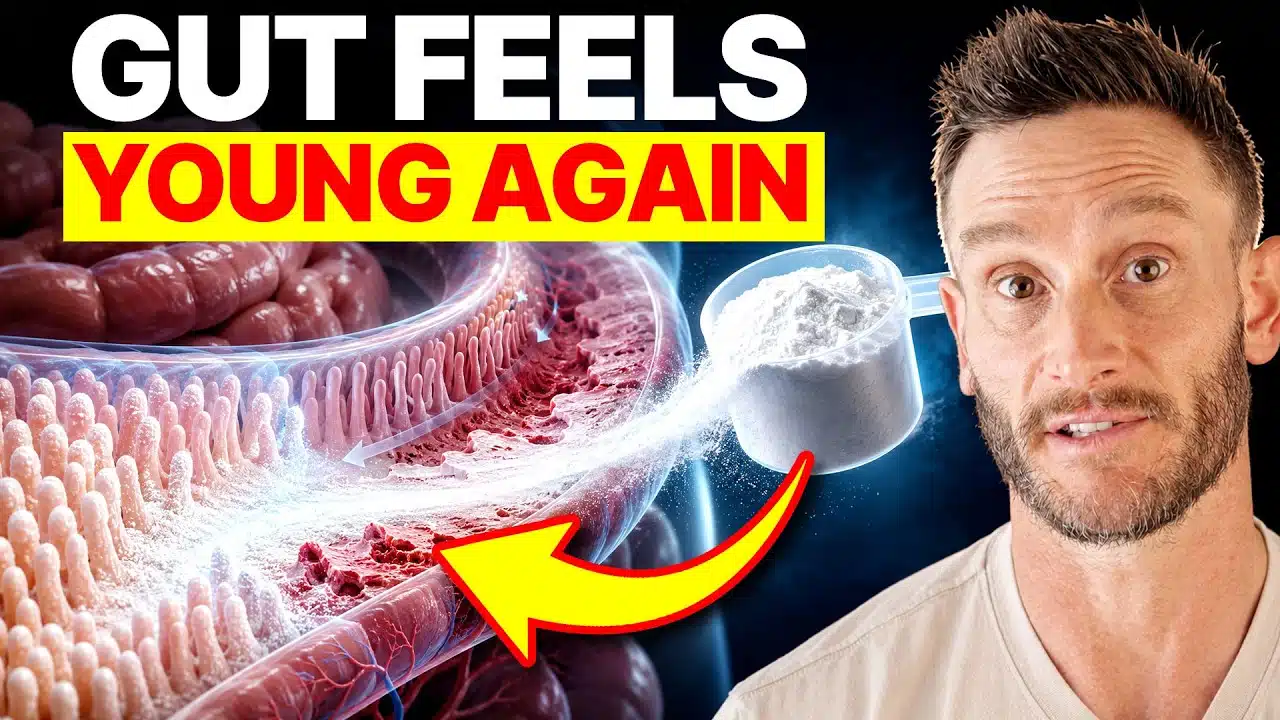
L-glutamine might be the fastest way to repair a damaged gut lining, according to emerging research on intestinal health.
Just one or two scoops of this simple amino acid powder—around 5 to 10 grams daily—directly feeds the epithelial cells lining the digestive tract, potentially improving gut permeability in a matter of days.
But glutamine is just the beginning when it comes to healing what’s commonly called “leaky gut.”
For those struggling with bloating, food sensitivities, brain fog, skin issues, or stubborn fat that refuses to budge despite a clean diet, the real problem might not be what’s being eaten—it’s what’s happening at the gut barrier level.
Jump to:
The Gut Lining Repairs Every Few Days
Epithelial cells in the gut renew themselves every 3 to 5 days, which means genuine repair is possible when the body receives proper support.
The epithelial cells in your gut renew every 3 to 5 days, which means you actually have a real shot at repair if you give your body what it needs.
This rapid turnover creates an opportunity for intervention, but only if underlying causes are addressed simultaneously.

If you want something simple that actually works, this is one of the most effective tools I’ve used to build strength, conditioning, and endurance without needing a full gym setup.
- Full-body training with one weight using swings, squats, and presses
- Solid cast iron build that feels stable and lasts for years
- Comfortable grip that makes high-rep workouts easier to handle
Understanding a Healthy Gut Barrier
Think of the gut lining like skin—it’s an epithelial barrier and a direct extension that runs from mouth through the entire digestive tract.
This barrier is selectively permeable, meaning it allows nutrients through while blocking everything else. Five key components keep this system functioning properly:
- Basic digestive function: Steady motility, adequate stomach acid, bile flow, pancreatic enzyme release
- Epithelial barrier: Held together by tight junction proteins (occludin, claudins, zonulin)
- Diverse microbiome: High microbial diversity, adequate short-chain fatty acids, resilience after stressors
- Two-layer mucus barrier: Mucin proteins prevent microbes from directly touching gut wall
- Underlying immune system: Maintains low-grade inflammation, ready to respond without overreacting
Signs of Intestinal Permeability
Leaky gut manifests in three distinct categories of symptoms.
Digestive Symptoms
Bloating, constipation, loose stools, excessive gas, and food intolerances are hallmark digestive signs. Many people report feeling sick, bloated, or experiencing histamine responses after eating specific foods.
Systemic Symptoms
When foreign particles enter the bloodstream, systemic inflammation follows. Fatigue, brain fog, skin issues, joint aches, headaches, and puffiness all stem from this inflammatory cascade.
Metabolic and Immunological Effects
Blood sugar swings, inability to process carbohydrates, weight loss resistance, worsening allergies, histamine intolerance, slow recovery, and autoimmune flare-ups round out the picture.
If you want something simple that actually works, this is one of the most effective tools I’ve used to build strength, conditioning, and endurance without needing a full gym setup.
- Full-body training with one weight using swings, squats, and presses
- Solid cast iron build that feels stable and lasts for years
- Comfortable grip that makes high-rep workouts easier to handle
Inflammation impairs insulin signaling and blocks fat-burning signals, explaining why some people can’t lose weight despite perfect dietary adherence.
How Inflammation Destroys Gut Integrity
Research published in Experimental and Molecular Medicine reveals how inflammatory cytokines—specifically TNF-alpha and interferon-gamma—attack proteins holding the gut barrier together.
These cytokines trigger caveolin-1 mediated internalization of occludin, essentially pulling this critical protein out of tight junctions and bringing it inside cells where it can’t function. Together, TNF-alpha and interferon disrupt the actomyosin scaffolding, the physical mechanical structure of the gut.
Oxidative stress acts as a partner in crime, causing phosphorylation of proteins so they can’t stay in place.
When the barrier opens, larger particles like lipopolysaccharides (bacterial endotoxins) and food antigens enter the bloodstream. The immune system flares, creating more inflammation and opening the barrier even wider—a vicious feedback loop.
Breaking the Inflammatory Cycle
Multiple angles of attack are necessary:
If you want something simple that actually works, this is one of the most effective tools I’ve used to build strength, conditioning, and endurance without needing a full gym setup.
- Full-body training with one weight using swings, squats, and presses
- Solid cast iron build that feels stable and lasts for years
- Comfortable grip that makes high-rep workouts easier to handle
- Remove triggers: Ultra-processed foods, refined sugar, industrially processed seed oils
- Stack anti-inflammatory compounds: Omega-3s from fish oil, mackerel, sardines (which also provide vitamin D, zinc, magnesium, calcium)
- Optimize minerals: Magnesium malate or magnesium glycinate for inflammatory pathways
- Prioritize sleep: Gut lining repairs overnight—inadequate sleep prevents epithelial wall restoration
I was in Vegas of all places, but I wasn’t there to party. I never go there to party. Definitely not. But what happened was I just didn’t sleep good. I had a later night than I usually do. My schedule was off. I got about 4 and a half hours of sleep. Next morning, I ate some eggs, which I normally have no problem with. I’m sneezing like crazy. I’m getting a histamine response from yogurt and eggs.
This personal example illustrates how dramatically one poor night affects gut barrier function.
The Fiber Paradox: When Gut Bacteria Turn Against You
A groundbreaking study published in Cell used rodent models colonized with human-derived microbiota, comparing high-fiber diets against fiber-free diets.
Results were dramatic. Mice on fiber-free diets experienced severe thinning of the mucous layer, increased proximity of bacteria to epithelial surfaces, and elevated expression of genes that degrade mucus.
When researchers introduced a pathogen, mice with compromised mucus barriers showed greater epithelial access and higher rates of lethal colitis. Mice with intact barriers remained healthy.
Without fiber to ferment, gut microbiomes switched fuel sources—they began eating the mucosal layer glycoproteins. Bacteria literally started consuming the gut lining itself.
Once the mucous layer thins, bacteria get closer to epithelial cells, pathogens access the gut wall directly, and inflammation plus tight junction damage accelerate.
If you want something simple that actually works, this is one of the most effective tools I’ve used to build strength, conditioning, and endurance without needing a full gym setup.
- Full-body training with one weight using swings, squats, and presses
- Solid cast iron build that feels stable and lasts for years
- Comfortable grip that makes high-rep workouts easier to handle
Not All Fiber Is Created Equal
Microbial diversity matters more than sheer fiber volume. Focus on:
- Resistant starches: Cooked and cooled potatoes, green bananas, rice that’s been heated and cooled
- Beta-glucans: Barley, mushrooms, seaweed
- Prebiotic fibers: Garlic, onions
- Fermented foods: Kefir, sauerkraut, kimchi
These foods ferment differently and fuel butyrate-producing bacteria—the keystone species for gut health.
The Butyrate Breakthrough: Reprogramming Immune Cells
Research published in Clinical Science tested butyrate’s effect on the mucus barrier in rodent models with colonic injury.
Butyrate treatment increased the number and proportion of mucin-secreting goblet cells. What’s remarkable: this process was macrophage-dependent.
Butyrate didn’t just feed goblet cells directly—it first reprogrammed macrophages into repair mode. Those repaired macrophages then activated a signaling cascade that drove goblet cell differentiation and increased mucus production.
This short-chain fatty acid acts as a signaling molecule that educates immune cells to switch from attack mode to repair mode, which then stimulates cells to rebuild the mucus barrier.
If you want something simple that actually works, this is one of the most effective tools I’ve used to build strength, conditioning, and endurance without needing a full gym setup.
- Full-body training with one weight using swings, squats, and presses
- Solid cast iron build that feels stable and lasts for years
- Comfortable grip that makes high-rep workouts easier to handle
Maximizing Butyrate Production
Several dietary strategies optimize butyrate:
- Direct consumption: Ghee (clarified butter)
- Fermentable substrates: Beta-glucans from mushrooms, resistant starches
- Polyphenol sources: Berries, dark chocolate, pomegranates (feed butyrate-producing bacteria)
- Root vegetables: Sweet potatoes, beets
Goblet cells also need raw materials to produce mucus:
- Vitamin A: Eggs, dairy, liver
- Glycine and collagen: Bone broth
- L-glutamine: Primary fuel for enterocytes (gut lining cells)
The Complete Gut Repair Protocol
A comprehensive approach addresses multiple pathways simultaneously:
Daily Supplementation
- L-glutamine: 5-10 grams daily (two scoops)
- High-quality probiotic/synbiotic: Multi-strain formula with prebiotic fiber and delivery mechanism that survives stomach acid
- Omega-3 fatty acids: From fish oil or fatty fish consumption
- Magnesium: Glycinate or malate forms
Food Foundation
- Daily bone broth: For glutamine, glycine, collagen
- Resistant starch rotation: Cooked and cooled potatoes/rice, green bananas
- Beta-glucan sources: Mushrooms, seaweed
- Polyphenol-rich foods: Berries, dark chocolate, pomegranates
- Fermented foods: Kefir, sauerkraut, kimchi
- Ghee: For direct butyrate
Lifestyle Factors
- Sleep prioritization: 7-9 hours for overnight gut lining repair
- Stress management: Chronic stress degrades gut barrier
- Remove inflammatory triggers: Ultra-processed foods, excessive alcohol
The gut lining depends on intact tight junctions and a thick mucous layer. Cutting inflammation while adding back key nutrients allows natural restoration within days to weeks.
For those dealing with bloating, food sensitivities, brain fog, or metabolic resistance, addressing gut permeability might be the missing link that finally unlocks progress.