Legendary bodybuilder Dorian Yates takes neuroscientist Andrew Huberman through an intense leg workout at M13 gym in Spain, demonstrating the same high-intensity training philosophy that earned him six Mr. Olympia titles.
This isn’t your typical gym session with endless sets and volume.
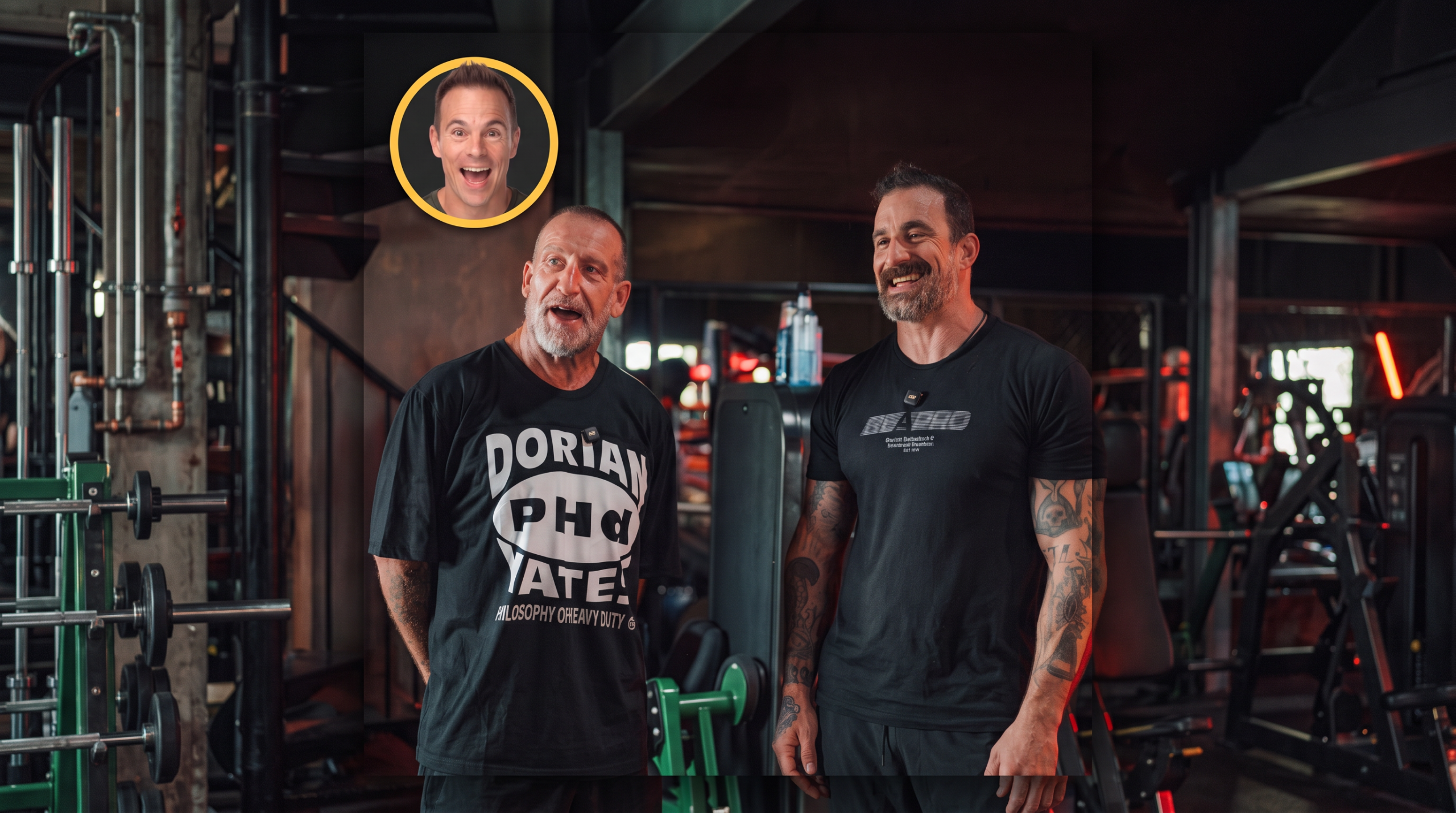
It’s part two of Yates’ famous “Blood and Guts” workout protocol—a brutal approach that prioritizes intensity over volume, pushing each set to failure and beyond.
And Huberman, despite decades of training experience, discovers muscles and mental reserves he didn’t know existed.
Jump to:
- The Philosophy Behind One Set to Failure
- Pre-Exhaustion: Setting Up Maximum Muscle Stimulation
- The Leg Press: Loading The Spring
- The Neurological Reality of True Intensity
- Hack Squats: Narrow Stance, Deep Focus
- Hamstrings and Glutes: Isolation Before Loading
- Systemic Fatigue: Why Recovery Matters More Than You Think
- The Minimum Effective Dose Versus Maximum Tolerable Volume
- Calves: Applying The Same Intensity To Stubborn Muscles
- The Mental Game: Why Most People Never Reach True Failure
- Recovery and Adaptation: Sending The Message
- Key Takeaways From Blood and Guts Leg Training
- Sources
The Philosophy Behind One Set to Failure
Yates’ training methodology challenges conventional bodybuilding wisdom that promotes high-volume workouts.
His approach stems from mentor Mike Mentzer’s principles, with crucial refinements that made all the difference during his competitive career.

If you want something simple that actually works, this is one of the most effective tools I’ve used to build strength, conditioning, and endurance without needing a full gym setup.
- Full-body training with one weight using swings, squats, and presses
- Solid cast iron build that feels stable and lasts for years
- Comfortable grip that makes high-rep workouts easier to handle
If we write on a piece of paper, Andrew does two sets of leg press, that will look like nothing. But it’s the intensity. We could do 10 sets where you stop two or three reps shy of failure and nothing will happen. Or we can send the correct message once.
The distinction matters enormously. Yates explains that telling someone to go all-out for one set creates a completely different psychological commitment than asking for maximum effort across multiple sets.
Your brain protects you when it knows more work is coming. But when you know this single set is everything, you access deeper reserves.
This singular focus on quality produces remarkable results with minimal time investment—the entire leg session, including warm-ups, takes approximately 45 minutes.
Pre-Exhaustion: Setting Up Maximum Muscle Stimulation
The workout begins with leg extensions, applying Yates’ pre-exhaustion principle.
This technique involves isolating a muscle group before hitting it with compound movements—the same approach used during their previous back workout with pullovers before pulldowns.
Three parts to the movement. One is the positive, the lifting. Second, static. Have a slight pause and then control on the way down.
Yates emphasizes controlled negatives because muscles are stronger during eccentric contractions. Since you can’t add extra weight specifically for the lowering phase, slowing down the negative maximizes tension throughout the entire range of motion.
If you want something simple that actually works, this is one of the most effective tools I’ve used to build strength, conditioning, and endurance without needing a full gym setup.
- Full-body training with one weight using swings, squats, and presses
- Solid cast iron build that feels stable and lasts for years
- Comfortable grip that makes high-rep workouts easier to handle
After warm-up sets with progressively heavier loads, Huberman hits a final set of 15 reps on the leg extension.
When he thinks he’s finished at 12, Yates demands three more—and gets them.
The Leg Press: Loading The Spring
Yates takes meticulous care with setup and positioning on the leg press, a machine he specifically selected for its superior biomechanics.
In Gold’s Gym in Venice where we were training, I don’t know how many leg presses they got in there, but let’s say 20. Every single pro uses this one cuz we all know this is the best one. The best mechanics.
Proper form requires keeping the pelvis locked into the seat throughout the movement. Yates addresses a common question about depth with practical wisdom.
Descend as far as anatomy allows without rotating the lower back out of its safe position. This varies individually, and internet absolutism about depth ignores biomechanical reality.
Huberman describes the mental image Yates provides—compressing a spring with tension maintained throughout the entire descent.
If you want something simple that actually works, this is one of the most effective tools I’ve used to build strength, conditioning, and endurance without needing a full gym setup.
- Full-body training with one weight using swings, squats, and presses
- Solid cast iron build that feels stable and lasts for years
- Comfortable grip that makes high-rep workouts easier to handle
After a moderate warm-up set, the final working set pushes to complete failure, followed by rest-pause technique for additional forced reps.
When you think there, you’re finished, there’s three or four more. Always.
The Neurological Reality of True Intensity
Between sets, Huberman explains the physiological mechanisms behind the energy surge from intense training.
When you move large muscle groups intensely, adrenal glands release adrenaline that binds to receptors on the vagus nerve, which connects to the locus coeruleus in the brainstem.
This brain region then activates the entire nervous system, creating the paradoxical effect where demanding exercise produces energy rather than depleting it.
If you’re too tired to train, get your rest, but go train. That will give you energy.
The systemic stress from leg training creates massive dopamine release, producing what Huberman describes as feeling like he just summited Mount Everest.
This neurological cascade activates nerves deep within the body that rarely receive such strong signals during ordinary activity.
If you want something simple that actually works, this is one of the most effective tools I’ve used to build strength, conditioning, and endurance without needing a full gym setup.
- Full-body training with one weight using swings, squats, and presses
- Solid cast iron build that feels stable and lasts for years
- Comfortable grip that makes high-rep workouts easier to handle
Hack Squats: Narrow Stance, Deep Focus
The hack squat machine provides another compound movement targeting pre-fatigued quadriceps.
Yates positions Huberman with feet closer together and slightly turned out, emphasizing maximum depth while maintaining spinal position.
The initial set establishes proper mechanics and neural patterns. The working set pushes beyond perceived limits.
You can really access a part of yourself you didn’t know existed in here, but also it’s like there’s nerves deep to the body that wake up.
Huberman notes something remarkable about completing reps he genuinely believed were impossible—the first thought is resistance, even frustration, but then comes profound satisfaction from discovering untapped capacity.
Hamstrings and Glutes: Isolation Before Loading
Following the pre-exhaustion principle, Yates begins posterior chain work with lying leg curls, isolating hamstrings before compound movements.
The technique emphasizes the same three-part rep structure—controlled positive, static contraction, slow negative.
If you want something simple that actually works, this is one of the most effective tools I’ve used to build strength, conditioning, and endurance without needing a full gym setup.
- Full-body training with one weight using swings, squats, and presses
- Solid cast iron build that feels stable and lasts for years
- Comfortable grip that makes high-rep workouts easier to handle
Stiff-legged deadlifts (or Romanian deadlifts) follow, with Yates demonstrating precise form to protect the spine while maximizing hamstring and glute stretch.
I’m going to put my shoulders back here, slight arch on the back. Keeping the arch, keeping the arch. I’ve got full extension now. I could go lower down, but that’s just going to put my back in a vulnerable position and get no more extension.
The movement creates leverage from hips to feet, stretching glutes and hamstrings without compromising spinal integrity. Technique trumps ego-driven range of motion.
Huberman discovers that pushing his glutes back further intensifies the stretch, demonstrating the mind-muscle connection developing throughout the session.
Systemic Fatigue: Why Recovery Matters More Than You Think
After completing the hamstring work, Yates and Huberman discuss the profound systemic demands of leg training compared to other body parts.
Leg workout is no doubt the most demanding workout you can do. Your quads, hamstrings, glutes, biggest muscle in your body, massive oxygen debt. And if you can really tap into where you are genuinely going to failure, then there’s a massive stress, but the massive stress causes a massive reaction.
Yates explains he always took two days off after legs during his competitive career because taking only one day meant his nervous system hadn’t fully recovered for the next workout.
This systemic recovery concept often gets ignored in training programs that focus solely on local muscle recovery.
If you want something simple that actually works, this is one of the most effective tools I’ve used to build strength, conditioning, and endurance without needing a full gym setup.
- Full-body training with one weight using swings, squats, and presses
- Solid cast iron build that feels stable and lasts for years
- Comfortable grip that makes high-rep workouts easier to handle
The overall nervous system and endocrine system require adequate restoration, especially after truly intense training sessions.
The Minimum Effective Dose Versus Maximum Tolerable Volume
Yates addresses the most common criticism of his approach—that the volume appears insufficient for muscle growth.
His response combines personal experience with logical reasoning.
When I started training, my calves went from 16 inches to 22 and a half. If I only did two sets of calf raises once a week, the argument is that’s not enough. Well, if it was not enough, how come my calves grew 6 and a half inches?
He acknowledges other approaches work but questions why anyone would choose a less efficient path when the destination is the same.
The focus should be finding the minimum required stimulus, not the maximum volume you can survive.
Huberman frames this perfectly—the question isn’t “how much training can I get away with” but rather “what’s the minimum I need to achieve my goal.”
If you want something simple that actually works, this is one of the most effective tools I’ve used to build strength, conditioning, and endurance without needing a full gym setup.
- Full-body training with one weight using swings, squats, and presses
- Solid cast iron build that feels stable and lasts for years
- Comfortable grip that makes high-rep workouts easier to handle
The research on training volume and muscle growth shows a more nuanced picture than Yates’ personal experience alone suggests. A 2017 meta-analysis in the Journal of Sports Sciences by Schoenfeld and colleagues found a dose-response relationship between training volume and hypertrophy, with higher volumes (up to a point) generally producing greater muscle growth across populations. However, the same research acknowledged significant individual variation in optimal volume, and that extremely high volumes can become counterproductive.
The key distinction: Yates achieved exceptional results with lower volume and maximum intensity, demonstrating this approach clearly works—but population-level studies suggest most people may benefit from moderate volume increases beyond single-set-to-failure protocols.
Calves: Applying The Same Intensity To Stubborn Muscles
The session concludes with calf training, targeting both the gastrocnemius (standing calf raise) and soleus (seated calf raise).
Yates emphasizes maintaining a straight line through shoulders, hips, and ankles without bending the knee during standing raises.
He addresses a common training mistake—treating calves as an afterthought with distracted, half-effort sets.
You might see a guy training his back or his chest really going for it and then you see later on the calves it’s like he’s texting. Oh, the calves don’t grow. Of course they don’t cuz you’re not focusing on them the same as you would on other muscle groups.
Maximum stretch at the bottom, explosive contraction onto the big toe, controlled negative—the same principles applied throughout the entire workout.
If you want something simple that actually works, this is one of the most effective tools I’ve used to build strength, conditioning, and endurance without needing a full gym setup.
- Full-body training with one weight using swings, squats, and presses
- Solid cast iron build that feels stable and lasts for years
- Comfortable grip that makes high-rep workouts easier to handle
The Mental Game: Why Most People Never Reach True Failure
Throughout the workout, a central theme emerges—most people dramatically underestimate their capacity.
Yates runs certification camps twice yearly where experienced trainers spend a week learning his methodology.
To a man, it’s like I thought I was training properly. I thought I was training hard, but this is another 20 percent. I didn’t even know it existed.
The training is more technical, focused, and mental than people expect from watching videos of heavy weights and intensity.
Your body only does what your mind believes it can do. Yates’ role isn’t touching the weight during forced reps—it’s convincing the trainee they possess untapped reserves.
And they always do.
Recovery and Adaptation: Sending The Message
After 45 minutes of focused intensity, Huberman describes feeling wide awake with mild euphoria, tired but not destroyed.
If you want something simple that actually works, this is one of the most effective tools I’ve used to build strength, conditioning, and endurance without needing a full gym setup.
- Full-body training with one weight using swings, squats, and presses
- Solid cast iron build that feels stable and lasts for years
- Comfortable grip that makes high-rep workouts easier to handle
His quads, hamstrings, and calves, however, are completely worked.
The message has been sent. Now we need to bring in the repair crew.
Yates emphasizes that training merely provides the stimulus. Growth occurs during recovery with proper nutrition and rest.
High-quality protein intake and adequate recovery time allow the body to adapt to the intense demands placed on it.
The efficiency becomes clear—in under an hour, with relatively few total sets, complete muscular stimulation is achieved without the systemic exhaustion that would impair recovery or subsequent training sessions.
Key Takeaways From Blood and Guts Leg Training
Yates’ approach delivers several crucial principles applicable to anyone seeking maximum results with intelligent training:
- Intensity trumps volume – One properly executed set to genuine failure outperforms multiple submaximal sets
- Pre-exhaustion works – Isolating muscles before compounds increases effectiveness of heavier movements
- Control the negative – Muscles are stronger eccentrically, so slower negatives maximize tension
- Respect individual anatomy – Range of motion should maximize muscle stretch without compromising joint safety
- Mental focus matters most – Technique, concentration, and willingness to push boundaries determine results
- Systemic recovery is real – Nervous system and hormonal recovery require adequate rest between intense sessions
- Efficiency saves you – Finding minimum effective dose prevents overtraining and sustainability issues
Huberman, after more than 30 years of training experience, calls it his best leg workout ever.
If you want something simple that actually works, this is one of the most effective tools I’ve used to build strength, conditioning, and endurance without needing a full gym setup.
- Full-body training with one weight using swings, squats, and presses
- Solid cast iron build that feels stable and lasts for years
- Comfortable grip that makes high-rep workouts easier to handle
The difference? Pushing into and genuinely beyond failure with someone who understands exactly how much reserve capacity exists when you think you’re finished.
One more in Yates math means three more before the next three.
That mathematical reality—that gap between perceived and actual limits—represents the difference between ordinary training and the approach that built one of bodybuilding’s most dominant physiques.
Sources
- Schoenfeld BJ, Ogborn D, Krieger JW. Dose-response relationship between weekly resistance training volume and increases in muscle mass: A systematic review and meta-analysis. Journal of Sports Sciences. 2017;35(11):1073-1082. https://pubmed.ncbi.nlm.nih.gov/27433992/