After 17 years, the American College of Sports Medicine has dropped something massive.
Their brand-new 2026 resistance training guidelines just flipped conventional wisdom on its head—and the message couldn’t be simpler.
Save
Forget perfection. Focus on showing up.
Built on data from over 30,000 participants and 137 systematic reviews, these landmark recommendations reveal that consistency matters infinitely more than complexity when building strength, muscle, and power.
ACSM’s newly published Position Stand represents the most comprehensive evidence-based guidance ever compiled on resistance training for healthy adults.
Researchers synthesized decades of scientific literature to answer one critical question: what actually works?
The findings challenge nearly every overcomplicated training protocol flooding social media and gym culture. The biggest performance leap happens when someone transitions from doing nothing to doing anything.
Stuart M. Phillips, PhD, FACSM, Professor in Kinesiology at McMaster University and author on this Position Stand, delivered the bottom line with clarity:
The best resistance training program is the one you’ll actually stick with. Training all major muscle groups at least twice a week matters far more than chasing the idea of a ‘perfect’ or complex training plan. Whether it’s barbells, bands, or bodyweight, consistency and effort drive results.
Why Your Training Doesn’t Need To Be Complicated
For years, fitness culture has promoted elaborate programs packed with periodization schemes, failure protocols, and specialized equipment requirements.
According to ACSM’s exhaustive review, most of that isn’t necessary for general health and fitness outcomes.
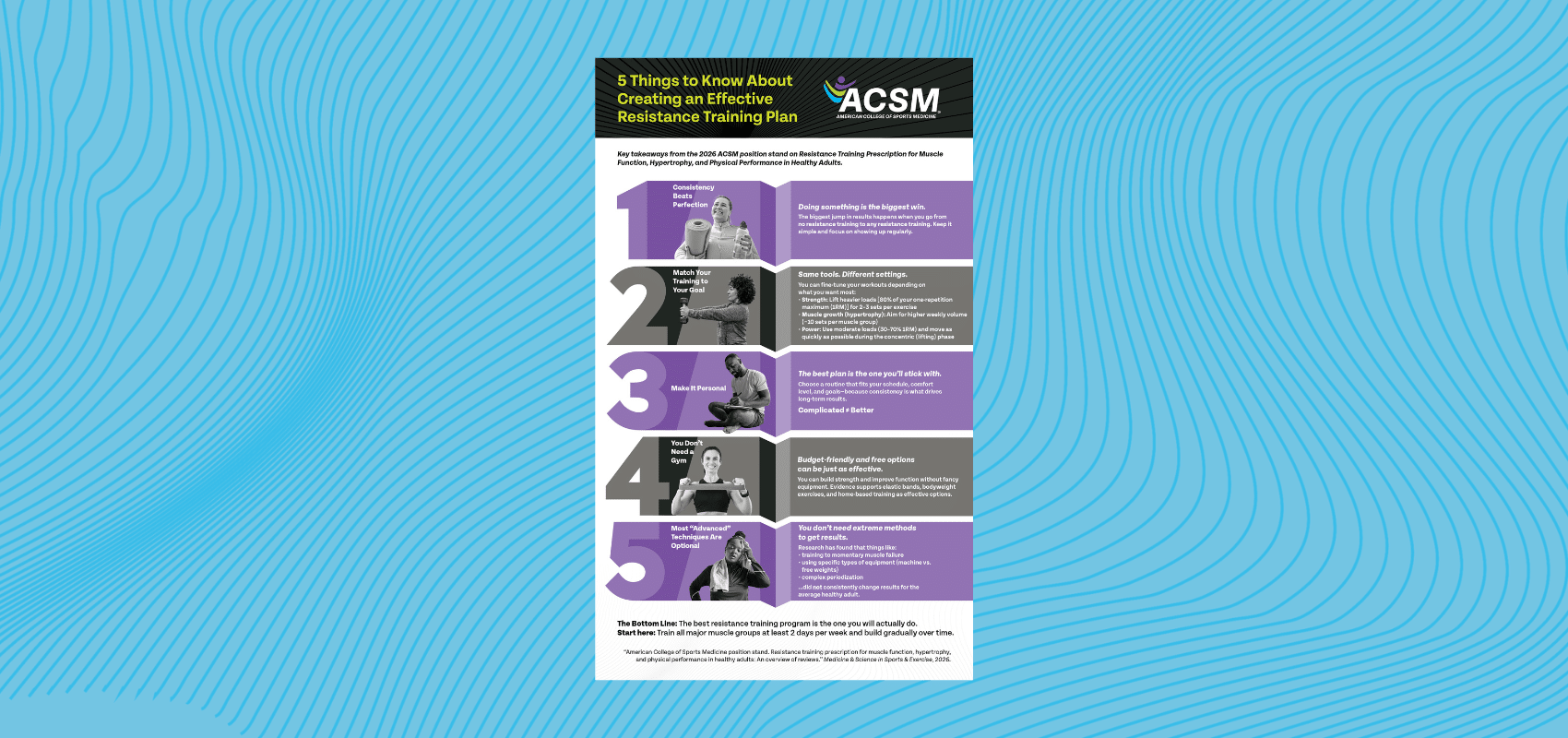
Elastic bands build muscle just as effectively as barbells. Bodyweight training produces measurable strength gains. Home workouts rival gym-based routines in real-world results.
Advanced techniques like training to absolute failure, obsessing over machines versus free weights, or implementing complex periodization didn’t consistently improve outcomes for average healthy adults.
What did? Regular participation. Effort. Progression over time.
How To Tailor Training To Your Goals
While consistency forms your foundation, ACSM’s guidelines do offer strategic adjustments based on specific objectives.
Building Pure Strength
Lift heavier loads—around 80% of your one-repetition maximum (1RM).
Perform 2-3 sets per exercise. Quality repetitions with challenging weight stimulate neural adaptations that translate directly to increased force production.
Maximizing Muscle Growth
Volume becomes king for hypertrophy.
Target approximately 10 sets per muscle group weekly, distributed across multiple sessions. Moderate loads with higher total work create the metabolic stress and mechanical tension necessary for muscle size increases.
Developing Explosive Power
Use moderate loads between 30-70% of 1RM.
Focus intensely on moving weight as explosively as possible during the lifting phase. Speed of movement matters more than absolute load when training for power output.
Individualization Beats Cookie-Cutter Programs
Perhaps the most revolutionary aspect of these guidelines? ACSM explicitly moved away from rigid, one-size-fits-all prescriptions.
Programs should be individualized based on three critical factors:
Personal goals: Strength, size, power, or general fitness all require slightly different approaches
Enjoyment: If you hate your program, you won’t stick with it long enough to see results
Safety considerations: Previous injuries, movement limitations, and individual biomechanics matter
Athletes and serious resistance trainees would naturally require more specific programming to optimize sport performance and training adaptations.
But for the vast majority pursuing health and fitness? Overthinking becomes the enemy of progress.
Training Without a Gym Still Works
One of the most liberating findings from ACSM’s comprehensive review centers on training accessibility.
Nontraditional resistance training produces legitimate results.
Resistance bands, bodyweight exercises, and home-based routines generated marked improvements in strength, hypertrophy, and physical function across multiple studies.
Gym memberships, elaborate equipment collections, and access to specialized facilities aren’t prerequisites for building meaningful strength and muscle.
Creativity, consistency, and progressive overload matter infinitely more than your training environment.
What Advanced Lifters Should Know
While these guidelines emphasize simplicity for general populations, competitive athletes and experienced trainees operate under different demands.
Sport-specific training, detailed periodization, and advanced programming techniques absolutely have their place when pursuing elite performance.
But even advanced trainees benefit from remembering the fundamentals highlighted in ACSM’s Position Stand.
Consistency still trumps complexity. Recovery remains non-negotiable. Progressive overload drives adaptation regardless of experience level.
The Two-Day-Per-Week Minimum
Among all the flexibility and individualization emphasized throughout these guidelines, one recommendation stands firm.
Train all major muscle groups at least twice weekly.
This frequency threshold consistently produced meaningful adaptations across the research literature. Whether you complete two full-body sessions or split muscle groups across multiple training days, hitting each major area twice per week creates sufficient stimulus for continued progress.
Less than that? You’re leaving significant gains on the table.
Why This Update Matters Now
Seventeen years separated ACSM’s previous resistance training recommendations from this 2026 update.
During that time, fitness culture exploded across social media, creating an overwhelming landscape of conflicting information, extreme protocols, and unnecessary complexity.
These evidence-based guidelines cut through the noise with clarity backed by the largest data synthesis ever conducted on resistance training for healthy adults.
For fitness professionals, these recommendations provide credible, research-supported guidance for program design. For individuals navigating their own training journey, they offer permission to simplify, focus on sustainability, and trust that showing up consistently matters more than perfection.
The full Position Stand, “Resistance Training Prescription for Muscle Function, Hypertrophy, and Physical Performance in Healthy Adults: An Overview of Reviews,” is now available in Medicine & Science in Sports & Exercise.
ACSM also released a complementary infographic summarizing key recommendations for quick reference and practical application.