A pharmaceutical company just did something that scientists have long considered impossible.
Reval Pharmaceuticals treated 75-year-old skin samples with an AI-engineered enzyme and functionally transformed them into 30-year-old skin.
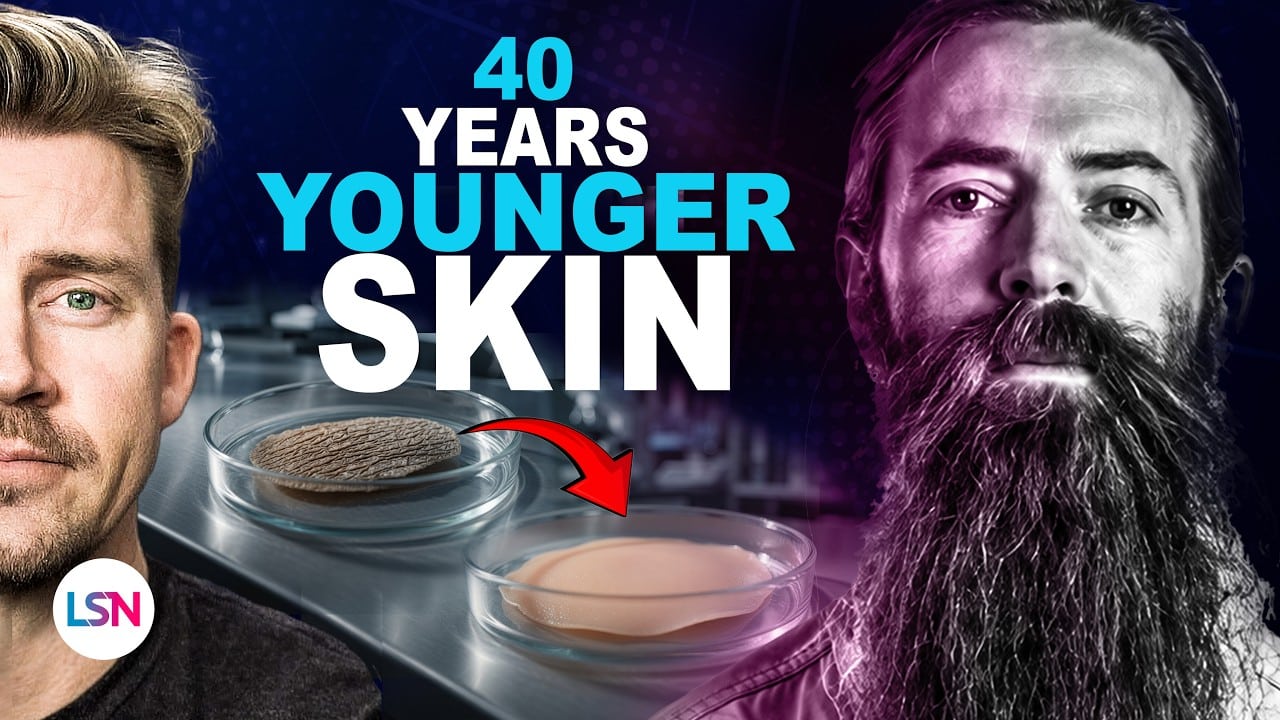
The breakthrough comes just days after respected longevity scientist Matt Kaeberlein declared that biological aging isn’t reversible.
Sitting across from Kaeberlein during that conversation was Aubrey de Grey, the researcher who’s spent 25 years insisting aging can be beaten by physically repairing cellular damage—and Reval spun out of SENS, a longevity foundation de Grey co-founded.
Jump to:
- The Enzyme That Breaks “Irreversible” Damage
- How Scientists Built What Nature Couldn’t
- Reversing Decades of Aging in a Dish
- What This Could Actually Fix
- The Gap Between Lab Success and Real Treatment
- Could a Skin Cream Come Faster?
- Why AI Changes Everything
- One Enzyme Doesn’t Solve Aging
- What You Can Do Right Now
- Timeline Expectations
The Enzyme That Breaks “Irreversible” Damage
For four decades, scientists believed certain types of age-related damage were permanent. Sugar molecules in blood naturally stick to proteins throughout life, creating sticky deposits called AGEs (advanced glycation end products).
While blood proteins renew every few months and clear out this damage, collagen, eye lenses, and artery walls last for decades. Sugar accumulation in these tissues creates stiffness and dysfunction that researchers thought couldn’t be undone.
Brian Johnson described them as “stiff, sticky chemical scars that affect skin, arteries, eyes, and more.”
The specific molecule causing most problems is called CML (carboxymethyl lysine). According to the research, nothing in nature breaks down CML—until now.
How Scientists Built What Nature Couldn’t
Reval’s team used AlphaFold, Google DeepMind’s protein structure prediction AI, to scan approximately 45,000 oxidase enzymes. From tens of thousands of candidates, they identified fewer than 50 that might work.
They found their winner in a glycine oxidase from Caldicellulosiruptor saccharolyticus, a heat-loving bacterium. But that natural enzyme barely functioned for their purpose.
The breakthrough came through directed evolution—essentially breeding better versions in the lab. Researchers engineered bacteria that could only survive if the enzyme successfully converted CML back into lysine, an amino acid they needed.
Five rounds of mutation and selection later, they had engineered an enzyme more than 10 times as active as their starting point.
Reversing Decades of Aging in a Dish
The engineered enzyme, called CMLase, was tested on proteins found throughout the human body: casein, collagen, retinal proteins, and hemoglobin.
Results showed CML removal ranging from 52% to 97% depending on the protein tested.
In human tissue samples from elderly donors, the numbers were equally dramatic:
- 75-year-old artery samples: more than 70% of CML eliminated
- Eye lens tissue: up to 78% reduction
- Aged skin: more than 55% decrease, bringing damage levels below those seen in 31-year-old skin
The paper states the enzyme “effectively reverses CML modifications in model proteins in vitro and in human tissue samples from elderly donors.”
Enzymatic correction of damaged proteins, beautiful work.
That endorsement came from David Sinclair, who has his own competing age reversal treatment currently in human trials.
What This Could Actually Fix
CML accumulation doesn’t just stiffen tissues. It also binds to a receptor called RAGE, triggering chronic inflammation linked to numerous age-related diseases.
Dr. Afshin Emrani, a cardiologist, noted that arterial stiffness drives systolic hypertension, heart failure, and stroke—and that he has no drug that reverses it. He can slow progression but not undo existing damage.
Reval’s website lists potential applications including:
- Heart disease
- Neurodegeneration
- Arthritis
- Skin aging
- Gout
The Gap Between Lab Success and Real Treatment
Kaeberlein’s skepticism isn’t entirely misplaced. While the breakthrough is remarkable, significant hurdles remain between reversing damage in a dish and treating living humans.
The enzyme must work inside living animals, reach damage buried deep in tissues, pass safety and immune system reviews, and survive years of human trials. None of that has happened yet.
There’s also the immune response problem. CMLase comes from bacteria, and the human immune system may object to repeated doses of foreign proteins.
Could a Skin Cream Come Faster?
Some have speculated this could reach consumers as a cosmetic skin cream, bypassing lengthy FDA drug approval processes.
The FDA doesn’t require approval for cosmetics before they reach market. However, the moment a product claims to change body structure, regenerate cells, or reverse aging, it becomes classified as a drug—triggering the same years-long approval requirement.
There’s another problem: skin is designed to keep things out.
The 500 Dalton rule in dermatology states that molecules larger than approximately 500 Daltons don’t cross intact skin. Enzymes are large proteins—this one weighs around 40,000 Daltons.
A simple rub-on cream almost certainly won’t reach the damage. Delivery methods like microneedle patches could work, but those are medical devices requiring their own approval pathways.
Why AI Changes Everything
This marks the second major enzyme-based age reversal breakthrough this year. A previous discovery involved rejuvenating cartilage through enzyme manipulation.
What’s different now is the tool finding these solutions: artificial intelligence that improves exponentially.
Just this year, AI has helped an independent researcher design a novel Alzheimer’s drug candidate from a home lab, assisted a founder in sequencing his dog’s cancer to design a personalized mRNA vaccine, and expanded into scientific research through platforms like Anthropic’s Claude.
AlphaFold’s database of predicted protein structures enabled researchers to scan 45,000 candidates—something that would have been impossible through traditional laboratory methods.
One Enzyme Doesn’t Solve Aging
Even advocates acknowledge this breakthrough has limits. Aubrey de Grey noted that CMLase clears CML but not glucosepane—the cross-link that stiffens tissue most severely and remains beyond current capabilities.
There will not be a single drug or drug family that is the holy grail, the silver bullets. We are, I believe, almost certainly going to see progress in dramatically extending health span only by a large portfolio of things that are done to the same people at the same time.
De Grey’s vision was never about finding one solution. The strategy involves developing multiple interventions, each targeting different aging mechanisms.
Glycation damage just became one piece scientists can actually solve.
What You Can Do Right Now
While waiting for CMLase or similar treatments to complete trials, individuals can influence one variable: blood sugar levels.
This damage accumulates because glucose in blood sticks to proteins over time. Controlling blood sugar won’t undo existing damage—that’s the enzyme’s job—but it slows how quickly new damage forms.
Standard interventions like diet, exercise, and metabolic health optimization remain the only levers currently available.
Timeline Expectations
Some social media posts suggested this treatment could be available through medical tourism in Panama or Thailand within five to seven years.
No human trials have begun. Anyone offering deglycation shots at clinics in the next couple years is likely not using this specific enzyme.
The research paper’s final line describes this work as establishing “a platform for developing enzymes to reverse age-related molecular damage.” That suggests more enzyme-based interventions may follow using similar AI-accelerated approaches.
Whether Kaeberlein’s caution or the optimists’ enthusiasm proves more accurate may depend on how quickly AI continues advancing the entire portfolio of aging interventions—not just this single breakthrough.