Dr. Rhonda Patrick has a radical idea that’s about to upend everything you think you know about daily movement goals.
Forget chasing 10,000 steps.
Instead, she wants you to focus on something far more powerful—and surprisingly, far more achievable: 10 breathless minutes a day.
What follows is a breakdown of why intensity might matter more than duration, backed by compelling new research that could save you hours each week while dramatically improving your health outcomes.
Jump to:
The Truth Behind 10,000 Steps
That sacred number didn’t come from scientists or medical researchers. It came from marketing.
This 10,000 steps a day originated back in the 1960s from Japan. There was a Japanese group that was trying to sell pedometers. And that’s where it came from. It didn’t come from science, didn’t come from medical research, it came from a Japanese company wanting to sell a pedometer.
Dr. Patrick isn’t dismissing walking entirely. Movement beats sitting any day. But she argues there’s a massive difference between light movement and what your body actually needs to create robust health adaptations.
Since those pedometer-selling days in Japan, research has evolved dramatically. Scientists now use accelerometers attached to people’s wrists, measuring actual movement intensity rather than relying on faulty memory and self-reported questionnaires.
What they’ve discovered changes everything.
What “Breathless” Actually Means
Before diving into the stunning research findings, understanding Dr. Patrick’s definition of “breathless” matters enormously.
She deliberately avoids specific heart rate targets or rigid definitions because everyone starts from different fitness levels.
If you’re very, you know, already exercising and very fit, breathless for you might be sprinting. It might, you know, it might be running. If you’re someone that doesn’t really exercise a lot, maybe you only walk, then breathless for you might just be walking uphill, you know, going up the stairs.
The practical test? You can only get out a few words before needing another breath. Singing is absolutely impossible. Talking becomes challenging.
This contrasts sharply with moderate-intensity exercise, where conversation remains possible but you’re noticeably breathy. Someone listening on the phone would clearly hear you’re exerting yourself.
Light activity? That’s casual walking around your house or office where talking remains completely easy.
The Stunning Math of Intensity
Recent research reveals something extraordinary about vigorous exercise compared to lighter movement. The differences aren’t just significant—they’re exponential.
For reducing all-cause mortality (death from cancer, cardiovascular disease, respiratory diseases, and other non-accidental causes), here’s what the data shows:
- 1 minute of vigorous exercise = 4 minutes of moderate-intensity exercise (brisk walking)
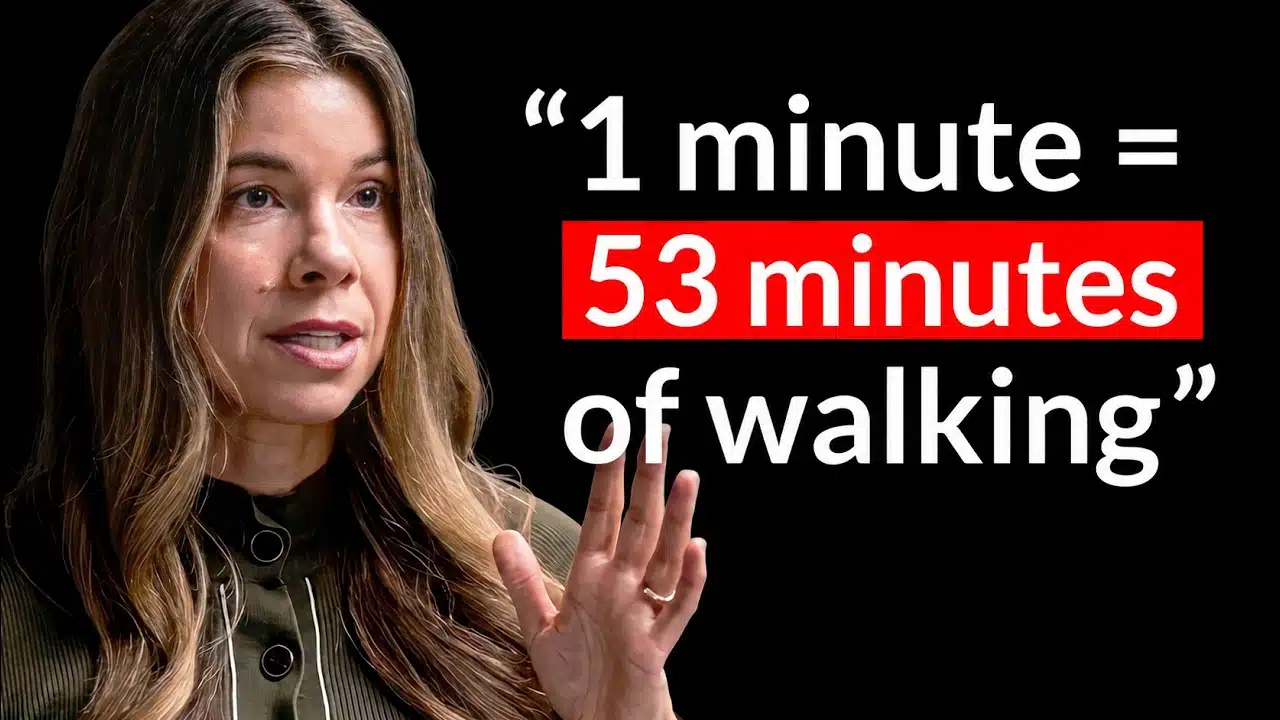
- 1 minute of vigorous exercise = 53 minutes of light activity (gentle walking around)
Read that again. One single minute walking breathlessly up a steep hill provides equivalent mortality reduction benefits as nearly an hour of casual walking.
The numbers become even more dramatic when examining specific causes of death.
Cardiovascular Disease Protection
Heart disease remains America’s number one killer. For cardiovascular-related mortality specifically:
- 1 minute vigorous = 8 minutes moderate intensity
- 1 minute vigorous = 90 minutes light activity
That single minute of breathless effort delivers the same cardiovascular protection as an hour and a half of casual movement.
Cancer Risk Reduction
Perhaps most remarkable are the findings around cancer mortality reduction across all cancer types:
1 minute of vigorous exercise equals 2.5 hours of light activity.
The implications are staggering. You could spend 150 minutes gently walking around, or you could achieve identical cancer-fighting benefits in just 60 seconds of intense effort.
Why Intensity Creates Superior Adaptations
The mechanism behind these dramatic differences relates to how your body responds to stress.
The bigger the stress you’re putting on it, which happens when you’re doing a more intense type of exercise, the better the adaptations are.
Vigorous exercise creates robust adaptations across multiple systems—cardiovascular, respiratory, immune, and neurological. Your heart strengthens more significantly. Your lungs expand capacity more effectively. Your immune system enhances surveillance capabilities more powerfully.
These adaptations prepare your body for life’s constant cellular stresses, particularly aging itself.
While you can’t see aging happening in the mirror daily, it occurs relentlessly at the cellular level. Bodies trained through intense bursts handle these accumulated micro-stresses far more effectively than those adapted only to gentle movement.
Practical Application: What This Looks Like
During the conversation, a perfect real-world example emerged: a 4-mile walking loop with friends.
For three-quarters of the route, conversation flows easily—catching up on family news, sharing stories, dogs running alongside. This represents moderate-intensity exercise.
Then comes the hill. Suddenly, everyone falls silent. Conversation becomes impossible. Breathing becomes labored.
That is exactly the vigorous type of exercise I’m talking about. That’s the breathless moment, the breathless breathless minute or 2 minutes or 3 minutes or 4, however long it takes you to get up that hill.
Those few minutes climbing provide disproportionate health benefits compared to the remaining pleasant stroll.
The Time Excuse Evaporates
Perhaps the most liberating aspect of Dr. Patrick’s recommendation is how it demolishes the “I don’t have time” excuse.
Walking 10,000 steps typically requires 60-90 minutes—a significant daily commitment for anyone juggling work, family, and other responsibilities. That’s roughly 5 miles of walking.
Ten minutes of breathless activity? That’s achievable for virtually everyone.
It could be:
- Running up stairs repeatedly
- Sprint intervals during a dog walk
- High-intensity bodyweight exercises
- Cycling hard up inclines
- Swimming laps at challenging pace
- Any activity that leaves you genuinely breathless
The beauty lies in the accessibility. Whether you’re already athletic or just beginning a fitness journey, breathless simply means breathless for you.
Beyond Mortality: Comprehensive Health Benefits
While the mortality reduction statistics capture attention, vigorous exercise delivers benefits extending far beyond simply living longer.
Intense activity strengthens mitochondrial function, improves insulin sensitivity, enhances cognitive performance, regulates inflammation, optimizes hormone production, and supports mental health.
These aren’t minor improvements. They represent fundamental enhancements to quality of life—more energy, sharper thinking, better mood regulation, increased resilience against disease.
Starting From Where You Are
Dr. Patrick acknowledges that many people haven’t incorporated vigorous exercise into their routines. The transition doesn’t require extreme measures or intimidating gym commitments.
Start with whatever makes you breathless today. If that’s walking briskly up a single flight of stairs, perfect. Do that daily. Your body will adapt.
Next week, maybe you tackle two flights. The month after, perhaps you walk faster. The goal isn’t immediate transformation—it’s consistent progressive challenge.
What matters most is understanding the powerful impact intensity delivers and recognizing that achieving it requires far less time than conventional wisdom suggests.
Ten breathless minutes daily might not sound revolutionary, but the research reveals it could be one of the most impactful health decisions you make.