A 32-week pregnant runner just did something that’s stopping the internet in its tracks.
On Sunday, Ali Anderson crossed the finish line at the Sydney Marathon in 2:59:43 — a sub-three-hour marathon — while seven months pregnant with her first child.
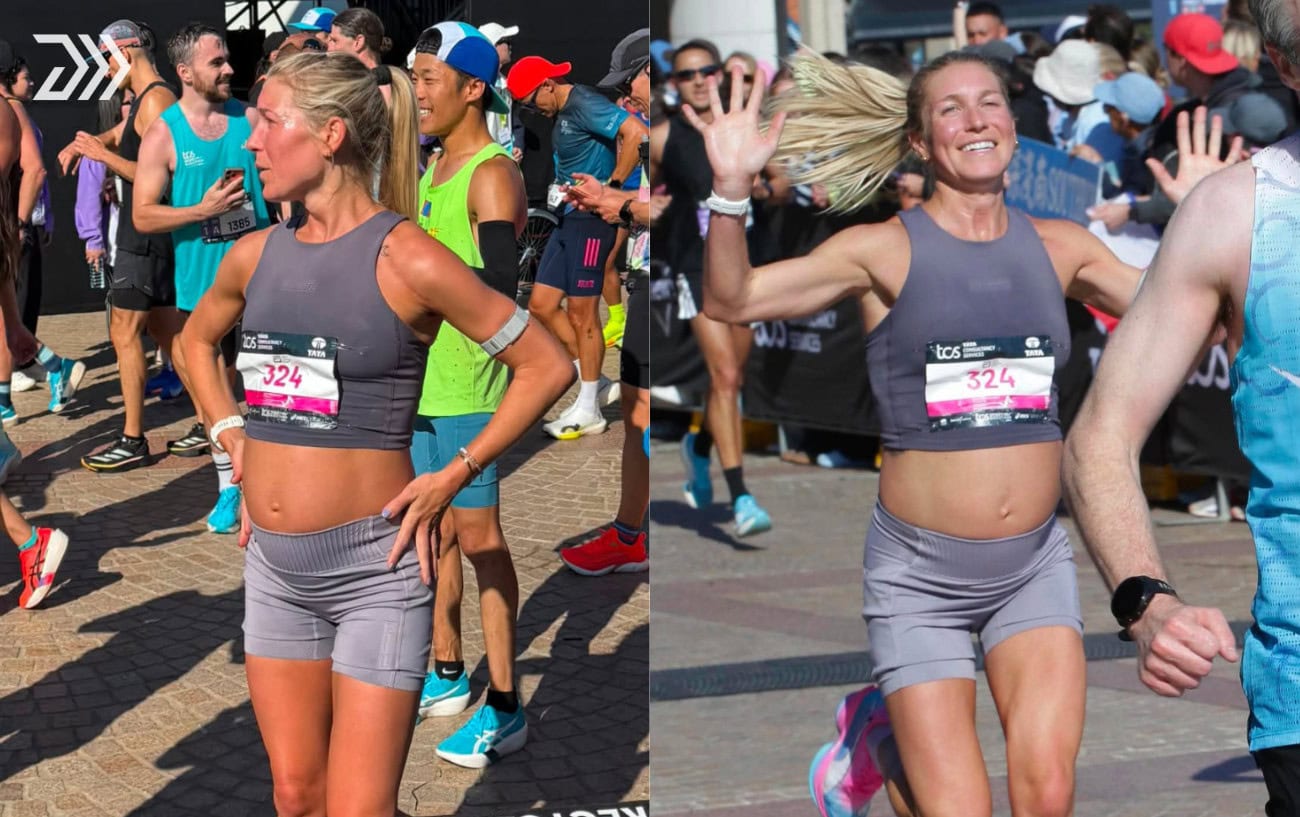
That places the 29-year-old firmly inside the top one percent of women ever to run the distance, a feat extraordinary enough on its own.
But the full story behind her race — the doctor’s advice, the bathroom stops, the science, and what comes next — makes this one of the most remarkable athletic performances in recent memory.
Jump to:
Her Boston Run Already Made Headlines — Then She Topped It
Anderson’s Sydney finish wasn’t even her first marathon while pregnant.
Back in April, at just 13 weeks along, she ran the Boston Marathon in a blazing 2:41:58 — a personal best — and announced her pregnancy only after crossing the finish line.
Boston averaged 6:11 per mile. Sydney, with a growing baby on board at 32 weeks, averaged 6:52 — roughly 41 seconds per mile slower, which is exactly as impressive as it sounds given the circumstances.
Sydney marked her seventh marathon overall and her fourth World Marathon Major, run alongside a record field of 40,000 participants on a course that sweeps from North Sydney to the iconic Opera House.
“I Wasn’t Pushing Too Hard” — But She Was Running a Sub-3
Anderson had originally entered Sydney before she even knew she was pregnant, and she saw no compelling reason to step away from the start line.
The course itself threw some curveballs. After dropping off the Harbour Bridge early, the route rolls through Sydney’s eastern suburbs — and with extra weight comes extra effort on every incline.
I’m obviously heavier, so the hills were a little bit more intense. But I felt really good, and I wasn’t pushing too hard.
And then there were the logistics that no race plan fully prepares you for.
The challenges were mostly just the potty stops and factoring that into my time.
She also noted that walking after the race actually felt harder than running it — a detail that underscores just how dialed-in her body was to the specific mechanics of marathon pace.
What Her Doctor Actually Said
Before lining up, Anderson did what any responsible athlete would — she went straight to her doctor with the question.
The answer she received was both reassuring and carefully considered.
There’s no reason to stop what you’re doing. You’re obviously not going for a personal record or anything, so it’s safe for you to keep going.
Anderson confirmed her pregnancy had been uncomplicated throughout, which matters significantly here. Conditions like preeclampsia or placenta previa would have ruled out running entirely.
Her own body awareness played a critical role too. Having logged thousands of miles over years of competitive running, she knew exactly where her limits were — and stayed well inside them.
When you run as much as I do, you get to know your body and what feels too much, so I was really in tune with not going at my maximum capacity.
What the Science Actually Says About Running Pregnant
Anderson’s choice isn’t just a personal story — it sits at the edge of what current sports science understands about vigorous exercise during pregnancy.
A 2019 systematic review published in BMC Pregnancy and Childbirth analyzed 15 studies covering more than 32,000 pregnancies. Its findings were striking.
Vigorous exercise continued into the third trimester showed no meaningful impact on birthweight — just an 8-gram mean difference — added roughly 0.21 weeks to gestation, and was actually associated with a lower risk of preterm birth.
There is one important caveat, however.
Among studies involving elite athletes, researchers identified fetal bradycardia — a slowing of the baby’s heart rate — when exercise intensity exceeded 90 percent of maximum heart rate. Anderson described actively managing exactly that threshold throughout her race.
A separate 2018 cohort study in BMJ Open Sport & Exercise Medicine surveyed 1,293 women and found that those who kept running into the third trimester showed no difference in delivery outcomes or infant birthweight compared to non-runners. The only notable difference was a slightly higher rate of assisted vaginal deliveries among runners — 27 percent versus 22 percent.
It’s worth noting that neither study specifically examined racing 26.2 miles near threshold effort — because almost nobody does that.
Sydney Was Her Last — For Now
Anderson had the option to defer her Sydney entry under the race’s pregnancy and postpartum policy, which allows pregnant entrants to push their place to 2027, 2028, or 2029 with a letter from a medical professional.
She chose not to use it.
With the finish line behind her, Anderson made clear that this chapter is closing — at least temporarily. She had a third marathon booked for December, along with plans to chase the U.S. Olympic Marathon Trials qualifying standard of 2:37:00 for 2028. Her Boston personal best sits 4 minutes and 58 seconds outside that mark.
For now, though, she’s giving her daughter a well-earned rest.
I have put her through two marathons now and that is enough for her.
With a sub-3 marathon at 32 weeks pregnant already on her résumé, whatever Anderson does next — on the roads or off them — the running world will absolutely be watching.