In a powerful exploration of human physiology and stress response, researchers are revealing something most people have never been told: the solution to chronic anxiety might not be in your mind at all.
It’s in your body.
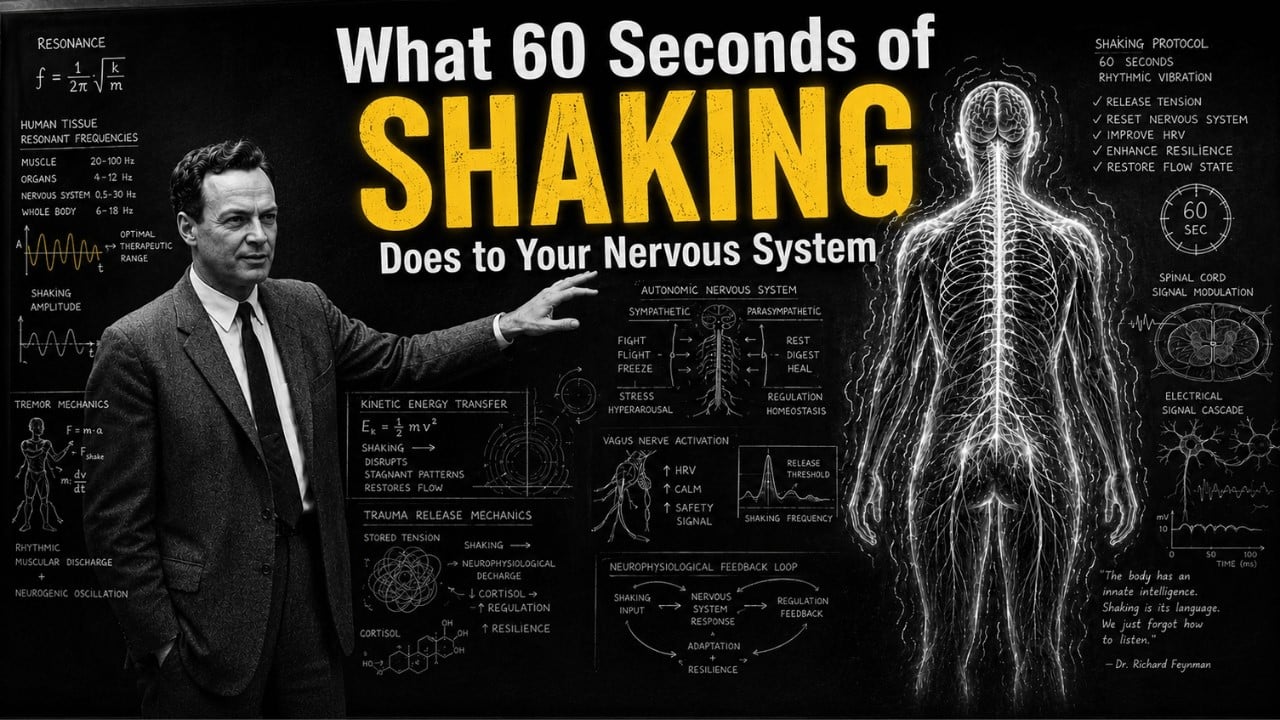
Waiting for you to stop suppressing the very reflex designed to save you.
And it takes just 60 seconds to activate.
Jump to:
- What Wild Animals Know That Humans Forgot
- The Gate Control Mechanism Living In Your Spine
- Why Sitting Still Makes Anxiety Worse
- Your Muscles Are The Ground Wire
- The Brainstem Doesn’t Speak Your Language
- The Psoas: Your Body’s Deepest Stress Vault
- The Vagus Nerve Highway Runs Bottom-Up
- Why You Can’t Sleep (And What To Do About It)
- The 60-Second Protocol
- The Mechanism Was Always There
What Wild Animals Know That Humans Forgot
Watch footage of a gazelle that’s just escaped a cheetah. After surviving by mere centimeters, its heart hammering at 200 beats per minute, something remarkable happens.
It stops, stands in grass, and shakes. Violently. Deliberately. For 60 to 90 seconds.
Legs trembling, flanks quivering, head loose. Then it simply walks away and begins grazing, completely calm, physiologically returned to baseline as if nothing happened.
This isn’t weakness. Trauma researchers studying animals in wild environments noticed this pattern across every species. The trembling completes the stress cycle rather than suppressing it.
Wild animals don’t develop post-traumatic stress disorder. Humans do.
The difference? We stopped shaking.
The Gate Control Mechanism Living In Your Spine
Inside your muscles exist sensors most people don’t know about: proprioceptors, mechanoreceptors, Golgi tendon organs. They’re position sensors and motion detectors embedded in every tendon, every joint capsule, every square centimeter of connective tissue.
When you shake your hands vigorously, millions fire simultaneously. That signal floods up your spinal cord on the largest, fastest nerve fibers your body possesses—A-beta fibers.
Meanwhile, anxiety signals travel on smaller, slower fibers.
Here’s what happens: Your spinal cord has a structure called the dorsal horn—a relay station deciding which signals get priority access to your brain. When you flood this gate with high-volume kinetic input, mechanical signals physically crowd out stress signals.
This is gate control theory, described in neuroscience literature since 1965. Your body has been running this program since before you were born.
Why Sitting Still Makes Anxiety Worse
We’ve been taught that stillness cures anxiety. Sit down, breathe slowly, don’t let anyone see you shake.
Cultural instruction is nearly universal: when stress arrives, suppress every physical impulse and stay rigidly controlled.
Here’s what that actually does inside your body.
Adrenaline is a fuel molecule. Your adrenal glands released it because your brain predicted you’d need to run, fight, or climb. It’s a physical substance circulating in your bloodstream, waiting to be metabolized by muscular contraction.
When you force stillness instead of moving, that fuel doesn’t disappear. It continues circulating. Cortisol lingers. Muscle tension remains loaded.
The sympathetic nervous system never receives confirmation that the emergency is over. The alarm stays on.
This is why you can have a stressful meeting at 9 a.m. and still feel it in your shoulders at midnight. Events end. Chemistry doesn’t—not without completion.
Your Muscles Are The Ground Wire
Think of your nervous system not as a brain, but as an electrical circuit. When lightning strikes a power grid, surge protectors don’t think about voltage—they trip a physical, mechanical response and redirect excess charge into ground before it fries appliances.
Your muscles are that ground wire.
Shaking isn’t a symptom of being overwhelmed. It’s your body’s surge protector physically tripping, redirecting thousands of millivolts of trapped survival energy through kinetic discharge.
You’re not losing control when you shake. You’re the only person in the room whose circuit breaker is actually working.
The Brainstem Doesn’t Speak Your Language
The reticular activating system—your brain’s threat radar—doesn’t process logic or reassurance. You cannot talk it down. You cannot think your way out of sympathetic activation because brainstem processes sensory data at a level below where language lives.
But it reads one signal with absolute clarity: loose, chaotic, unguarded limb movement.
In threat detection language of the brainstem, a creature with locked, rigid, contracted muscles is still in danger. A creature with loose, bouncing, freely moving limbs has survived.
Chase is over. Stand down.
The Psoas: Your Body’s Deepest Stress Vault
There’s one muscle holding more of this story than any other. You can’t see it from outside. You can’t feel it directly with fingers.
The psoas runs from lumbar vertebrae through your pelvis down to attach at the top of your femur. It’s the largest, deepest hip flexor in the human body.
Anatomists call it “the fight or flight muscle” because when your brain perceives threat, the psoas is among first structures to contract. It pulls torso forward and knees upward—beginning of a running stride or beginning of a fetal curl.
In chronically stressed bodies, it never fully returns to rest.
Pelvic tremors during genuine neurogenic discharge look slightly odd from outside, which is precisely why people instinctively suppress them. But that pelvic shaking is your body unlocking the deepest layer of defensive curl, physically breaking contraction patterns holding torso folded forward in unconscious preparation for threats no longer present.
When psoas releases, lumbar spine extends, pelvis tilts back toward neutral, chest opens. Something that feels remarkably like a deep breath arrives without being forced.
The Vagus Nerve Highway Runs Bottom-Up
The vagus nerve is your longest cranial nerve, traveling from brainstem down through neck, chest, diaphragm, and into abdomen. It’s the primary highway of your parasympathetic nervous system—the branch responsible for rest, digestion, recovery, and calm.
Here’s what changes everything: Approximately 80% of vagus nerve fibers are afferent, meaning they carry signals upward from body to brain, not the other way around.
This architecture makes bottom-up regulation not just possible, but faster and more reliable than top-down approaches.
When you shake, mechanical oscillation travels through trunk, through thoracic cavity, and stimulates sensory branches of the vagus nerve through movement of organs, rib cage, and diaphragm.
Vagal afferents carry this mechanical signal directly to brainstem, which reads it as evidence of physical safety. Heart rate variability begins shifting within seconds of sustained rhythmic movement.
Why You Can’t Sleep (And What To Do About It)
Most people don’t sleep poorly because minds are overactive. They sleep poorly because bodies are still loaded.
Sympathetic nervous system is still running its low hum. Cortisol that never fully cleared is suppressing melatonin production. Psoas is still contracted, making it impossible to fully relax core.
The reticular activating system is still scanning, interpreting residual muscular tension as evidence that situation hasn’t resolved, maintaining physiological vigilance preventing transition into deep, slow-wave sleep.
You cannot think your way out of this. A racing mind at bedtime isn’t the cause—it’s the symptom.
Address the body first. Mind follows.
The 60-Second Protocol
Before you lie down, stand up. Let arms hang completely loose. Unlock knees—don’t straighten them, don’t bend them, just release them.
Shake your hands like you’re flicking water off fingertips. Bounce your heels. Let movement travel up through calves, thighs, hips, torso.
Let it get slightly ridiculous. Let pelvic movement happen without bracing against it.
You’re not exercising. You’re not performing. You’re running the shutdown sequence your body has been trying to initiate since last time you suppressed it.
What happens in those 60 seconds:
- Mechanoreceptors flood spinal gate with kinetic data
- Adrenaline metabolizes through rapid muscle spindle cycling
- Psoas trembles and releases
- Vagal afferents carry mechanical signal to brainstem
- Reticular activating system reads free limb movement and begins standing down radar
- Lymphatic system flushes residual stress chemistry from tissue
- Heart rate variability shifts upward as parasympathetic tone increases
- Cortisol clears, melatonin rises
Whole program runs in 60 seconds. Not because you forced calm. Not because you convinced yourself everything is fine.
But because you gave your body the one input it’s been waiting for since moment stress first arrived: the kinetic signal that threat is over, delivered in the only language brainstem has ever trusted.
Movement. Completion. Release.
The Mechanism Was Always There
You don’t need an app. You don’t need a subscription, supplement, or special technique learned over weeks of practice.
You need 60 seconds and enough trust in your own biology to stop suppressing the reflex built over hundreds of millions of years of evolution specifically to save you from exactly the kind of accumulated stress modern life produces every single day.
The gazelle already knew this. Wild mammals across every species know this. A child who falls off a bicycle and is allowed to cry hard and shake and discharge will stand up 10 minutes later wanting to ride again.
The mechanism lives in your brainstem, in primitive architecture of your nervous system that formed before language, before cognition, before civilization.
It’s still there. Still functional. Still waiting.
All you have to do is stop overriding it.