Pain doesn’t have to bench you.
In a recent podcast episode, fitness coach Judd Lienhard fielded questions on training around shoulder, back, hip, knee, elbow, and ankle problems.
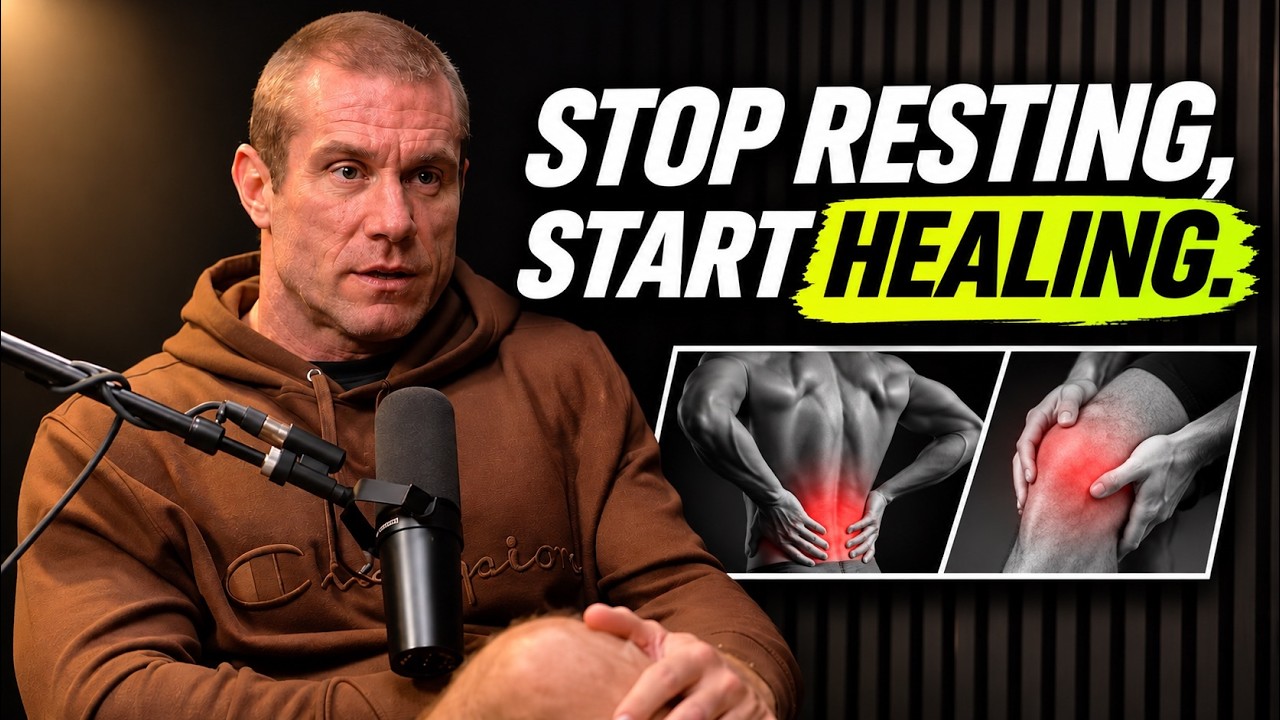
His central idea? Stress isn’t automatically good or bad.
Ahead: a squat-bracing fix most lifters never learn, a quirky finger trick for sore elbows, and an ankle-sprain approach that defies old-school advice.
Keep reading to see which simple swaps could keep you training.
Jump to:
One Question Decides Every Exercise Swap
So, is stress a good thing or a bad thing? It depends.
Joint stress you can recover from and adapt to builds capacity. Stress that damages tissue, even slightly, can snowball into deterioration.

If you want something simple that actually works, this is one of the most effective tools I’ve used to build strength, conditioning, and endurance without needing a full gym setup.
- Full-body training with one weight using swings, squats, and presses
- Solid cast iron build that feels stable and lasts for years
- Comfortable grip that makes high-rep workouts easier to handle
I am not a physical therapist, so always go to your physical therapist if you have an injury.
Suspected tears, significant injuries, or lingering pain deserve a professional evaluation. Everything below is general education, not a prescription.
Shoulder Pain and Rotator Cuff Irritation
Rotator cuff injuries are really common. A lot of us have tears without even realizing it as we get older.
Judd explains that the cuff is actually four muscles (supraspinatus, infraspinatus, teres minor, and subscapularis), so what to avoid depends on where it hurts.
Moves to Pause
- Upright rows and heavy carries, which can squeeze the space beneath the acromion
- Very high lateral raises, particularly with supraspinatus trouble
- Barbell bench and overhead presses, which demand heavy external-rotator stability
- Dips, at least temporarily
Smarter Substitutes
- Banded external and internal rotation to rehab gently
- Isometrics such as upside-down kettlebell holds and carries
- Push-ups, a closed-chain option
- Dumbbells, letting the arm find a pain-free groove
- Face pulls and mid-back postural work
- Slow reps with a pause at the bottom
Landmine pressing is great for people with rotator cuff injuries for a while.
His weird advice: consider machines. Free-weight presses force injured stabilizers to hold the load, while machines let bigger muscles work and give the cuff breathing room.
Why Squats Make Your Low Back Hurt
Bracing comes first. The classic cue (chest high, eyes to the ceiling, big breath) hyperextends the lumbar spine and loads the back of the disc.
Judd prefers drawing ribs and sternum down, then breathing out into a belt-like brace around the whole torso. That spreads pressure evenly across vertebral discs.
More Fixes Worth Trying
- Mobilize shoulders and thoracic spine pre-squat, since stiffness there gets compensated for in the low back
- Swap to a safety bar or machine temporarily
- Open tight hip flexors, which can tip the pelvis forward
- Strengthen without axial loading using reverse hypers, 45-degree back extensions, and hip thrusts
More frequent smaller stresses will help give your back time to build up a little bit more.
His example: rather than one all-out weekly session, squat three times weekly, keeping two light with pauses and technique work.
If you want something simple that actually works, this is one of the most effective tools I’ve used to build strength, conditioning, and endurance without needing a full gym setup.
- Full-body training with one weight using swings, squats, and presses
- Solid cast iron build that feels stable and lasts for years
- Comfortable grip that makes high-rep workouts easier to handle
Hip Flexor Pain Without Losing Mobility
Runners should lean in slightly, keeping the chest lower to level the pelvis, and take smaller, quicker strides.
Lunging deserves caution too. Walking lunges can swap out for step-ups.
Judd also notes that a true Bulgarian split squat sits lower, with the ball of the rear foot planted. That setup creates glute tension that eases hip flexor strain, unlike many rear-foot-elevated versions seen in gyms.
Stretch With a Sequence
Rather than simply tugging, he recommends researching PNF stretching and “pails and rails” methods. His sample routine:
- Hold a glute bridge for a couple of 20-second rounds
- Roll onto the stomach and lift the bent knee without letting the hip bone leave the floor
- Finish with a half-kneeling stretch
Make sure you squeeze your glute. That is going to hold that pelvis in place and make sure the range of motion comes from your hip flexor, not your lower back.
Knee-Friendly Squatting
Squats do more than build quads. Modified versions still hit glutes, adductors, core, and the lumbar region.
- Box squats limit range and remove the stretch reflex
- Low-bar squats turn the lift more hip dominant
- Zercher squats tend to feel kinder
- Elevated heels reduce ankle strain, which travels up the chain
- Slow eccentrics and bottom pauses
- Higher reps for quad growth
Studies have shown when volume is equated that concentrics can build muscle just as well as normal traditional weight training.
Judd doesn’t name specific papers in the episode, so treat this as coach-level guidance. His concentric picks: sled pushes, seated high-resistance biking, and sled back-pedaling.
If you want something simple that actually works, this is one of the most effective tools I’ve used to build strength, conditioning, and endurance without needing a full gym setup.
- Full-body training with one weight using swings, squats, and presses
- Solid cast iron build that feels stable and lasts for years
- Comfortable grip that makes high-rep workouts easier to handle
Golfer’s Elbow: Keep Training Smartly
Severe cases may justify a week off. Judd battled a bad one himself after coaching kids in speed work, throwing footballs, and practicing muscle-ups.
First of all it’s going to take a while to get better. Just be patient with it.
- Use a supinated or semi-supinated grip for pulling, without over-supinating
- Pull with index and middle fingers rather than ring and pinky
- Add straps to reduce grip demand
- Row outward, as if pulling the handle apart, instead of squeezing inward
- Rehab daily with racquetball squeezes, rice-bucket work, or twisting a rod in rice
Ankle Sprains Need More Than Waiting
Ankle sprain is one of those things that like it gets thrown out there like it’s not a big deal. It sort of is a big deal.
Judd views a sprain as torn ligament tissue of varying severity. He’s skeptical of extended rest, icing, bracing, and boots, though icing for short-term pain relief is fine by him.
That’s his coaching stance, and clinicians differ. Ask yours before abandoning a prescribed brace or boot.
His Progression Ladder
- Gentle passive motion in every direction the ankle allows
- Walking once pain stays at two or three out of ten, ideally within a couple of weeks
- Skipping and easy pogo hops, then multi-directional, then single-leg versions
- Stair climbing, incline treadmill walking, sled pushes, and sled back-pedaling
- High-rep hopping, like jump rope
Even when it starts to feel better you’re going to have to take special care to strengthen that ankle back up.
Skipping that step, he warns, leads many people to sprain the same ankle repeatedly.
The Bottom Line
Modify, don’t quit. Match each exercise to what injured tissue tolerates, rebuild capacity progressively, and loop in a qualified professional when pain persists.