A 2-foot park wall humbled a guy who lifts three times every week.
In a recent YouTube video, a fitness creator in his late 40s explained how chasing his daughter off that ledge left his knee aching.
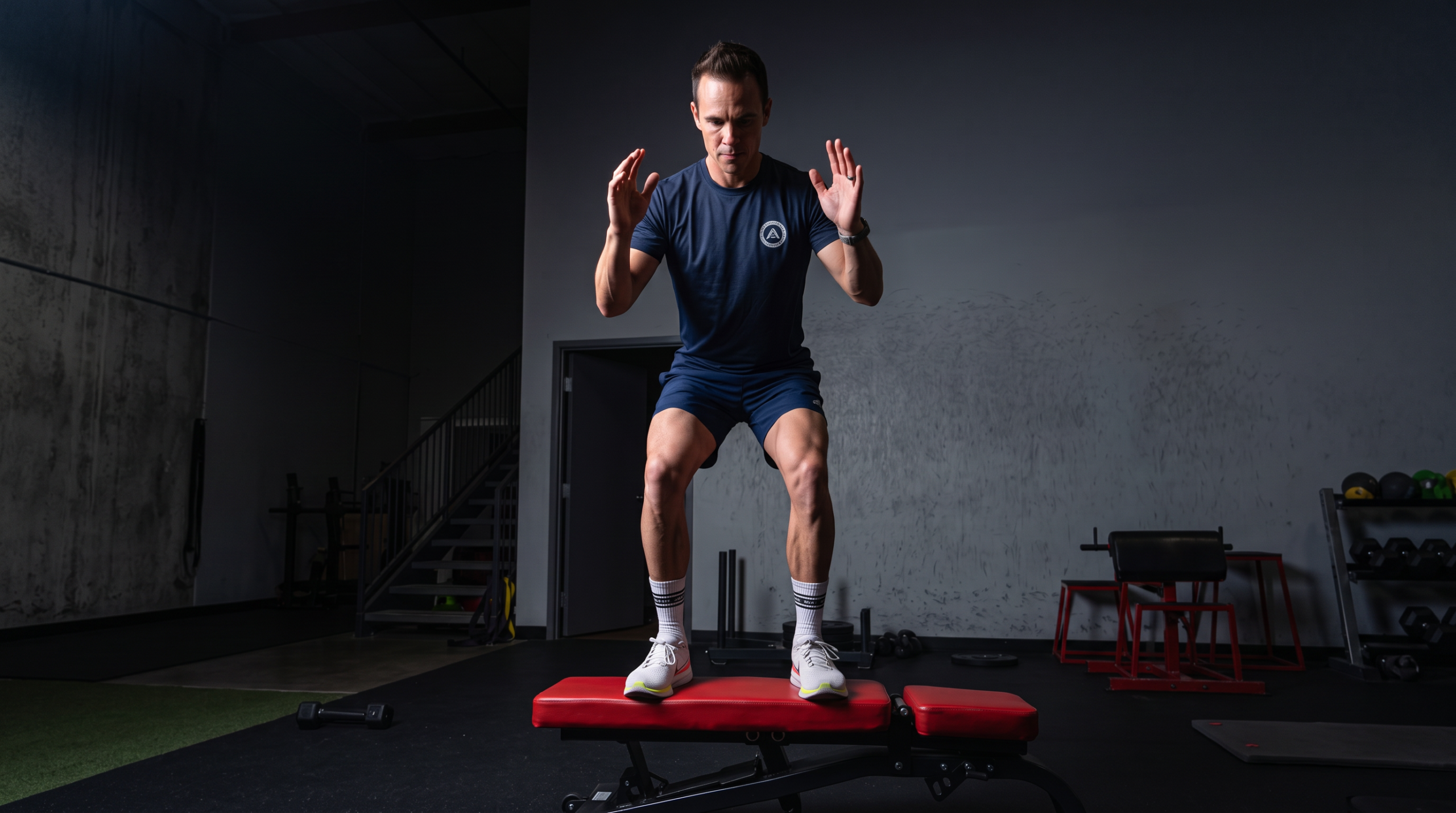
His big realization: strength and athleticism sit in two separate bank accounts.
Most adults over 40 keep depositing into only one.
Below, find the sneaky aging number almost nobody mentions, plus the four-phase jump plan he used to fix his own gap.
Jump to:
The Hidden Number Behind Aging
Everyone knows that we lose strength as we age, around 1 and 1/2% per year if you don’t maintain it.
Power, however, slips around 3.5% per year by his estimate. That is more than double the pace.

If you want something simple that actually works, this is one of the most effective tools I’ve used to build strength, conditioning, and endurance without needing a full gym setup.
- Full-body training with one weight using swings, squats, and presses
- Solid cast iron build that feels stable and lasts for years
- Comfortable grip that makes high-rep workouts easier to handle
You won’t see it inside the gym. It’s just going to show up in life.
Where does a power deficit reveal itself? He pointed to everyday moments:
- Catching a toe on a curb at 70, with half a second to swing a leg underneath you
- Springing off the couch when something crashes in another room
- Grabbing your kid before pavement arrives
- Stepping off a curb and landing at an angle you never planned
None of these movements are decided by how much you squat.
Speed of force production and force absorption decide outcomes. Plyometrics train both.
Why Jump Training Starts With Landing
Forget the image of a 22-year-old CrossFitter missing box jumps and shredding his shins. That, he says, is the deep end.
Real plyometric training starts with the most unathletic thing in the gym and that’s learning how to land.
Absorb first, produce later. Tendons, ankles, and knees must learn bracing before they ever chase height.
Run These 5 Baseline Tests First
Total time: roughly 15 minutes. Equipment needed: none.
- Vertical jump: Reach up beside a wall, mark it, jump, touch as high as possible, then measure the difference.
- Standing broad jump: Leap forward off two feet, stick the landing, measure heel to toe.
- Three-hop consistency: Hop forward three times continuously. Does hop number three fall apart?
- Single-leg stance: Balance 30 seconds, arms at sides, eyes open. Repeat with eyes closed.
- Controlled step-down: Step off a low step and hold the landing about two seconds, with no wobble and no knee cave.
Expect humbling results. In his words, most people over 40 will be humbled by the eyes-closed balance test.
If you want something simple that actually works, this is one of the most effective tools I’ve used to build strength, conditioning, and endurance without needing a full gym setup.
- Full-body training with one weight using swings, squats, and presses
- Solid cast iron build that feels stable and lasts for years
- Comfortable grip that makes high-rep workouts easier to handle
Write numbers down, then retest at week six.
The 4-Phase Plyometric Progression
Every stage carries one job: absorb force, create it with control, create it repeatedly, then create it fast.
You don’t move up because four weeks have passed. You move up because your body has earned it over the course of time.
Phase 1: Absorb Force (Weeks 1 to 4)
Train twice weekly, spaced at least 48 hours apart. Goal: teach your body to slow down quietly and hold shape.
- March in place or brisk walk: 30 seconds
- Low pogo hops, small and controlled: 2 × 10
- Small squat jumps with a two-second landing: 2 × 3
- Step-off from a low step, sticking the landing: 2 × 3
Rest 30 seconds minimum between drills. Whole routine: about 5 minutes.
The landing is the exercise.
Carry two cues throughout: land quietly, and hold until the landing stops feeling like it might break you.
If you jump and the people in the next room can actually hear you, you’re not ready to jump higher. You have to jump softer.
Placement matters. Skip finisher slots, since plyometrics are a nervous system skill best practiced fresh, before lifting, when coordination peaks.
If you want something simple that actually works, this is one of the most effective tools I’ve used to build strength, conditioning, and endurance without needing a full gym setup.
- Full-body training with one weight using swings, squats, and presses
- Solid cast iron build that feels stable and lasts for years
- Comfortable grip that makes high-rep workouts easier to handle
Phase 2: Elastic Control (Weeks 4 to 8)
Graduate once landings are quiet, knees track over toes, torso stays organized, and next-day soreness is absent. Sessions stay at two weekly, 48 hours apart.
- Pogo hops: 2-3 × 10-15
- Low box jumps: 3 × 3
- Box jumps with stuck landing: 3 × 3
- Line hops forward and back: 2 × 10 each direction
- Low lateral line hops: 2 × 8-10
Rest 60 to 90 seconds between sets. Why include boxes here? Landing on a box lets you practice producing force without paying full landing costs.
One rule: step down afterward. Never jump down.
Phase 3: Repeated Force (The Sweet Spot)
Move here when jumps stay crisp across every set and recovery between sessions feels fine. Spend three to four solid weeks building it.
Now the stretch-shortening cycle gets real, because time between landing and takeoff shrinks.
- Repeated pogo hops: 2-3 × 15-20
- Continuous line hops: 2-3 × 10-20
- Low bounds: 2-3 × 4-6 contacts
- Broad jump into vertical jump, stuck landing: 2-3 × 3
The moment that your rhythm breaks down, the moment your posture goes, the moment your landing quality drops, the set is over.
He also made a bold claim: most people over 40 can live here permanently and collect about 90% of the benefit. This figure reflects his personal coaching view rather than a measured result.
If you want something simple that actually works, this is one of the most effective tools I’ve used to build strength, conditioning, and endurance without needing a full gym setup.
- Full-body training with one weight using swings, squats, and presses
- Solid cast iron build that feels stable and lasts for years
- Comfortable grip that makes high-rep workouts easier to handle
Phase 4: Advanced Reactive Work (Optional)
Depth jumps and complex combinations load tendons harder, reverse force faster, and leave much less room for error. Reach this stage only after several clean months of the previous one.
- Depth jump from 12 inches: 2-3 × 3
- Depth jump to vertical jump: 2-3 × 3
- Depth jump to broad jump: 2-3 × 3
- Single-leg reactive work, only once two-legged work looks excellent
Skipping the phase four just because it looks impressive is exactly how people end up telling everyone that plyometrics are dangerous.
Your Green-Light Checklist Before Advancing
Every item below must be true before climbing a rung:
- Zero pain during the session
- No lingering joint or tendon soreness next day
- Quiet, stable landings with knees tracking properly
- Final rep matches the first
- Same session repeatable 48 hours later without trouble
Miss any single item? Stay put, perhaps trimming volume.
The most common programming error I see is advancing by calendar instead of by movement quality.
Calendars cannot predict how an Achilles tendon will feel. Movement quality is the real green light.
Anyone with existing knee, ankle, or tendon problems should check with a physician or physical therapist before adding jumps.