In a recent YouTube video, the creator behind Frankenstein Hypertrophy argued that one bone explains stalled chest growth.
Forget bench angle.
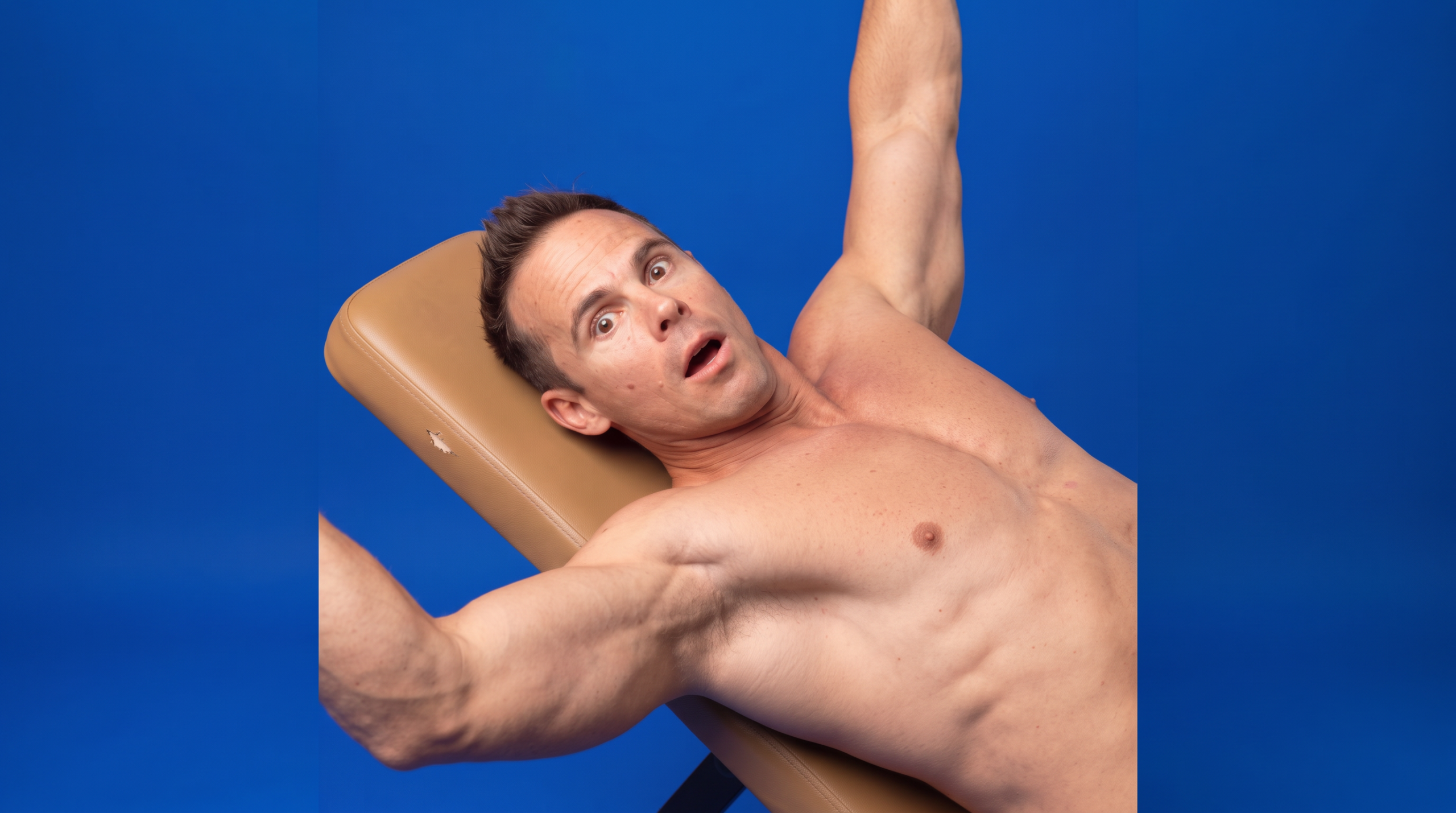
Depth of stretch? Also not the culprit.
He admits he got this wrong for years, and his pecs paid the price.
Keep reading to discover the single landmark that tells you exactly where each rep should stop.
Jump to:
- Why a Bone Your Pec Never Touches Controls Chest Growth
- The Fix: Pin Your Shoulder Blades Back and Keep Them There
- Why a Deeper Stretch Isn’t a Better Stretch
- A Training Leash for Stubborn Shoulders
- The Back Muscles That Hold the Position
- Do Flys Follow the Same Rules?
- How Often Should You Train Chest?
- Quick Recap: Six Rules for Pec-Dominant Pressing
Why a Bone Your Pec Never Touches Controls Chest Growth
Your pec does not attach to your scapula. So how much could shoulder blade position matter?

If you want something simple that actually works, this is one of the most effective tools I’ve used to build strength, conditioning, and endurance without needing a full gym setup.
- Full-body training with one weight using swings, squats, and presses
- Solid cast iron build that feels stable and lasts for years
- Comfortable grip that makes high-rep workouts easier to handle
Quite a lot. Pec fibers converge on the humerus, and the humerus sits in the glenoid, which belongs to the scapula.
Your shoulder blade carries the socket.
Press with protracted scapulae (rolled forward) and the pec starts near the end of its range. Chase extra length from there and you run out of room.
Only one escape exists: tipping the shoulder forward. That is why delts light up during chest day.
He points to how far the bony tip of the shoulder blade can travel, which is the acromion. Retraction moves it back roughly 4 cm on average, while protraction pushes it forward about 6 cm.
Most lifters sit between those extremes, with a mostly neutral scapula that slides and rotates slightly. Even so, every centimeter the scapula covers is a centimeter the shoulder joint skips, and shoulder-dominant pressing follows.
The Fix: Pin Your Shoulder Blades Back and Keep Them There
Left alone, scapulae work with the shoulder joint and humerus as a team. Serratus anterior, anterior delts, and triceps all join the movement.
If you want something simple that actually works, this is one of the most effective tools I’ve used to build strength, conditioning, and endurance without needing a full gym setup.
- Full-body training with one weight using swings, squats, and presses
- Solid cast iron build that feels stable and lasts for years
- Comfortable grip that makes high-rep workouts easier to handle
Great for function, less great for chest-biased growth. Retracting from the first inch lengthens the starting position of the pec and limits help from serratus and triceps late in the rep.
He is not alone in recommending this. According to him, the National Strength and Conditioning Association has advised retracted-scapula pressing for over 20 years, citing shoulder safety, while powerlifters use it to shorten bar travel.
My reason is less about shoulder safety and bar travel and more superficial. I just want male decups. Is that really too much to ask for?
Expect the rep to look shorter. That is by design, since the range you lose is mostly triceps and serratus territory.
Why a Deeper Stretch Isn’t a Better Stretch
Deep stretches feel productive. Heavy mechanical tension, surely growth follows?
He cites a cadaver experiment run by surgeons studying pec ruptures. Chests were bolted into a frame and a bench press was simulated.
Fibers lengthened fairly evenly for most of the motion. Past the point where the elbow dropped level with the torso, the short lower rib fibers stretched almost twice as much as the rest of the muscle.
If you want something simple that actually works, this is one of the most effective tools I’ve used to build strength, conditioning, and endurance without needing a full gym setup.
- Full-body training with one weight using swings, squats, and presses
- Solid cast iron build that feels stable and lasts for years
- Comfortable grip that makes high-rep workouts easier to handle
Worth remembering: that was a lab simulation on cadavers, not a muscle-growth trial. Still, it hints that the deep-stretch sensation may come from the most injury-prone fibers.
Your Stopping Landmark
The disproportionate stretch appeared when the shoulder joint hit hyperextension, not simply when the pec was long. Retraction moves the socket back, buying extra range before that point.
- Retract your scapulae before unracking.
- Lower until your elbows are even with your torso.
- Stop there. Anything deeper is shoulder hyperextension.
Feels unsafe at first? Strength is specific to the range you train, so progress weight slowly and hold the posture. You will get stronger and safer in this position.
A Training Leash for Stubborn Shoulders
Holding retraction through an entire set is brutal at first. His solution is Donnie Thompson’s Formal Bowtie, a posture device worn upside down to cause retraction and slight depression.
Think of it like training wheels or like that backpack parents use for kids, but it’s actually a leash.
Beyond guiding position, it provides kinesthetic feedback when form slips. He also used it diagnostically: after wearing it for a couple of hours, the culprit behind his rolled shoulders turned out to be pec minor.
The Back Muscles That Hold the Position
Rolled shoulders can’t be stretched away, he says. Strengthen the antagonists instead, since those same muscles keep you retracted under load.
If you want something simple that actually works, this is one of the most effective tools I’ve used to build strength, conditioning, and endurance without needing a full gym setup.
- Full-body training with one weight using swings, squats, and presses
- Solid cast iron build that feels stable and lasts for years
- Comfortable grip that makes high-rep workouts easier to handle
- Mid traps: Shrug-style movements matching fiber orientation. Skip the high-elbow row, whose weak link is horizontal shoulder abduction. Avoid tilting the torso forward, since extra length then comes from scapular elevation.
- Low traps: A shrug-style lat pulldown, plus an occasional 90/90 variation finishing with a press.
- Rhomboids: A bench set near 35 degrees, with low, close, sweeping reps that rotate the scapula’s lower portion toward the spine.
- Serratus anterior: A triceps strap wrapped around the elbow, then retract, protract, and add slight external rotation upward. He calls the lower serratus the most neglected portion.
One hybrid row-shrug looks awkward, but if it feels weak, you have found your limiter.
Have you ever seen anybody with horrible posture, internally rotated shoulders, and a giant chest? Usually doesn’t happen.
Do Flys Follow the Same Rules?
Yes. Flys are the purest form of horizontal shoulder adduction, so scapular control matters even more.
Machine flys offer a pad to pin your scapulae against. Unilateral versions feel unnatural but work incredibly well, he says.
His common mistake: leading with the elbow for depth, which forces internal rotation and turns the fly into a delt-driven movement. Now he stretches into external rotation instead, promoting posterior scapular tilt.
Stop when your arm aligns with your torso. Expect lighter loads initially, since you have probably been flying with your delts for years.
How Often Should You Train Chest?
Whether frequency spikes protein synthesis more often or simply adds volume, he argues the lagging muscle deserves the most sessions.
If you want something simple that actually works, this is one of the most effective tools I’ve used to build strength, conditioning, and endurance without needing a full gym setup.
- Full-body training with one weight using swings, squats, and presses
- Solid cast iron build that feels stable and lasts for years
- Comfortable grip that makes high-rep workouts easier to handle
He trained chest every third or fourth day, whenever recovered, and scheduled everything else around it.
Quick Recap: Six Rules for Pec-Dominant Pressing
- Pin your shoulder blades back and keep them there. Forward slide means serratus and shoulders are taking over.
- Don’t chase length. Elbows even with the torso is plenty.
- Don’t finish by reaching. Spreading scapulae or locking out shifts work to serratus and triceps.
- Flys follow identical rules, plus slight external rotation, stopping when your arm aligns with your torso.
- Train mid traps, low traps, rhomboids, and serratus to sustain retraction.
- Build your program around chest if growth is the goal.