Calisthenic athletes often possess a paradox that baffles traditional gym-goers.
They move weight that seems impossible for their lean frames.
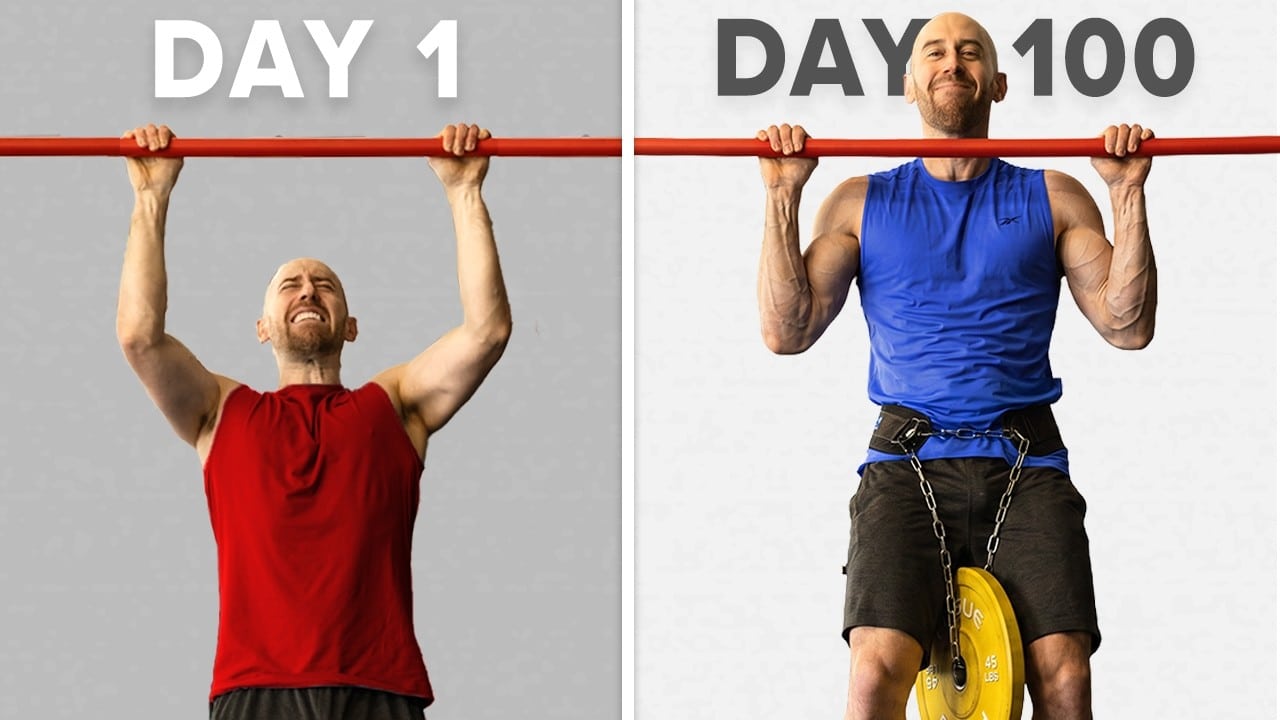
In a recent 100-day experiment, fitness content creator Brandon set out to discover if he could transform himself into someone who’s stronger than he looks by training specifically for elite calisthenic strength.
His journey culminated in an unofficial street lifting competition against some of his city’s best athletes—and the results might surprise you.
Jump to:
Day One Reality Check
Brandon began his journey by testing his one rep max with Ryan McClellan, a national powerlifter, pro bodybuilder, and weighted calisthenics champion. The goal was ambitious: hit 50% of Ryan’s top lifts on day one.
For weighted pull-ups, that meant achieving 75 pounds, since Ryan’s max sits at an impressive 154 pounds.

If you want something simple that actually works, this is one of the most effective tools I’ve used to build strength, conditioning, and endurance without needing a full gym setup.
- Full-body training with one weight using swings, squats, and presses
- Solid cast iron build that feels stable and lasts for years
- Comfortable grip that makes high-rep workouts easier to handle
Once you add weight and your form starts breaking down, that form breakdown can inform you of how you want to target your training.
Brandon managed a 55-pound weighted pull-up on his first attempt—clean form, chin well above the bar. However, when attempting 60 pounds, his chin barely cleared the bar before failing.
Moving to dips proved equally humbling. Ryan’s record stands at six plates—a staggering 270 pounds. Brandon tapped out at 80 pounds, failing quickly at the bottom of the movement.
Three Core Training Principles
Ryan established three fundamental rules that would guide Brandon’s entire 100-day transformation.
Isolate Your Weakness
Brandon’s dip failure occurred at the bottom of each rep, indicating weakness in that specific range. His pull-up breakdown happened at the top third of the movement.
A good way to emphasize that in your training is to just emphasize depth, even potentially touching your chin to the dip bar.
At the end of each workout, Brandon stripped away all weight and focused exclusively on his weak points—grinding out reps at maximum depth for dips and isolating just the top portion for pull-ups.
High Intensity, Low Volume Sets
Training consisted of three to five reps per set, with a minimum of five sets per workout plus warm-ups. This approach meant spending over 30 minutes just on pull-ups and dips before moving to other exercises.
If you want something simple that actually works, this is one of the most effective tools I’ve used to build strength, conditioning, and endurance without needing a full gym setup.
- Full-body training with one weight using swings, squats, and presses
- Solid cast iron build that feels stable and lasts for years
- Comfortable grip that makes high-rep workouts easier to handle
Short? Yes. Easy? Absolutely not.
Mental Warfare Every Single Set
Every set required complete psychological commitment—psyching up before each attempt and training to absolute failure. The mental toll accumulated rapidly across weeks of training.
Unexpected Equipment Challenge
Brandon’s primary training gym lacked dip bars entirely, forcing him to use gymnastics rings for all his dip training. While this provided significantly less stability and forced him to train with lower weights initially, it may have provided an unexpected advantage.
Despite dipping 80 pounds on parallel bars during testing, Brandon could barely manage 25 pounds for three reps on rings. The instability was brutal.
Progress Through Month One
Brandon meticulously tracked his improvements across all three competition lifts: pull-ups, dips, and squats.
His pull-up progression showed consistent improvement, averaging 5 pounds every two weeks. Starting at 55 pounds on day one, this represented steady, measurable gains.
If you want something simple that actually works, this is one of the most effective tools I’ve used to build strength, conditioning, and endurance without needing a full gym setup.
- Full-body training with one weight using swings, squats, and presses
- Solid cast iron build that feels stable and lasts for years
- Comfortable grip that makes high-rep workouts easier to handle
Dip progress proved harder to measure since he couldn’t retest on the same equipment, but his ring performance showed gradual improvements despite the added difficulty.
Squats presented a different beast entirely. His day one max hit 215 pounds—just shy of two plates. But there was a problem.
Fear Factor
Training squats to failure terrified Brandon. Having heavy weight loaded on his shoulders created psychological barriers that slowed his progress considerably compared to his upper body lifts.
This mental block meant he avoided retesting his one rep max, instead focusing on building confidence in the three to five rep range.
Breaking Through Plateaus
Around the midpoint of his journey, Brandon’s pull-ups stalled completely at 75 pounds. No matter how hard he pushed, 80 pounds remained out of reach.
Desperate for a win, he joined a new gym with proper parallel bars to retest his dips. The results exceeded expectations—his one rep max jumped not 10 pounds, but 20 pounds despite training exclusively on unstable rings.
If you want something simple that actually works, this is one of the most effective tools I’ve used to build strength, conditioning, and endurance without needing a full gym setup.
- Full-body training with one weight using swings, squats, and presses
- Solid cast iron build that feels stable and lasts for years
- Comfortable grip that makes high-rep workouts easier to handle
Pull-ups, however, remained stubbornly stuck at 75 pounds.
Competition Crisis
Street lifting competitions—powerlifting-style events for calisthenics athletes testing one rep maxes in pull-ups, dips, squats, and muscle-ups—turned out to be extremely rare.
Brandon’s best option involved flying to Houston to compete against athletes at Ryan’s elite level, which seemed both impractical and potentially embarrassing.
His solution? Organize his own competition by reaching out to local calisthenics gyms and communities. After several inquiries, Caliber Fitness agreed to host an unofficial street lifting meet-up during their monthly gathering.
Building Momentum
With three weeks remaining, Brandon constructed a home gym to maximize training opportunities. His first session there proved transformative.
After four careful warm-up sets, he loaded 80 pounds onto his pull-up belt and achieved what had eluded him for weeks—a clean 80-pound weighted pull-up on a door-mounted bar.
If you want something simple that actually works, this is one of the most effective tools I’ve used to build strength, conditioning, and endurance without needing a full gym setup.
- Full-body training with one weight using swings, squats, and presses
- Solid cast iron build that feels stable and lasts for years
- Comfortable grip that makes high-rep workouts easier to handle
Additional breakthroughs followed rapidly. Brandon completed three consecutive muscle-ups—an exercise he couldn’t perform even once at the start of his journey.
I always just assumed I was not a particularly strong person, genetically on the weaker side. But training like this and pushing myself hard for low reps, high intensity it’s been a game-changer.
Squat Setback
With squats excluded from the competition format, Brandon decided to attempt a new personal record at 225 pounds—1.5 times his bodyweight.
During his final warm-up set, disaster struck. Brandon’s lower back seized up completely—a stress response that had plagued him before when handling heavy loads.
While not a serious injury, the timing couldn’t have been worse. He spent his final week focusing on recovery and loosening his back rather than pushing for new maxes.
Competition Day Arrives
Walking into Caliber Fitness, Brandon immediately recognized he was outmatched. Athletes performed skills he couldn’t dream of attempting.
But the competition focused purely on strength—one rep max weighted pull-ups and dips. Form requirements were strict: palms facing away, full dead hang at bottom, chin clearly above bar for pull-ups.
If you want something simple that actually works, this is one of the most effective tools I’ve used to build strength, conditioning, and endurance without needing a full gym setup.
- Full-body training with one weight using swings, squats, and presses
- Solid cast iron build that feels stable and lasts for years
- Comfortable grip that makes high-rep workouts easier to handle
Pull-Up Competition
Competitors progressed in 10-pound increments. Brandon sailed through 60 pounds—the weight that defeated him on day one—with ease.
At 80 pounds, his current personal best, he executed a clean rep with authority. Feeling confident, he attempted 90 pounds.
His first attempt came agonizingly close. Observers debated whether his chin cleared the bar, ultimately giving him a narrow pass.
Narrowing his grip for better leverage, Brandon attacked 85 pounds and succeeded. But returning to 90 pounds, he failed—his chin stopping just millimeters short of the bar.
It’s always the hardest part for me. It’s the end. Those last inches.
Brandon finished sixth in pull-ups—last place, but with a respectable 90-pound performance.
Dip Domination
Moving to dips, Brandon’s push strength proved far more competitive. He progressed smoothly through early weights, hitting 90 pounds cleanly.
If you want something simple that actually works, this is one of the most effective tools I’ve used to build strength, conditioning, and endurance without needing a full gym setup.
- Full-body training with one weight using swings, squats, and presses
- Solid cast iron build that feels stable and lasts for years
- Comfortable grip that makes high-rep workouts easier to handle
At 100 pounds, he moved the weight with surprising ease. At 115 pounds—a new personal record—he ground out another successful rep.
His first attempt at 125 pounds failed, getting stuck midway through the movement. But Brandon refused to accept defeat.
On his second attempt at 125 pounds, everything clicked. Clean descent, powerful drive upward, successful lift.
After going from a 125-pound jump, that’s big. Big.
Transformation Complete
Over 100 days, Brandon achieved remarkable strength gains:
- Weighted dips: 45-pound improvement (80 to 125 pounds)
- Weighted pull-ups: 30-pound improvement (55 to 85-90 pounds)
- Muscle-ups: Zero to three consecutive reps
One week after the competition, Brandon finally conquered the weight that had tormented him throughout his journey—achieving a clean 90-pound weighted pull-up in training.
His results demonstrate that elite relative strength isn’t reserved for genetic outliers. Focused training with proper programming—isolating weaknesses, training with high intensity, and pushing through mental barriers—can transform average strength into exceptional performance.
If you want something simple that actually works, this is one of the most effective tools I’ve used to build strength, conditioning, and endurance without needing a full gym setup.
- Full-body training with one weight using swings, squats, and presses
- Solid cast iron build that feels stable and lasts for years
- Comfortable grip that makes high-rep workouts easier to handle
Brandon didn’t just become stronger than he looked. He became stronger than he ever believed possible.