In a recent YouTube video, a popular fitness creator revealed the six Shaolin-inspired leg exercises that replaced squats in his routine.
His starting question is uncomfortable: why do legs stay weak exactly when real life demands strength?
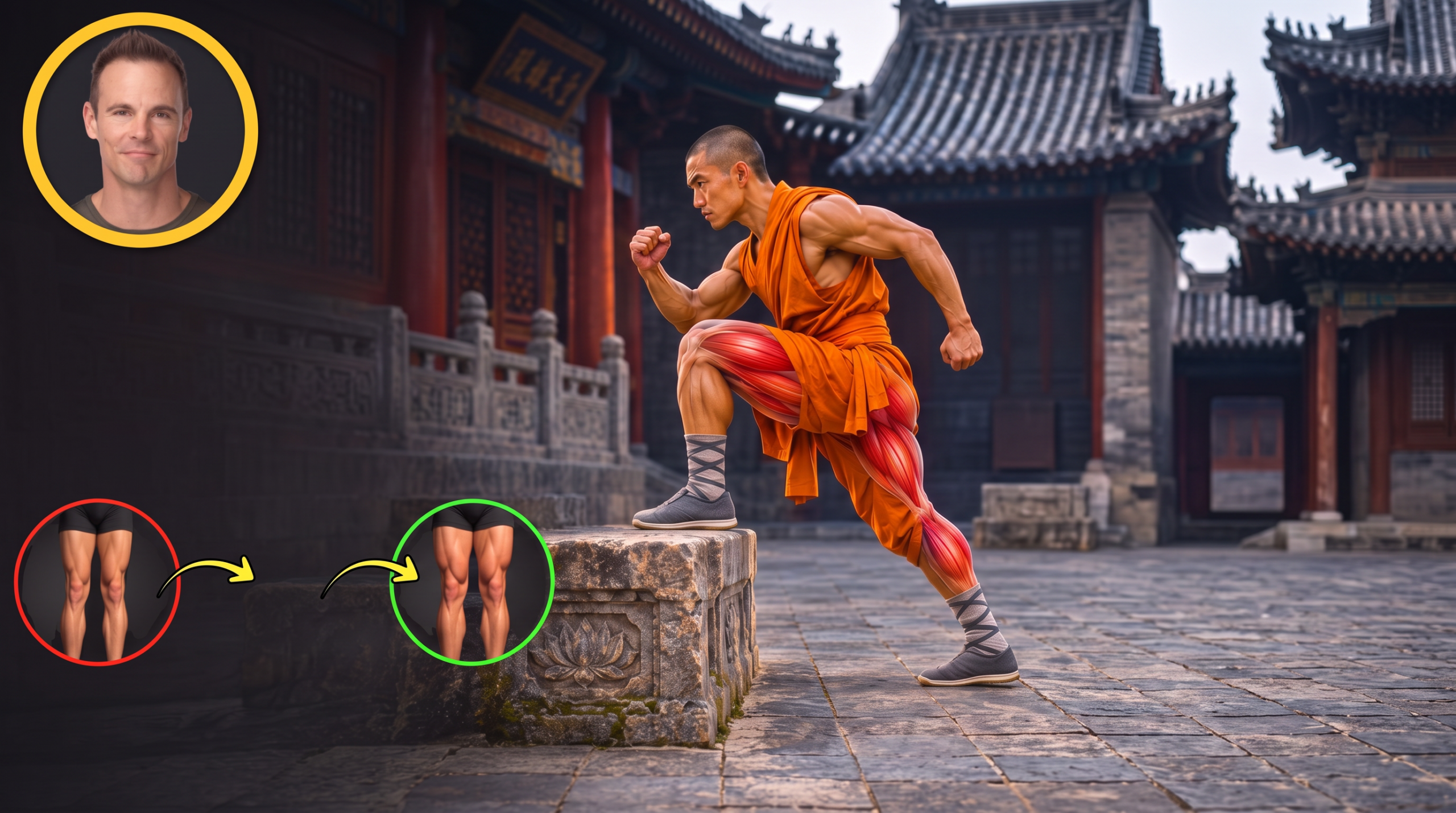
His answer might change how you approach leg day.
Two bonus moves quietly fix problems most lifters never notice.
Ready to see what made him ditch the barbell?
Jump to:
Why Squats Alone May Leave Gaps
His core argument: strength built in one repetitive pattern doesn’t automatically transfer to climbing stairs with a load, rising from the floor, or catching yourself after a misstep.

If you want something simple that actually works, this is one of the most effective tools I’ve used to build strength, conditioning, and endurance without needing a full gym setup.
- Full-body training with one weight using swings, squats, and presses
- Solid cast iron build that feels stable and lasts for years
- Comfortable grip that makes high-rep workouts easier to handle
The traditional squat trains strength almost always in a single repetitive movement and leaves aside stability, hip mobility, and positional endurance.
The fuller picture is more nuanced. Squats remain among the best-supported ways to build leg strength, so treating these moves as additions rather than replacements is the safer reading.
1. Horse Stance: The Isometric Foundation
That sounds like an exaggeration until you try to hold it for 2 minutes and discover that your thighs have very strong opinions on the matter.
Apprentices traditionally started here. The stance hits the quadriceps, glutes, and adductors while the core keeps the torso steady.
He also credits isometric training with lowering resting blood pressure. Research does point that way, but benefits appear with consistent practice over weeks, not a single session.
- Setup: feet about twice shoulder width, toes forward, thighs near parallel, chest open.
- Cue: imagine pushing the floor apart to fire the glutes.
- Avoid: caving knees, forward lean, held breath.
- Dose: 3 x 20 to 30 seconds, building toward 60.
- Caution: acute knee pain or uncontrolled high blood pressure calls for professional input first.
2. Duck Walk: Strength on the Move
Nobody looks elegant walking like this, not even actual ducks.
Unlike a squat’s up-and-down path, this crouched travel forces side-to-side weight transfer while the legs stay loaded low.
- Setup: squat to near parallel or below, torso tall, hands forward or on hips.
- Move: short steps, hips level.
- Avoid: long strides and a rounded back.
- Dose: 3 rounds of 10 to 15 steps, progressing to 25.
- Caution: skip it with meniscus injuries, advanced knee osteoarthritis, or recent lower-limb surgery.
3. Frog Pump: Wake Up the Glutes
Every low base position in martial arts depends on strong glutes.
Soles together and knees falling outward, this move isolates the gluteus maximus, the body’s largest muscle. Strong glutes stabilize the pelvis and may help protect the lower back.
Claims of a big extra calorie burn after training are optimistic. Post-exercise energy expenditure is real, yet usually modest.
If you want something simple that actually works, this is one of the most effective tools I’ve used to build strength, conditioning, and endurance without needing a full gym setup.
- Full-body training with one weight using swings, squats, and presses
- Solid cast iron build that feels stable and lasts for years
- Comfortable grip that makes high-rep workouts easier to handle
- Setup: lie back, heels close to hips, drive upward, squeeze, pause one second.
- Cue: draw ribs toward pelvis first so the lower back stays quiet.
- Dose: 3 x 20 to 30 reps, or lengthen the pause to 3 seconds.
- Caution: groin or adductor pain means narrowing the knee opening.
4. Seated Hamstring Stretch
Shaolin monks are known for flexibility as much as power. Tight hamstrings can tilt the pelvis and load the lower back.
The goal is not to touch your head to your knees. It is to keep the spine straight and let the hips lead the movement.
Evidence that stretching alone prevents knee injuries is limited. Pairing it with hamstring strengthening, which he says step-ups and frog pumps provide, makes more sense.
- Setup: legs extended, spine long, hinge from the hips.
- Tip: loop a towel around the feet if reaching is tough.
- Dose: 2 to 3 holds of 30 seconds, ideally after training.
- Caution: avoid with disc herniation, acute sciatica, or a fresh hamstring injury.
5. Step-Up: Fix Your Weaker Side
Shaolin Temple sits among long stone stairways, so climbing is daily life there. Step-ups train the pattern you use most: pushing your body upward one leg at a time.
Many discover that one leg is noticeably weaker and less stable than the other.
He stresses a 2 to 3 second lowering phase. His claim that this portion drives 40 to 50 percent of muscle growth lacks a firm figure behind it, though slow, controlled lowering is a legitimate growth stimulus.
- Setup: full foot on a step, knee near 90 degrees, push through the heel.
- Tip: lean slightly forward to emphasize glutes.
- Avoid: springing off the trailing leg or letting the knee cave.
- Dose: 3 rounds of 10 to 12 per leg, then 15.
- Caution: use a railing if balance is shaky.
6. Single Leg Balance: The Golden Rooster
This classic kung fu stance sounds too simple until you try holding it for a minute. He cites research linking inability to stand on one leg for 10 seconds with higher mortality risk in older adults.
That test is a marker of overall health, not a cause. Balance still depends on ankles, glute medius, core, and proprioception, all trainable.
If you want something simple that actually works, this is one of the most effective tools I’ve used to build strength, conditioning, and endurance without needing a full gym setup.
- Full-body training with one weight using swings, squats, and presses
- Solid cast iron build that feels stable and lasts for years
- Comfortable grip that makes high-rep workouts easier to handle
You will know you are doing it right when you feel your foot and ankle making small corrections the entire time.
- Setup: lift one knee to hip height, torso tall, gaze fixed on a still point.
- Avoid: hip drop toward the raised leg.
- Dose: 3 x 30 seconds per side, building toward 60.
- Caution: stay near a wall with vertigo or a fall history.
Bonus 1: Resting Squat
In much of Asia, people wait for buses in this deep position. Many Western adults can’t get there without tipping backward.
It’s mainly a mobility drill for ankles, hips, and lower back, and it should make duck walks and horse stance feel easier.
The goal is to feel comfortable in the position, not to suffer through it.
- Setup: feet slightly wider than hips, toes out, elbows pressing knees apart.
- Fix: slide a folded towel under lifting heels.
- Dose: accumulate two to three minutes daily.
- Caution: avoid with meniscus injury, advanced osteoarthritis, or joint replacements unless cleared.
Bonus 2: Calf Raise
The calf is known as the second heart of the body.
Each contraction helps push blood back toward the heart, and calves also drive rapid balance corrections after a stumble.
- Setup: balls of feet on a step edge, heels dropping below, rising high with a one-second hold.
- Variation: turn toes in or out between sets.
- Avoid: bouncing and knee bending.
- Dose: 3 to 4 rounds of 15 to 20, with 45 seconds of rest.
- Caution: acute Achilles tendinitis or painful plantar fasciitis means staying on flat ground.
The Takeaway
Whether or not you retire your barbell, these moves fill real gaps in stability, mobility, and single-leg control.
Start with two or three, progress gradually, and check with a professional if joints complain.