

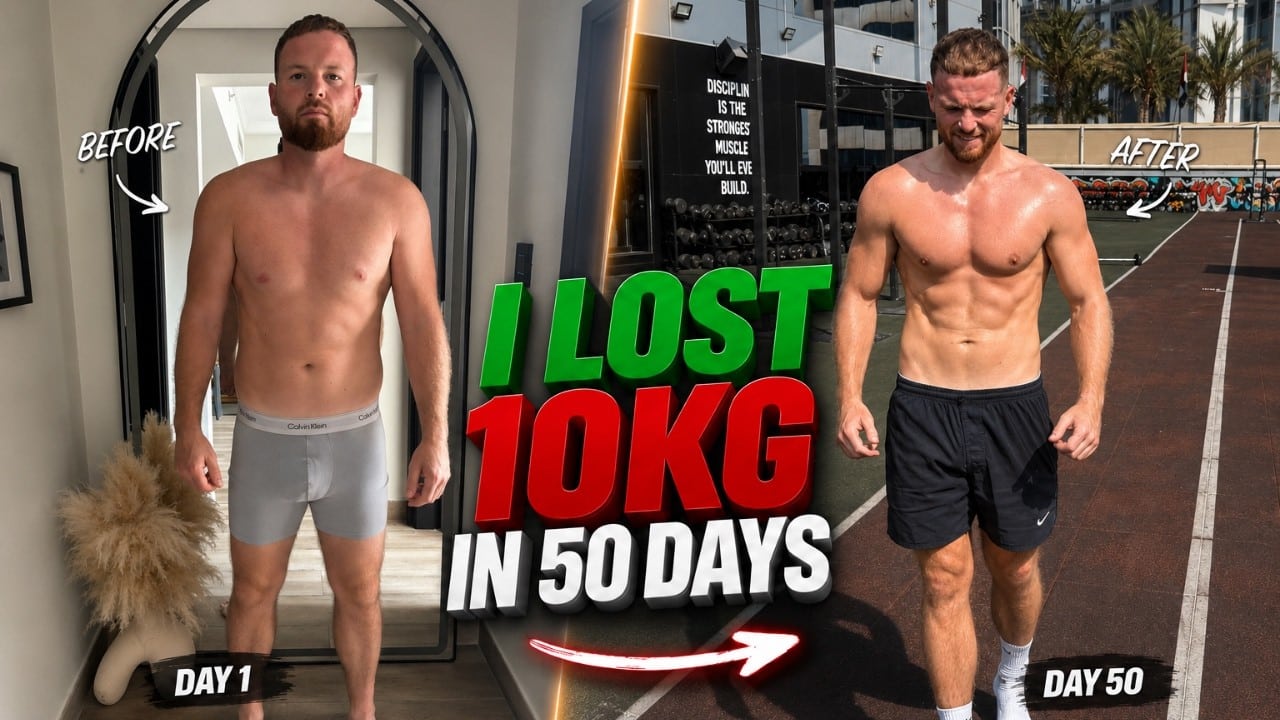
A fitness entrepreneur recently documented his dramatic 50-day transformation, shedding 10 kilograms while managing business demands and content creation.
The journey wasn’t just about dropping weight—it was about accountability, consistency, and finding sustainable strategies that fit into a hectic lifestyle.
From hotel rooms to restaurant collaborations, every scenario tested his commitment.
But the results speak volumes: 80 kilograms down to 70, with detailed tracking revealing exactly what it takes to achieve serious fat loss.
Jump to:
- The Starting Point and Motivation
- The First 10 Days: Water Weight and Early Wins
- Days 11-20: Hitting The Wall
- Core Food Strategy: Simplicity Over Variety
- Social Pressure and Staying Disciplined
- Training Evolution: Ramping Up Output
- Days 30-40: Breaking Through Stubborn Fat
- The Final Push: Days 40-50
- Final Results and Key Metrics
- Practical Takeaways for Sustainable Fat Loss
The Starting Point and Motivation
Starting at roughly 80 kilograms with an estimated 20% body fat, the fitness professional knew he’d been in better shape before—around 72 kilograms at approximately 12% body fat.
Constant eating out and food-centric lifestyle habits had gradually added unwanted pounds. He enlisted fitness coach Rob Brown specifically for accountability.
Basically, I’ve got Rob on board just so if I had no one, no accountability, I would have had a snack there. Literally, that’s the reason.
Despite maintaining baseline fitness through regular training and running, he needed that extra push to strip away stubborn body fat.
The First 10 Days: Water Weight and Early Wins
Initial progress came quickly. Within five days, over one kilogram dropped off—primarily water weight from implementing strict dietary controls.
By day 10, three kilograms were gone. The formula during this phase included:
- Three weight training sessions weekly: Approximately 50 minutes each
- Four cardio sessions: Primarily running
- Under 2,000 calories daily: Strict tracking from day one
Meal prep became non-negotiable. Even during hotel stays, he brought pre-portioned chicken and rice rather than relying on restaurants or room service.
Days 11-20: Hitting The Wall
The second 10-day block proved mentally challenging. Weight didn’t just plateau—it actually increased initially despite maintaining the same routine.
The weight didn’t change. It actually went up the first half of this 10 days. I didn’t change what I was doing. My body must have just been holding on to some fat. Was probably shocked by the crash we had.
Rather than panicking or drastically altering his approach, he stayed the course. By day 20, he’d dropped over four kilograms total, reaching 75.8 kilograms.
Calories were reduced slightly to around 1,800 daily. His rotation of “15 key foods” made meal planning simple and sustainable.
Core Food Strategy: Simplicity Over Variety
The daily eating pattern revolved around three main meals with minimal variation:
Morning routine: Dates and coffee with coconut oil before training, followed post-workout by approximately 500 calories of yogurt, berries, rice cakes, and protein powder.
Midday meal: Tuna with chickpeas, salad, and yogurt mixed together—or 200 grams of chicken breast with low-calorie sauces.
Evening dinner: Variations of chicken with rice or potatoes, tinned tomatoes, and vegetables. Another frequent option was two tins of tuna with air-fried carrots, onion, yogurt, and a small amount of potato—delivering around 500 calories with 50 grams of protein.
Everything was weighed meticulously. Even cooking spray was logged to maintain accurate calorie tracking.
Social Pressure and Staying Disciplined
Days 22-32 presented unique challenges. Family visiting for nine days meant constant exposure to takeaways and restaurant meals.
Business collaborations required attending steakhouses and pizzerias while creating review content—all while watching others enjoy indulgent meals. A kitchen renovation forced him to prepare meals on a table, and hotel stays required packing multiple pre-made dishes.
You’ve just got to be consistent. No excuses. Prep. Take things with you.
By day 32, he’d reached 74.2 kilograms while maintaining just over 1,800 calories daily—though he began targeting closer to 1,750 as progress slowed.
Training Evolution: Ramping Up Output
Weight sessions remained consistent throughout: three to four sessions weekly, approximately 45-50 minutes each, focusing on upper body, lower body splits with supersets.
Typical upper session structure included chest press supersetted with pull-ups, bench press paired with rows, shoulder press, then biceps and triceps work.
What changed dramatically between days 30-40 was cardio volume. Initially four moderate running sessions weekly, this evolved into:
- 15 minutes StairMaster: Added after weight sessions initially
- 30 minutes StairMaster: After every weight session by day 40
- 60 minutes StairMaster: On non-weight training days (three days weekly)
- Evening incline walks: Added as daily routine
- Daily step target: Increased from 15,000 to averaging 20,000
Caloric expenditure jumped to over 1,500 calories daily while food intake remained around 1,750—creating a substantial deficit.
Days 30-40: Breaking Through Stubborn Fat
The aggressive increase in activity paid dividends. Targeting 72.5 kilograms by day 40, he actually hit 72 kilograms—ahead of schedule.
Protein intake increased to nearly 200 grams daily to preserve muscle mass during the intensified deficit. Training occupied roughly two hours each morning, with long evening walks added for additional calorie burn.
It has been tough, but not crazy tough. Just smart food choices, trained for a couple of hours in the morning, and then the long walk in the evening.
Diet remained virtually unchanged—the same meals daily to eliminate decision fatigue and maintain consistency.
The Final Push: Days 40-50
With momentum building, the last stretch required mental fortitude more than physical ability. At day 47, with only five days remaining, maintaining 15,000+ steps meant walking beaches for 45 minutes even during work brunches.
The output’s just gone up so much. The extra stair master, the extra steps. Even today we’re at like a brunch working, and I’ve got to hit my 15k plus steps, so I’ve just left to just walk up and down the beach.
Zero slip-ups occurred throughout the entire journey. Not once did restaurant temptations or social situations derail progress.
Final Results and Key Metrics
Day 50 brought the final weigh-in: 69.8 kilograms. From 80.1 to 69.8 represented 10.3 kilograms lost in 50 days.
Four critical metrics defined success:
- Average daily calories consumed: Approximately 1,750-1,800
- Average daily calories burned: Over 1,500 through activity
- Average daily protein: 180-200 grams
- Average daily steps: 15,000-20,000
The StairMaster became the most challenging component, particularly during 60-minute sessions in the final weeks.
I never want to see a stair master again. That was the hardest part for me the last few weeks, 60 minutes Rob was putting me through there.
Practical Takeaways for Sustainable Fat Loss
Accountability matters immensely. Hiring coach Rob Brown provided external motivation during vulnerable moments when willpower alone might have failed.
Meal prep eliminates excuses. Bringing pre-portioned meals to hotels, restaurants, and family gatherings removed environmental barriers to compliance.
Simplicity beats complexity. Eating virtually identical meals daily reduced decision fatigue and streamlined grocery shopping, cooking, and tracking.
Plateaus require patience. When weight increased mid-journey despite consistent effort, trusting the process rather than making reactive changes proved essential.
Progressive overload applies to cardio. Gradually increasing StairMaster duration and daily steps broke through stubborn fat when diet alone plateaued.
Protein preserves muscle. Maintaining 180-200 grams daily during aggressive caloric deficits helped retain lean tissue despite rapid fat loss.
Meticulous tracking provides data. Weighing all food, logging cooking sprays, and monitoring daily metrics created accountability and identified what actually worked.
This wasn’t about perfection or extreme restriction—it was about consistent execution of fundamentals. Creating non-negotiable daily habits, preparing for challenging situations, and maintaining unwavering commitment to predetermined goals.
Anyone willing to embrace temporary discomfort, plan meticulously, and execute relentlessly can achieve similar transformations.










