Tia-Clair Toomey, the six-time CrossFit Games champion and one of the most decorated athletes in functional fitness history, just announced her decision to compete at the highest level in both CrossFit and HYROX in 2024.
This bold move has turned heads across both sports.
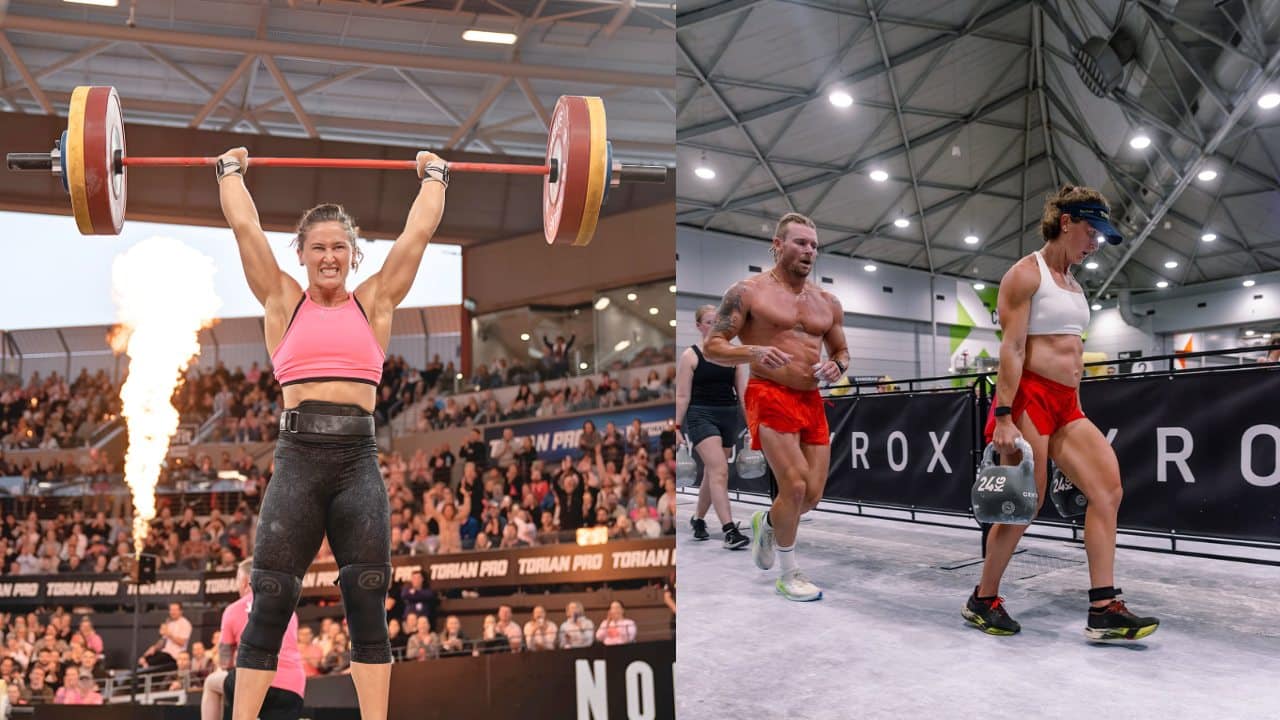
While her dominance in CrossFit is well-established, HYROX is a different animal—an endurance-based fitness race that prioritizes sustained output over explosive power. Attempting to excel in both at once, especially in the same season, raises serious questions about physiological trade-offs, energy system clashes, and training volume conflicts.
“Even for an athlete like Tia-Clair Toomey, this is going to be a real challenge,” said Gommaar D’Hulst, senior scientist at Wod-Science. “We’re talking about two completely different sports at the elite level. The adaptations required are not just different—they’re in many ways opposing.”
So what exactly makes this dual pursuit so difficult?
Jump to:
Why CrossFit and HYROX Demand Opposite Athletic Profiles
CrossFit and HYROX may both fall under the umbrella of functional fitness, but their training styles, energy demands, and movement patterns couldn’t be more different.
CrossFit: Short, Sharp, and Power-Heavy
At its core, CrossFit is about maximum intensity over short bursts. Workouts are designed to produce extreme power output in short time frames, relying on compound, multi-joint movements like Olympic lifts, gymnastics skills, and plyometrics.
Using motion analysis technology, Wod-Science tracked power output during classic CrossFit movements like air squats, pull-ups, and hang power cleans.
Even an unweighted movement like air squats produced instantaneous power spikes over 2,000 watts. During a hang power clean—a loaded, explosive barbell movement—power output soared far beyond endurance-based exercises like rowing.
“CrossFit is what we call a power-dominant sport,” said Gommaar D’Hulst. “These movements are about generating force rapidly. Power spikes, followed by recovery, followed by another spike. That’s the rhythm of CrossFit.”
HYROX: Endurance-Driven and Cyclical
HYROX, by contrast, is a continuous fitness race combining 8 kilometers of running with 8 functional workout stations (like sled pushes, rowing, wall balls). The race takes between 60 to 90 minutes for top competitors.
Unlike CrossFit, HYROX movements are far more cyclical and rhythm-based. The emphasis is on maintaining a steady, sustainable pace—especially during the run.
The physiological demands here are entirely different. Instead of drawing on short-term energy systems like the phosphocreatine system (PCR), HYROX athletes rely on aerobic energy production—fueling their bodies over time using oxygen, with less emphasis on maximal output.
Conflicting Energy Systems: A Physiological Tug-of-War
The core issue lies in how the body creates and uses energy in these sports.
CrossFit: Powered by the Phosphocreatine System
CrossFit workouts engage the phosphocreatine system—a short-term, high-power energy source that fuels intense effort for about 10 to 20 seconds. This system allows athletes to lift heavy weights and perform explosive movements repeatedly.
But there’s a catch: recovery is oxygen-dependent. After depleting phosphocreatine stores, the body needs time and oxygen to regenerate them. This leads to the familiar “work-recover-work” structure seen in CrossFit MetCons.
Muscle oxygenation data from elite CrossFit athlete Yella Hoste shows a full return to baseline between sets—a sign that his body is efficiently restoring PCR levels.
HYROX: Built on Aerobic Efficiency
In HYROX, the emphasis shifts entirely.
There’s minimal PCR system depletion during the long running portions. Instead, the body taps into aerobic systems that provide consistent, lower-intensity energy. The longer the race, the more important these systems become.
Toomey herself explained the challenge:
“When I was coming back from pregnancy, I hadn’t done much strength work—but my running was super fast. Then I started doubling down on strength again, and my running slowed down.”
This is the central dilemma: building strength compromises endurance, and vice versa. The energy systems don’t just differ—they often compete for adaptation.
Muscle Oxygen Data Proves the Recovery Divide
To further illustrate the point, Gommaar D’Hulst compared muscle oxygen recovery between himself and Hoste during a 15-round CrossFit EMOM called Macho Man.
- Hoste: Maintained near-full recovery of muscle oxygen between rounds, sustaining high output across the workout.
- Gommaar D’Hulst: Recovered well early on, but muscle oxygen plummeted in the final rounds, leading to total system failure.
“CrossFit athletes like Yella are machines at recovering anaerobic energy. But that skill doesn’t help much in a sport like HYROX, where you never fully stop.”
Training Volume: The Second Major Barrier
Endurance Requires Hours—Every Day
To compete in HYROX, an athlete must train like a distance runner or triathlete.
Case in point: Olympic gold medalist Kristian Blummenfelt trained 28 to 30 hours per week, burning 7,000–8,000 calories daily. These levels of endurance training volume are essential to build the aerobic base and running capacity required at the elite level.
HYROX is no different.
Tia will need to log high weekly mileage, perform long sessions of zone 2 cardio, and condition her body for sustained output. That comes at a steep cost—time, energy, and recovery capacity.
CrossFit Training Is More Intense, Less Tolerable
CrossFit, by contrast, involves much higher intensity over shorter sessions. The mechanical and neuromuscular fatigue is more severe, making recovery slower and training volume lower.
Toomey confirmed this herself:
“That last 50-calorie row in the CrossFit Open felt way harder than the whole HYROX event. My feet were cramping, my lungs were burning.”
Why? Because CrossFit taps into anaerobic reserves and depletes systems rapidly. It creates central nervous system fatigue, and you simply can’t train at that intensity for 30 hours a week without breaking down.
Combining the two means something has to give—either compromised strength or underdeveloped endurance.
Could the HYROX Doubles Format Be a Loophole?
There may be one avenue where Toomey could make this experiment work: the HYROX doubles format.
Unlike the solo race, doubles allows athletes to alternate stations and share the workload—creating a structure more akin to interval training.
“The doubles format favors athletes from power sports,” Gommaar D’Hulst said. “There’s more rest between efforts, which plays to Tia’s strengths as a CrossFitter.”
This version of HYROX may allow her to maintain more of her CrossFit capacity while still gaining valuable experience in the endurance domain.
But it won’t eliminate the core issue—you still need to run fast. A lot. Which brings the focus back to adaptation. If she prioritizes running, lifting suffers. If she prioritizes lifting, running suffers.
And in elite sport, 1% compromises are often the difference between gold and failure.
Is It Possible to Excel at Both?
The scientific data suggest that excelling simultaneously at CrossFit and HYROX is extremely difficult—but not necessarily impossible.
Toomey is already showing signs of intelligent programming and self-awareness. She’s embraced the challenge, acknowledged the risks, and is transparent about the tradeoffs.
Still, the road ahead is steep. She’s navigating a physiological balancing act with no precedent.
Gommaar D’Hulst sums it up best:
“Tia is the most dominant functional athlete of our era. But even for her, combining both sports at the world level is going to be a massive test. If anyone can do it, it’s her. But the science says the odds are stacked against it.”
Now all eyes are on Toomey—and whether she can defy not just her competition, but biology itself.