Chinese weightlifting has dominated international competitions for three decades, and their secret weapon isn’t genetic superiority—it’s their methodical approach to building leg strength.
Despite having smaller frames and less natural explosiveness than European or Western competitors, Chinese athletes consistently produce the strongest pound-for-pound lifters in the world.
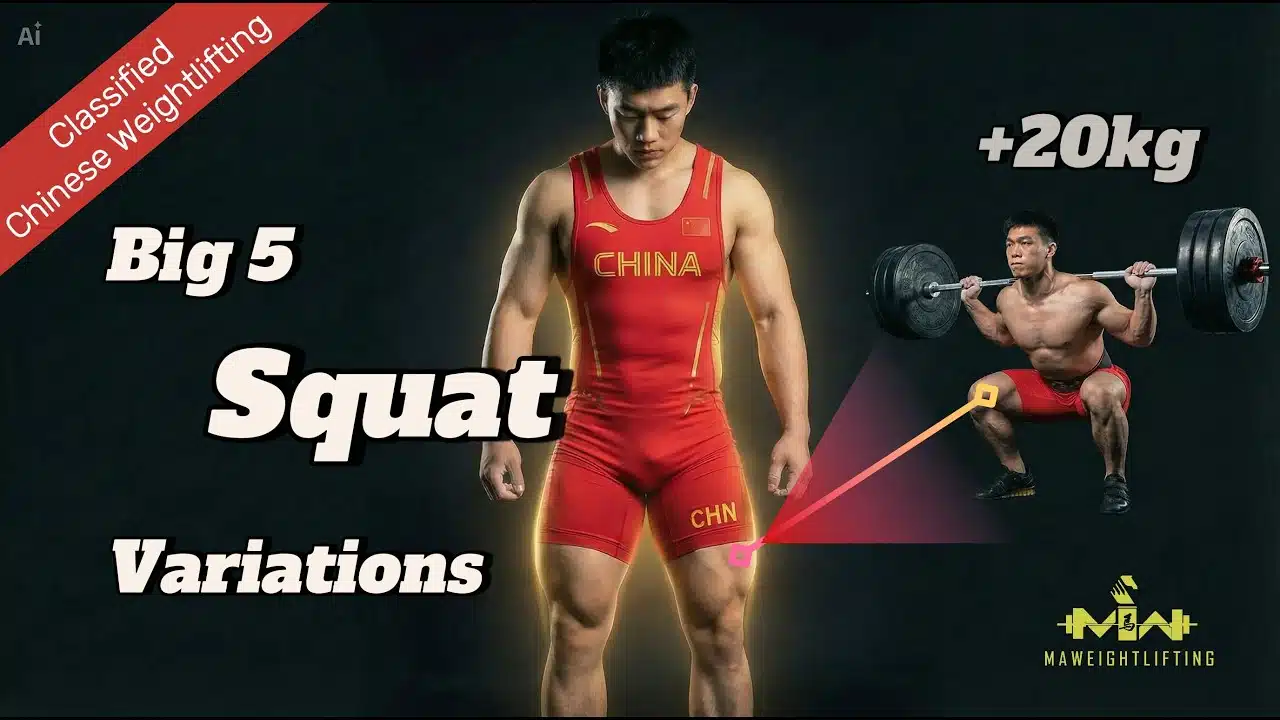
Their advantage comes from refined biomechanics, dialed-in technique, and squat programming that’s been turned into a precise science.
In a recent video, a weightlifting coach broke down the exact system Chinese athletes use—including five critical squat variations, must-do accessories, and programming logic that anyone can apply to develop elite-level leg strength.
Jump to:
The Programming Philosophy That Changes Everything
Before diving into specific exercises, understanding the programming philosophy is crucial for long-term leg strength development.
Chinese weightlifters only squat twice per week. This surprises most people, especially since weightlifting is such a leg-dominant sport.
Many assume athletes would squat daily, but Chinese coaches are conservative on purpose. They squat twice weekly compared to Bulgarian or American programs where athletes squat three or more times per week.
Squatting isn’t the end goal, it’s a helpful tool to improve your snatch and clean and jerk.
Squatting less prevents fatigue, overtraining, and knee injuries. Leg accessories are spread throughout the week rather than crammed into single sessions.
This approach makes sense for athletes—not bodybuilders chasing maximum hypertrophy. Accessories are balanced throughout training to maintain proper energy levels.
Two Critical Macro Cycles
Chinese programming operates on two distinct phases. The pre-competition cycle lasts roughly two months and centers on volume—typically five sets of five reps on squats.
Variations and leg accessories receive maximum attention during this block because athletes can afford spending energy on higher training volumes before transitioning to intensity-focused work.
The competition cycle ramps up intensity. Athletes chase daily maxes, then drop back 10 to 20% for working sets.
The Five Squat Variations Chinese Lifters Swear By
1. Zombie Squats for Upright Positioning
Struggling with chest collapse during front squats or back rounding when catching cleans? Zombie squats solve this problem.
With arms extended straight forward, upper back and core work overtime to maintain upright positioning and prevent the bar from rolling off.
I added this to my workout recently because I have trouble with a rounded back and I absolutely feel the difference.
Perform zombie squats at 70 to 85% of front squat max for three to five reps. Adding a brief hold at the bottom intensifies back and core activation.
2. Motionless Squats for Endurance
Running out of energy halfway through heavy squats isn’t just about lacking strength—it’s about losing tension and endurance.
Motionless squats build this endurance through isometric holds just above parallel for 30 seconds up to one minute. Weight stays light, but tension remains constant.
Widening stance shifts load onto hips. Narrowing stance emphasizes quads. This variation works for both front and back squats.
3. Parallel Squats Target the Sticking Point
The hardest point through any squat is breaking through the bottom around that 90-degree mark.
Without momentum from rebounding out of the hole, parallel squats directly target where most lifters struggle. Loading ranges from 70 to 85% for five sets of three to five reps of max squat.
4. Pause Squats Build Raw Concentric Strength
Pausing at the bottom kills momentum from the stretch reflex that normally assists during squats.
Generating force from nothing is incredibly effective and directly applicable to weightlifting. Pause for three seconds while keeping core braced entirely.
Same loading parameters apply: 70 to 85% for five sets of three to five reps.
5. Speed Squats Develop Explosive Power
Weightlifting is fundamentally a speed sport. Strength without speed means never accelerating the bar high enough.
During the second pull, all speed generates from legs—the primary engine driving bar velocity. Speed squats train fast-twitch muscle output and teach legs to produce force explosively.
In the second pull, all that speed is generated by your legs. It’s our primary engine that drives the speed into the bar.
A useful combination: three-second descent with optional pause, then explode upward as fast as possible. Keep weight light enough—around 70 to 80%—to actually move fast without grinding.
Must-Do Accessories for Strong, Healthy Squats
Ankle Mobility: Chinese athletes stretch ankles before every session without exception. Limited ankle mobility prevents knees from tracking forward, shifting weight backward and causing squat breakdown.
Barbell ankle stretches—one side at a time for one to three minutes—fix this problem more than people realize.
Narrow Squats: After stretching ankles, practice loading knees forward through full range of motion. This quad-dominant movement builds strength and stability in knees. Use light loads for around 10 reps where intensity is felt clearly.
Hip Thrusters: Build hip strength by staying in the range where hips feel loaded and tension doesn’t drop off. Hip extension targets glutes—the driving force behind hip power.
Using glutes together with quads during extension creates faster second pulls.
Core Work: Non-negotiable for building strength. Core work minimum two to three times weekly.
In the Chinese weightlifting halls, I see core work being done almost every day.
Essential exercises include weighted planks, back extensions, and reverse planks.
Honorable mentions: Split squats, pistol squats, leg extensions, and leg curls. Sprinkle these throughout the week to build extra muscle for joint stability and power output.
How to Structure Your Training Week
Application depends on training frequency:
Three Days Per Week
- Day 1: Back squats + one variation + core work
- Day 2: Two leg accessories
- Day 3: Front squats + one variation + core accessory
Four Days Per Week
- Day 1: Back squats + one variation + core work
- Day 2: Two leg accessories
- Day 3: Front squats + one variation + core work
- Day 4: Two leg accessories
Five Days Per Week
- Day 1: One accessory
- Day 2: Back squats + one variation + core work
- Day 3: Two leg accessories
- Day 4: Rest legs
- Day 5: Front squats + one variation + core exercise
Why This Method Works for Athletes
The Chinese method for training leg strength excels for athletes and weightlifters where squatting isn’t the primary goal but rather a tool for developing leg strength and explosiveness.
Unlike powerlifters or bodybuilders, getting bigger legs or stronger squats isn’t the end goal. Athletic performance is.
Spreading leg work throughout the week balances energy levels, prevents fatigue, and maintains healthy knees. Athletes in basketball, hockey, or football benefit from this approach by preserving energy in their legs for sport-specific performance.
It definitely helped shift my perspective in training legs when I started learning like the Starting Strength or 531 method where volume and intensity of the squat felt like too much on top of weightlifting.
This systematic approach prioritizes quality over quantity, allowing athletes to develop elite leg strength without compromising recovery or increasing injury risk—precisely why Chinese weightlifters continue dominating international platforms.