Chris Pratt’s transformation from pudgy sitcom star to intergalactic action hero remains one of Hollywood’s most dramatic physical metamorphoses.
In six months, the Parks and Recreation actor shed 60 pounds and built the kind of physique that makes comic book characters leap off the page.
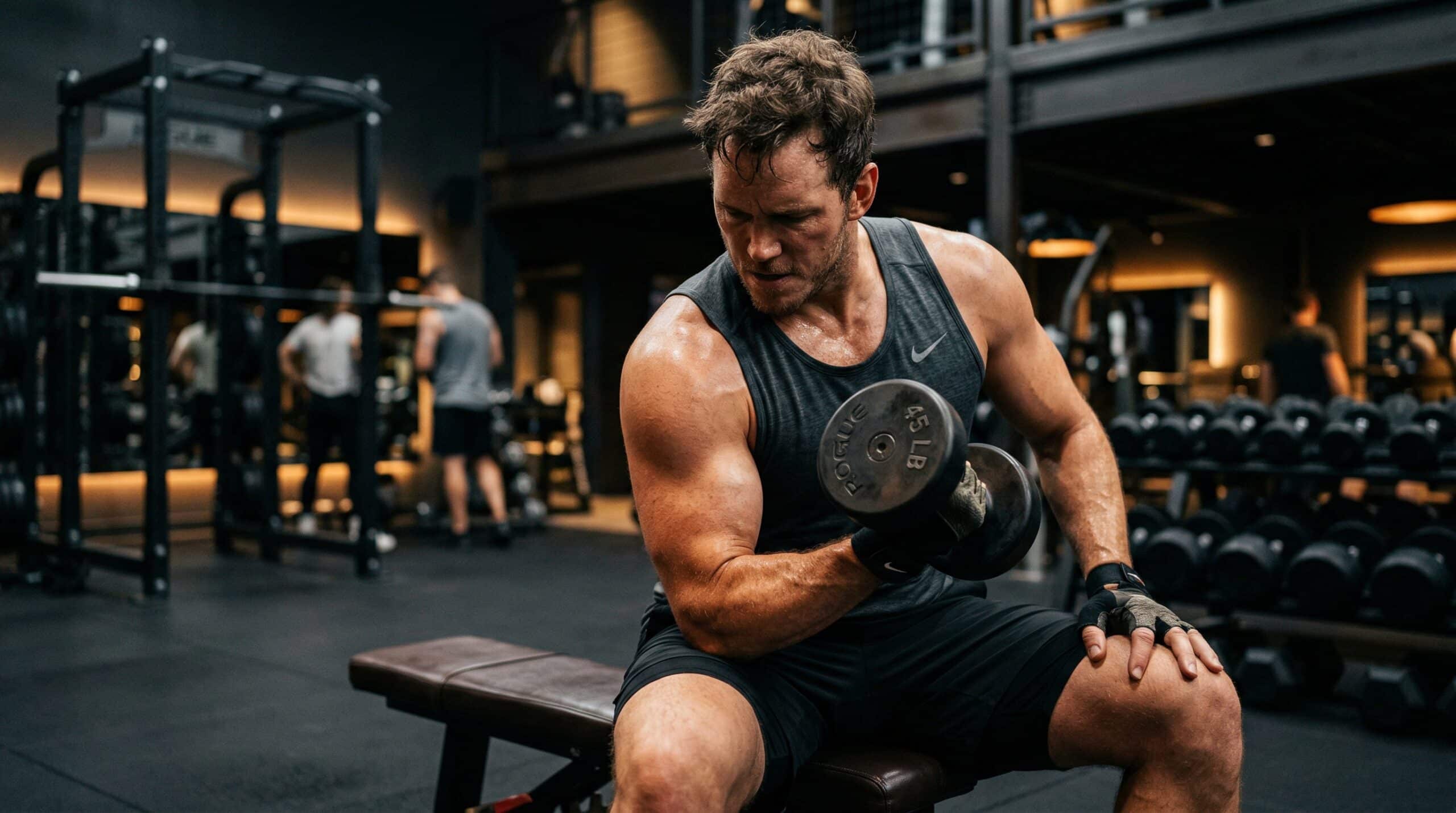
His trainer? Former Navy SEAL sniper Duffy Gaver, who applied military-grade discipline to create Star-Lord.
Here’s exactly how Pratt went from self-described “couch potato” to Guardian of the Galaxy—and what regular people can learn from his grueling journey.
Jump to:
- The Starting Point: 295 Pounds and Zero Athletic Background
- The Training Program: Four Hours Daily, Six Days Weekly
- The Nutrition Protocol: 4,000 Calories of Suffering
- The Timeline: Six Months of Daily Suffering
- Key Exercises From Pratt’s Program
- What Regular People Can Actually Apply
- The Trainer Behind the Transformation
- The Mental Game: Accountability Through Social Media
- Lessons From Star-Lord’s Transformation
The Starting Point: 295 Pounds and Zero Athletic Background
Before Marvel came calling, Pratt had built an entire career on being the lovable, overweight slacker. At 6’2″ and hovering around 295 pounds, he was the walking antithesis of superhero material.
When director James Gunn offered him the role of Peter Quill, Pratt faced a monumental challenge: transform his body while maintaining the comedic timing that got him the part.
Enter Duffy Gaver, whose client roster includes Chris Hemsworth and several other Marvel actors. Gaver understood something critical—Pratt needed functional athleticism, not just gym muscles.
The Training Program: Four Hours Daily, Six Days Weekly
Gaver designed a punishing regimen combining multiple disciplines into marathon training sessions.
The program incorporated Olympic lifting for explosive power, gymnastics work for body control, swimming for cardiovascular capacity and shoulder development, and boxing for coordination. This wasn’t bodybuilding—it was building an actual athlete from scratch.
Olympic Lifting: Building Explosive Strength
Power cleans, barbell back squats, and Romanian deadlifts formed the foundation. These compound movements recruited maximum muscle fibers while teaching Pratt’s body to generate force rapidly—essential for action sequences.
Gaver programmed five sets of five reps on squats with three-minute rest periods, prioritizing strength development over hypertrophy in early phases.
Gymnastics Integration: Movement Quality Over Quantity
Ring dips and pull-up variations developed relative strength—the ability to control bodyweight through space. These movements built the kinesthetic awareness that separates clumsy choreography from fluid action scenes.
Weighted pull-ups progressed from four sets of eight reps to higher volumes as Pratt’s strength-to-weight ratio improved dramatically.
Swimming and Boxing: Conditioning Without Muscle Loss
Traditional cardio can sabotage muscle gain, but swimming builds cardiovascular capacity while developing shoulder width. Boxing sharpened hand-eye coordination while torching calories without the joint stress of running.
These modalities allowed Pratt to maintain a significant caloric deficit without sacrificing the muscle he was simultaneously building.
The Nutrition Protocol: 4,000 Calories of Suffering
Despite consuming roughly 4,000 calories daily during heavy training phases, Pratt described being perpetually hungry. The quality of those calories made the difference.
The hardest part was giving up beer completely.
Pratt’s admission resonates with anyone who’s attempted serious body recomposition—sometimes the psychological sacrifices hurt more than physical training.
Macronutrient Breakdown
Working with nutritionists, Pratt followed a structured approach:
- Protein: Approximately 300-350 grams daily from chicken breast, salmon, eggs, and lean beef
- Carbohydrates: 300-400 grams timed around training sessions for glycogen replenishment
- Fats: 100-120 grams from avocados, nuts, and fatty fish for hormonal health
Alcohol was completely eliminated. Processed foods were minimized. Meal timing synchronized with training to optimize recovery and muscle protein synthesis.
The diet wasn’t just about losing fat—it was engineered to preserve muscle mass during aggressive weight loss while supporting intense daily training.
The Timeline: Six Months of Daily Suffering
Pratt’s transformation timeline was driven by Marvel’s production schedule, making it one of Hollywood’s more compressed superhero metamorphoses.
Starting at approximately 295 pounds with significant body fat, he systematically dropped to 225 pounds with visible abs and upper-body mass that looked convincing on camera.
That’s losing 60 pounds—the weight of an average ten-year-old child—while simultaneously building enough muscle to play an action hero. Mathematically, this required losing roughly 2.5 pounds weekly while gaining lean tissue.
The Reality Behind the Numbers
I woke up sore every single morning, questioning my life choices during particularly brutal sessions.
Pratt’s honesty about the difficulty separates his transformation from typical Hollywood mythology. This wasn’t easy or enjoyable—it was months of disciplined suffering.
He documented progress on social media, turning personal accountability into marketing genius. By the time Guardians of the Galaxy premiered in August 2014, audiences were already invested in the transformation story.
Key Exercises From Pratt’s Program
While the complete program lasted four hours, these movements formed the foundation:
Barbell Back Squat
Five sets of five reps with three-minute rest intervals built leg mass and systemic strength. This movement pattern recruits maximum muscle fibers while triggering hormonal responses favorable for body composition.
Power Clean
Five sets of three explosive reps developed full-body power. Olympic lifting variations teach rate of force development—how quickly muscles generate strength—critical for athletic performance.
Weighted Pull-Up
Four sets of 8-10 reps built the back width and arm development visible in shirtless scenes. Progressive overload came from adding weight rather than increasing reps indefinitely.
Incline Dumbbell Press
Four sets of 10-12 reps emphasized upper chest development, creating the filled-out appearance superhero costumes demand. The incline angle prevents shoulder impingement while maximizing pectoral activation.
Farmer’s Carry
Four sets of 40-meter walks with heavy dumbbells or kettlebells built grip strength, trap development, and core stability simultaneously. This exercise mirrors real-world strength in ways isolated movements cannot.
What Regular People Can Actually Apply
Four-hour daily training sessions aren’t realistic for anyone with employment or family obligations. However, the principles absolutely transfer.
A practical adaptation would involve 60-90 minute sessions four or five days weekly, using the same movement patterns at lower volume.
Realistic Weekly Structure
- Day 1: Lower body strength (squats, Romanian deadlifts)
- Day 2: Upper body push (incline press, landmine press)
- Day 3: Conditioning (swimming, boxing, or interval training)
- Day 4: Lower body power (power cleans, farmer’s carries)
- Day 5: Upper body pull (weighted pull-ups, rows)
This maintains the strength, power, and conditioning emphasis while fitting into normal life constraints.
Nutrition Adjustments for Non-Actors
Pratt’s 4,000-calorie intake supported extreme training volume. Most people attempting similar body recomposition would start with calculated maintenance calories, then adjust based on weekly progress.
The non-negotiables remain: high protein intake (1 gram per pound of target bodyweight), elimination of alcohol during aggressive fat loss phases, and meal timing that supports training intensity.
The Trainer Behind the Transformation
Duffy Gaver’s military background fundamentally shaped his approach. As a former Navy SEAL sniper, he understood that physical preparation must serve functional performance.
Gaver’s client list—Chris Hemsworth, Scarlett Johansson, Brad Pitt—demonstrates his ability to deliver results under Hollywood’s unforgiving timelines. His methodology emphasizes movement quality, progressive overload, and building bodies that can actually perform the stunts they portray.
Unlike trainers who chase pump and soreness, Gaver programs for adaptation—systematic improvements in strength, power, and work capacity that accumulate into dramatic transformations.
The Mental Game: Accountability Through Social Media
Pratt’s decision to document his transformation publicly created external accountability that private training cannot replicate.
Progress photos went viral, turning personal suffering into marketing momentum. By premiere time, the transformation story had become inseparable from the film itself.
This strategy works for regular people too—public commitment increases adherence rates significantly compared to private goals.
Lessons From Star-Lord’s Transformation
Pratt’s journey illustrates several evidence-based principles:
- Dramatic body recomposition requires dramatic commitment—half-measures produce half-results
- Strength training must be prioritized even during aggressive fat loss to preserve muscle
- Nutrition quality matters as much as quantity—4,000 calories of protein and vegetables hits differently than 4,000 calories of processed food
- Multiple training modalities prevent adaptation and build well-rounded athleticism
- External accountability dramatically improves adherence to difficult programs
Perhaps most importantly: the transformation that looks effortless on screen required six months of daily suffering that Pratt openly admits was genuinely difficult.
Sometimes the best superhero origin story isn’t on screen—it’s in the gym at 5am while everyone else sleeps.