In a recent YouTube video, Dr. Ashley Frazer explained why two buzzworthy peptides, retatrutide and tesamorelin, keep appearing in the same conversation.
Both melt fat, yet each takes a totally different route.
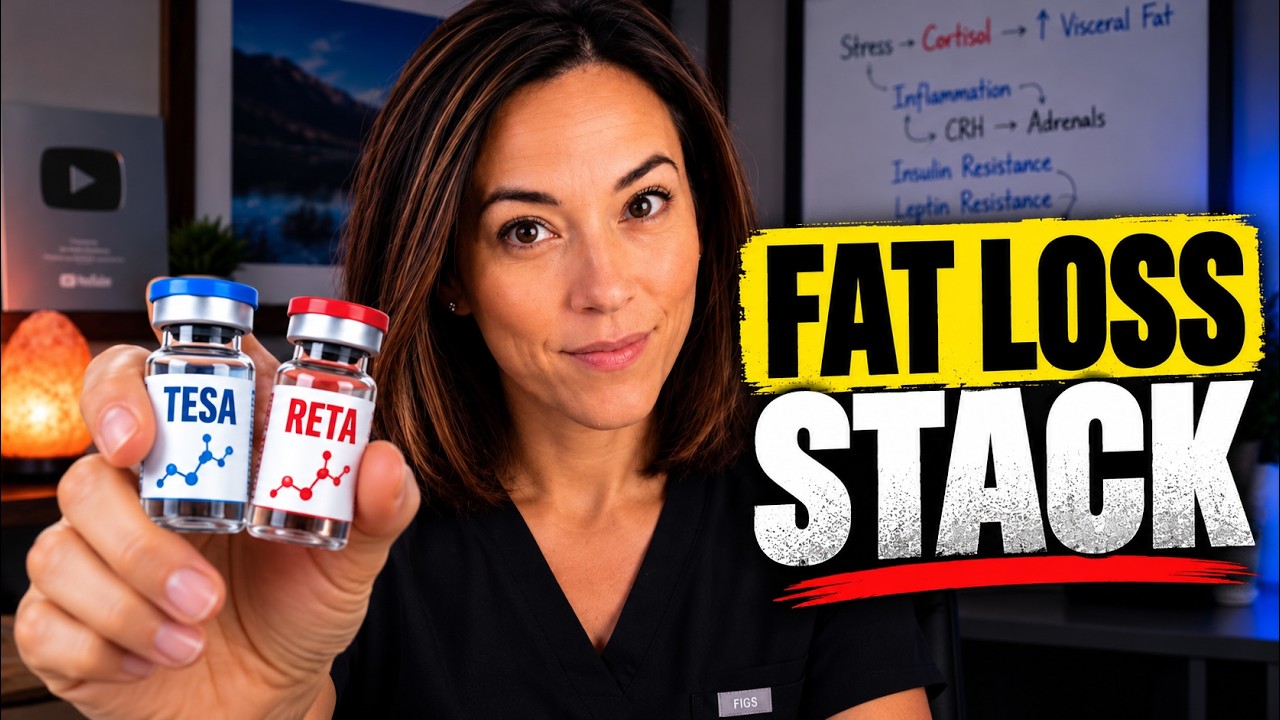
On paper, pairing them looks like a dream team.
Frazer, however, points to one hormone that could quietly sabotage both.
Which hormone is it, and what else should anyone considering this stack know?
Jump to:
Two Fat Loss Tools, Two Very Different Jobs
Doubling up does not automatically mean double the results. Frazer stresses that neither peptide simply “blasts” fat away.
They’re strategic tools, and they work differently.
Retatrutide: The Dimmer Switch
Retatrutide is generating excitement because of what Frazer calls unprecedented fat loss in clinical trials. Its secret is triple receptor action.
- GLP-1: Slows gastric emptying and signals fullness to the brain
- GIP: Improves insulin sensitivity and influences how fatty acids leave fat tissue
- Glucagon: Raises resting calorie burn, even during a deficit
That glucagon piece is the game changer. Frazer says burning extra energy while eating less was unheard of until now.
There is a limitation, though. Retatrutide controls how much energy comes in and goes out, but not where the loss happens.
It is not a lever on where the calories energy and fat get burned. It’s just not very choosy.
That means muscle retention is up to the user.
So, it doesn’t decide whether your body holds on to lean tissue and muscle mass. You decide that.
Myostatin inhibitors are drawing attention as a way to preserve muscle on GLP-1 drugs. Resistance exercise and plenty of protein remain the proven, accessible options.
One reality check: retatrutide is not FDA approved or on the market yet, as Frazer points out.
Tesamorelin: The Spotlight
Here is where targeting enters the picture. Tesamorelin is famous for shrinking visceral fat, the deep belly fat that tends to accumulate with chronic stress and too little movement.
Tesamorelin mimics growth hormone-releasing hormone. Unlike relatives such as sermorelin and CJC-1295, which are fragments, it is a full-length 44-amino acid version, with a lab-made addition that boosts potency.
Why does that matter? Visceral fat is packed with growth hormone receptors. It can also outgrow its blood supply, turning necrotic and inflammatory, which is a big reason it harms health.
Activating those receptors sets off several changes:
- Fatty acid mobilization: Stored fat gets released and burned
- Less inflammation: Growth hormone helps calm inflamed fat tissue
- PGC-1 alpha activation: Triggers new mitochondria, which then leak energy as heat
Tesamorelin is a spotlight. It’s a selective lever. It supercharges visceral fat and changes its identity to become a fat burning furnace.
Frazer adds that both peptides also reduce liver fat. Her verdict on the pairing so far? Pretty complementary.
The Hormone That Could Cancel Both Out
Cortisol is the catch. Visceral fat carries growth hormone receptors, but also a second set that answers to the stress hormone.
Frazer has treated many people on GLP-1 drugs whose bodies seemed to treat eating less as a threat. Some stopped sleeping well, while others caught virus after virus, including repeated shingles.
And all of that to me seems like the body is signaling stress in some way. And with stress comes cortisol release.
Cortisol, she explains, acts as a biological safety net, parking fat around the organs when times get hard. Picture one fat cell receiving two opposite orders.
- Tesamorelin says: burn it and use it
- Cortisol says: emergency, store everything
It’s kind of like trying to drain a bathtub while the faucet’s still running.
Important context: Frazer frames this as a theoretical risk rooted in clinical observation, and she says it herself with the word “theoretically.” No head-to-head trial of this stack was cited, so treat the cortisol conflict as a reasoned hypothesis rather than a proven outcome.
How to Keep Cortisol in Check
Her top suggestion is simple: regular exercise. She has a dedicated video on lowering cortisol for anyone wanting more detail.
Side Effects Worth Knowing About
Frazer lays out risks for each peptide, and several rarely get airtime.
Retatrutide
- GI trouble: nausea, reflux, constipation, or loose stools
- Dehydration, lowered insulin, and low sodium
- Body pain: flares, especially in the knees
- Allodynia: a sunburn-like skin sensation without any sun exposure
Fatigue, headaches, or cramping may hint at a need for extra sodium. Check with a personal doctor first.
Tesamorelin
- Fluid shifts: swelling and tingling in hands and feet, sometimes with carpal tunnel
- Poor sleep: an odd twist, given growth hormone is supposed to support deep sleep
- Allergic reactions: growth hormone-releasing peptides carry a serious risk of anaphylaxis
- Tumor concerns: a theoretical risk of encouraging unknown tumors when growth hormone is influenced
So, Is This the Ultimate Fat Loss Stack?
I mean, kind of. Yeah. But, it helps to know what each of them are doing, and if you’re somebody who has a high cortisol load, it’s important to know that either of them could be canceled out by the cortisol.
Frazer emphasizes that her video is education, not encouragement to buy peptides online. She simply knows people are experimenting anyway.
Regulatory status matters here too. Retatrutide is not yet approved, and tesamorelin is a branded drug with tight restrictions.
Key takeaways:
- Retatrutide adjusts total energy balance but is not selective about where fat or muscle is lost
- Tesamorelin targets visceral fat through growth hormone pathways
- Chronic stress and cortisol may work against both, according to Frazer’s theory
- Exercise, protein, and a doctor’s guidance remain the smartest foundation