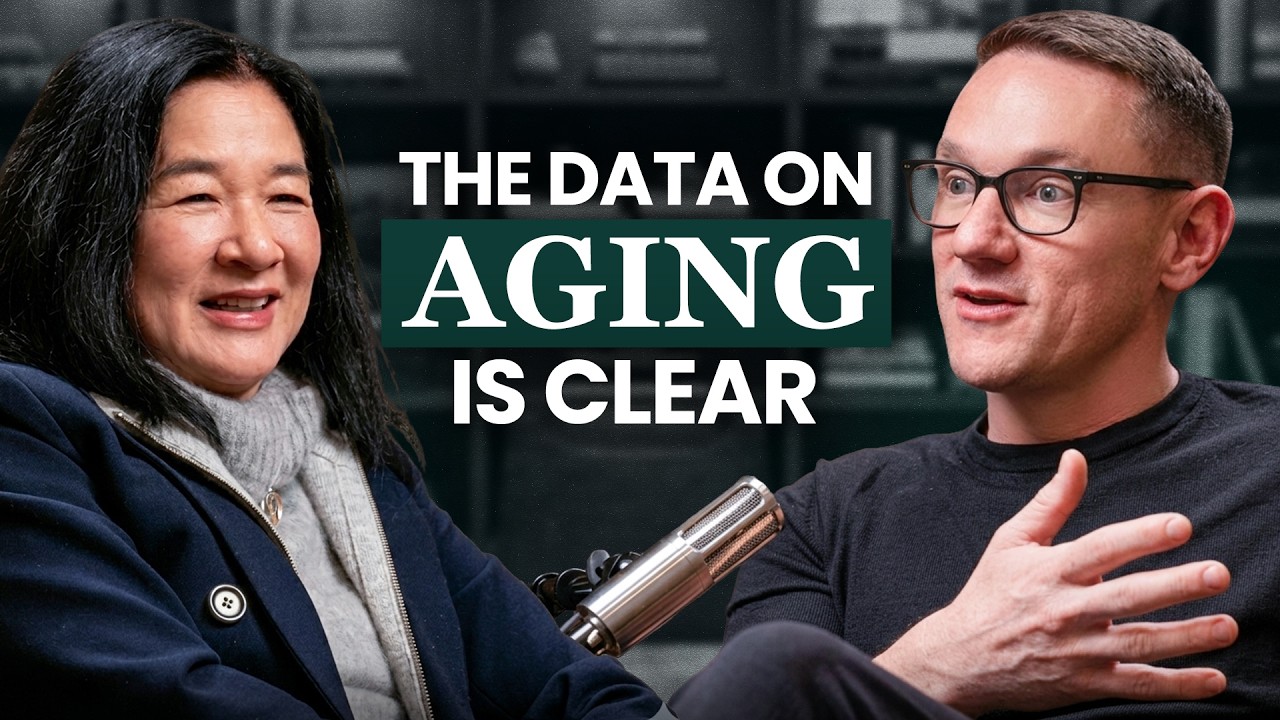
In a recent podcast interview, Dr. Deborah Cardo, professor of medicine and co-director of the Stanford Longevity Center, challenged how most people think about getting older.
Her core idea? Much of what we label “normal aging” may not be normal at all.
She shared why hunched posture might be a red flag for early death.
She also named one trendy longevity supplement she considers wildly overrated.
Read on for the surprising muscle trait she says predicts fractures better than grip strength.
Jump to:
- The 15-Year Gap Between Living Long and Living Well
- Why a Rounded Back Could Be a Warning Sign
- Falls: A Rising Threat After 60
- Power Might Matter More Than Strength
- It’s Never Too Late to Start Training
- Can Medicine Rebuild Bone?
- Bank Bone Early, Protect It Later
- The Most Overrated Longevity Advice
- Underrated Longevity Boosters
- The Bigger Goal: Compress the Bad Years
The 15-Year Gap Between Living Long and Living Well
Cardo pointed to a sobering gap. A baby born today can reasonably expect a 100-year life, yet US life expectancy was 79 as of 2023, while the WHO puts average health span at 64.
That leaves roughly 15 years in less-than-great health.
So, I say health span is not what I’m looking at, I’m looking at healthy longevity.
Her reasoning: health setbacks can strike at any age, but recovery and thriving remain possible. She described cancer survivors who overhauled their diet and activity levels, then looked completely well 15 to 20 years later.
Why a Rounded Back Could Be a Warning Sign
Cardo’s research career began with bone. Early in her fellowship, she studied thousands of older women and found that more vertebral fractures meant a higher chance of dying over the next eight years, whether or not the women knew about them.
Only about one-third of vertebral fractures get diagnosed. Two-thirds of people may be walking around with spinal fractures they never knew about.
Digging deeper, her team looked at spinal curvature, a condition called hyperkyphosis. The more hunched participants were, the sooner they tended to die, often from lung-related causes.
Regardless of the cause, the more hunched over you were, the more likely it was that you were going to be walking slower. You’re going to have a decline in physical function. That you might even fall.
Those findings were replicated in other studies, she said, which strengthens the case that posture is more than cosmetic.
Falls: A Rising Threat After 60
Cardo confirmed that CDC data show fall-related deaths rising since 2000. Trips and falls remain a leading cause of injury-related death in older adults.
She also cited the oft-quoted figure that roughly 25% of people die within a year of a hip fracture. She noted that this number stems from 1980s data and that she hasn’t personally re-examined it, though she believes it has stayed fairly constant.
Power Might Matter More Than Strength
Cardo was especially excited about one observational study of about 2,000 older men, average age 84, who jumped on a force plate. After 10 years of follow-up, power was the most predictive trait for who avoided fractures.
Her co-guest added that power declines two to three times faster than strength.
My take home from the research part is like we should be thinking about power as we would think about muscle.
Her suggestion is a composite benchmark: strength, power, and lean tissue tracked together.
It’s Never Too Late to Start Training
Recalling a small study from around 1990 in the Journal of the American Medical Association, Cardo described frail nursing home residents, roughly 87 to 93 years old, who trained with a coach three times weekly for 12 weeks.
Per her account, they gained major muscle, walked faster, and climbed stairs they previously avoided. She was recalling details from memory, so treat exact figures as approximate.
It just kind of proved the concept that even if you’re late to the party, you can still have a good time and still enjoy substantial increments in function.
Can Medicine Rebuild Bone?
Lifestyle changes help, but reversing low bone density is tough. Cardo says FDA-approved drugs can raise bone density.
- Alendronate (Fosamax) and related bisphosphonates: Available since 1995, these slow bone resorption so formation can catch up.
- Romosozumab: Approved in 2019, this anti-sclerostin antibody is given as two monthly shots for a year. Spine density rose about 12%, with fewer fractures of all types.
Bisphosphonates took a reputational hit around 2008 after high-profile media coverage of rare side effects such as atypical femur fractures. Cardo says some patients were left on the drugs indefinitely, “like a statin,” which is why they aren’t meant to be forever.
In the correct setting, the medications are fantastic.
She also noted that IV bisphosphonate trials hinted at a mortality benefit, though that wasn’t the reason for the drug’s development. Should everyone take them? Osteoporosis expert Steve Cummings argued against it in a professional debate.
As for a hydrogel injected into bone, Cardo says she hasn’t seen human efficacy data yet. A promising concept is not a proven therapy.
Bank Bone Early, Protect It Later
Bone mass peaks around the 30s, then declines. Women see a steep drop at perimenopause and menopause, while men lose bone more gradually.
Cardo compares it to VO2 max: start higher, and you may never reach the fracture threshold, even after a fall.
- Eat well: Fresh fruits, vegetables, and enough protein
- Cover the basics: Adequate calcium and vitamin D
- Train muscle: Strong, flexible, powerful muscles protect bone
- Check the fundamentals: Balance, posture, breathing, and sleep
- Get a medical workup: Some bone loss has causes beyond age
The Most Overrated Longevity Advice
Asked to name it, Cardo answered instantly: NAD, in all forms.
If you look at human trials, they’re for about 24 hours to maybe 3 months and what they all show, and this is why you can buy it, is that guess what? Your blood levels go up.
Her catch? Trials of NAD precursors like NMN and NR show no difference between groups for blood pressure, blood sugar, or muscle function.
Underrated Longevity Boosters
Exercise aside, Cardo’s pick for most underrated: purpose. Her co-guest chimed in with love.
He also described a study linking lower inflammation markers to positive emotions, with awe producing the biggest drop. Cardo pointed to Stanford’s Ali Crum and Yale’s Becca Levy, whose work on mindset and attitudes toward aging shows how outlook can shape outcomes.
On diet, she said her patients aged 95 and older tend to eat something green and fruit daily. Her coffee verdict: drink up, with filtered coffee possibly even better.
The Bigger Goal: Compress the Bad Years
Cardo referenced “compression of morbidity,” a term coined in 1980 by Stanford rheumatologist James Fries. The aim is shrinking time spent in poor health, even if lifespan doesn’t grow.
Exercise is the thing that comes up time and time and again for every single thing we talk about associated with aging.
Cardo agreed: “The evidence is absolutely clear.” She also warned against age-segregated living and favors communities mixing generations and interests.
Quick Takeaways
- Train power, not just strength: Jumps, fast lifts, and explosive movements count.
- Watch posture: Increasing curvature deserves a doctor’s attention.
- Talk to a clinician about bone health: Proven drugs exist.
- Skip the NAD hype: Higher blood levels haven’t translated into measurable benefits.
- Prioritize purpose, connection, and awe: They may matter more than any supplement.