Rowing machines are staples in gyms worldwide, yet most people struggle with proper form.
After a decade of coaching, one fitness expert has discovered a counterintuitive technique that fixes roughly 90% of common rowing mistakes instantly.
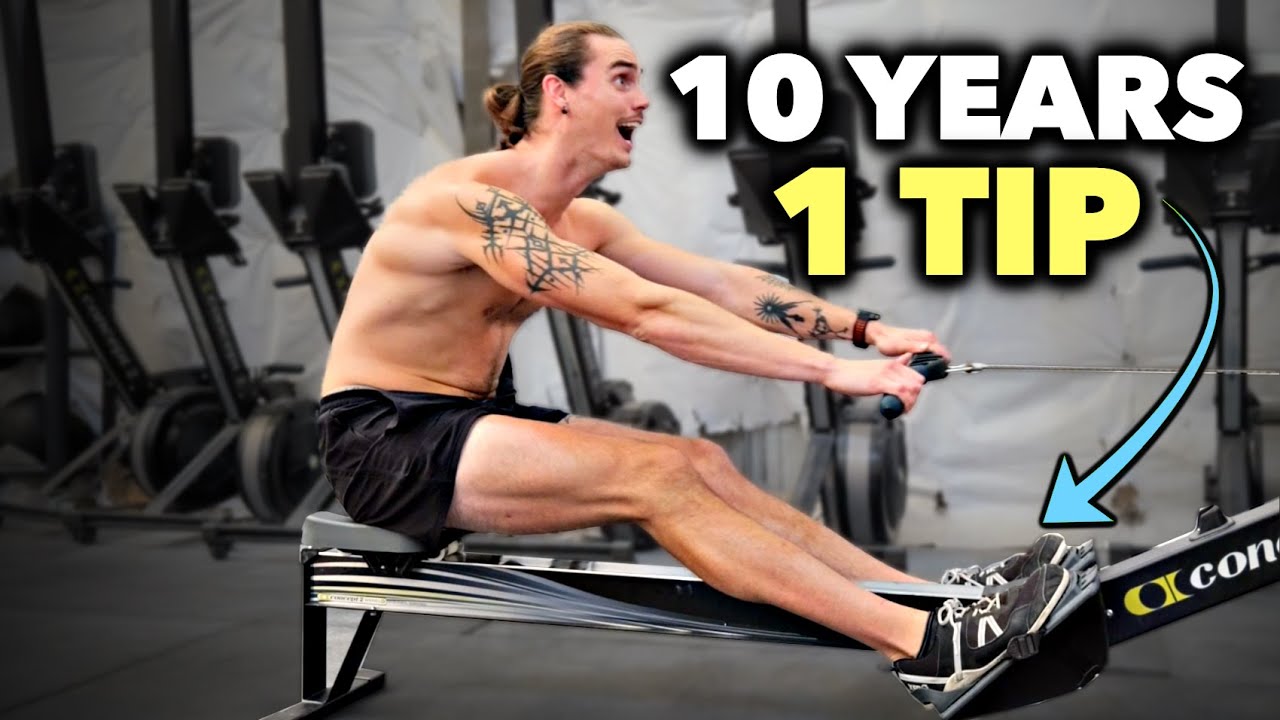
The secret? Unstrap your feet.
While it might sound dangerous, rowing coach and content creator Training Tall explains why removing foot straps during practice sessions transforms technique faster than any other cue.
Jump to:
Why Foot Straps Create Bad Habits
Foot straps serve an important purpose during high-intensity workouts and competitions. They allow rowers to generate maximum power without worrying about stability.
But here’s the problem: beginners rely on them as a crutch.
The problem with these foot straps is while they are great for when it’s race time, when it’s time to really go after it, the thing is when we’re learning to row, we rely way too much on these foot straps and that leads to compensations.
These compensations manifest in several ways:
- Bending knees before the handle clears them
- Leaning back excessively
- Pulling the handle too high toward the neck
- Getting lazy and losing engagement mid-workout
Foot straps mask these technical flaws by keeping you anchored to the machine. Without them, your body receives immediate feedback—and not the pleasant kind.
When you take your feet out of the foot straps, it essentially eliminates any of that from happening. Cuz guess what happens if you lose track of your form? You fly off the rower and that’s not going to feel good.
The Progressive Protocol for Feet-Out Rowing
Simply unstrapping and rowing normally is a recipe for disaster. Training Tall emphasizes starting slowly with a progressive drill sequence.
Start at the Finish Position
Never begin at the catch position (legs compressed, arms extended forward). That’s where most people fall off.
Instead, start with your torso vertical, handle pulled just below your chest. From this stable position, lean back slightly—shoulders behind hips at roughly an 11 o’clock to 1 o’clock angle.
You’ll immediately notice your abs engaging more intensely than usual. That’s the counterforce working through your feet into the footplates—the connection that makes rowing efficient.
Phase One: Arms Only
Spend one to two minutes practicing just the arm portion of the stroke.
Pull the handle below your chest, driving elbows out and back. Keep your shoulders down, legs stationary, and torso fixed.
You will notice as you do this that you feel this small sense of pressure in your feet. And that’s the counterforce of you pulling in, being directed from your feet into the foot plates.
This subtle pressure is what you’re searching for throughout every stroke.
Phase Two: Arms and Body
After mastering arms-only movement, integrate torso lean.
Extend arms, lean torso to vertical, then past vertical as you pull the handle in. Practice this sequence for another minute or two.
The pressure through your feet increases noticeably. That connection indicates proper sequencing—essential for powerful, efficient strokes.
Phase Three: Half Slide
Don’t jump straight to full strokes yet.
Move to the half-slide position: arms extended, body leaning forward, knees partially bent with the handle over your feet (not ankles).
Push, swing, pull. Arms out. Lean past the knees. Bend. Handle over ankles. Push. Swing. Pull.
Feel the connection through the footboards intensify even more. This builds the muscle memory required for full strokes.
Phase Four: Full Strokes
Only after completing the previous phases should you attempt full strokes with feet unstrapped.
By now, you’ve built sufficient awareness of proper foot pressure and sequencing. Your body understands what to do—and what happens if technique breaks down.
Why This Method Works So Effectively
Feet-out rowing doesn’t just improve one aspect of technique. It addresses the root cause of most rowing mistakes: lack of proper connection and sequencing.
Without foot straps, you can’t cheat. Your core must engage fully. Your sequencing must be precise. Your leg drive must connect directly through your feet.
Any lapse in form results in immediate, uncomfortable feedback. This accelerates learning exponentially compared to verbal cues about shoulder blade protraction or hip extension timing.
And what you’re going to find is that this fixes probably about 90% of form mistakes that most people make.
Implementing Feet-Out Rowing Into Your Training
Try this protocol before your next rowing workout as part of your warm-up routine.
Even experienced rowers benefit from periodic feet-out sessions. They reveal compensations that creep in over time, especially during high-volume training when fatigue compromises form.
Start conservatively. Follow the four-phase progression every single session until the movement pattern becomes automatic.
Remember: the goal isn’t to row hard without foot straps. It’s to develop awareness and proper mechanics that transfer when you strap back in for intense workouts.
Once you’ve mastered basic technique through feet-out rowing, you’ll notice dramatic improvements in power output, efficiency, and endurance during regular strapped-in sessions.
Your rowing stroke will feel smoother, more connected, and considerably less exhausting—all from one simple change that costs nothing and requires no special equipment.