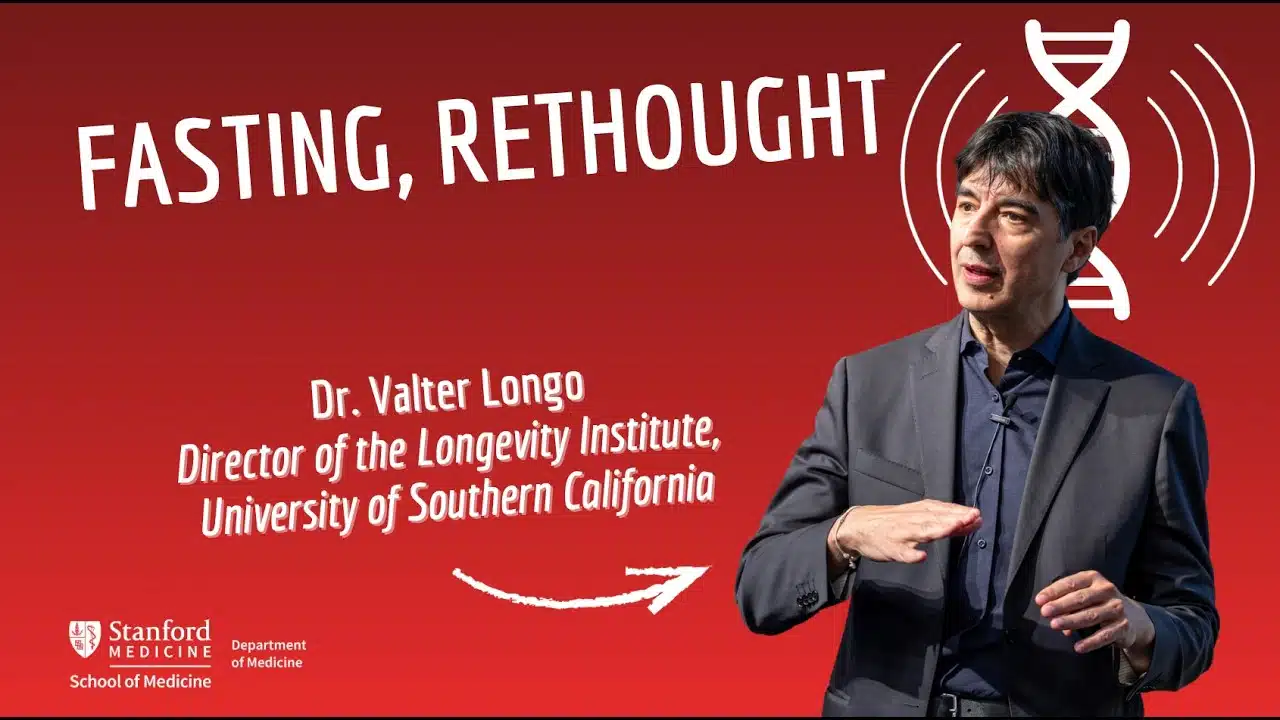
Dr. Valter Longo has spent decades studying what keeps people alive—and what kills them early.
His research at USC’s Longevity Institute has uncovered something remarkable: many popular diet trends praised for short-term benefits may actually shorten lifespan when followed long-term.
That includes ketogenic diets, very low-carb approaches, and even the trendy 16-hour intermittent fasting protocol.
But there’s a fasting approach that does work—one that can reverse cholesterol problems and heart disease markers in just five days per month.
Jump to:
- From Rock Guitarist to Longevity Scientist
- The Worst Career Choice in Science
- The Yeast Breakthrough That Unlocked Human Longevity
- The Biosphere 2 Experiment That Changed Human Nutrition Science
- Five Days Per Month That Reverse Heart Disease
- The Dark Side of Popular Fasting Protocols
- Rethinking Protein: Why Amount Doesn’t Matter
- The 500-Person Trial Results Are Coming
- What This Means for Your Health Today
From Rock Guitarist to Longevity Scientist
Longo’s path to becoming one of the world’s leading aging researchers wasn’t conventional.
Growing up between Genova and Calabria in Italy, he moved to Chicago at 16 with dreams of becoming a rock star. He spent years touring Rush Street’s blues clubs at night, guitar in hand, taking the “L” train through dangerous neighborhoods.
I wanted to be a rock star, right? That’s for sure. I told my parents when I was 12 I wanted to go to London.
He attended the University of North Texas—then the leading jazz program in the US—studying under bebop musicians and training to blend jazz sophistication with rock performance.
But when the music school required him to direct the marching band during his second year, Longo made a pivotal decision. He switched his major to biochemistry.
A Childhood Memory That Changed Everything
The switch wasn’t random—it was driven by something that had haunted him since age five.
As a five-year-old, just seeing somebody dying in the room, my grandfather, thinking this has got to be the most important thing that I can do: figure out why people die.
That memory, combined with noticing his Italian relatives in Chicago developing diabetes and cardiovascular disease—conditions he never saw back in Italy—sparked his interest in nutrition and longevity.
Even his biochemistry professor doubted him initially, but Longo found the coursework easier than music school’s brutal demands.
The Worst Career Choice in Science
By the late 1980s, studying aging was considered career suicide in academic science.
Longo joined UCLA to work with Roy Walford, a pioneer in caloric restriction research. But the field was so stigmatized that researchers wouldn’t even admit what they studied.
They would ask us in biochemistry, ‘What are you working on?’ We wouldn’t say aging, right—being embarrassed. We’d say, ‘Oh, free radical biochemistry.’
Longo made it worse by choosing to study starving yeast—not the replicative lifespan everyone else measured, but chronological aging in nutrient-deprived cells.
He was literally the only person on Earth studying aging that way. Even fellow yeast researchers mocked him.
Why the Scientific Community Dismissed Aging Research
The prevailing view was simple: if you want to help humanity, focus on concrete diseases—heart disease, cancer, atherosclerosis.
Aging seemed too amorphous, too complicated, too diffuse. What measurable outcome could you possibly achieve?
Longo even considered abandoning his PhD for a biotech lab job. The outlook seemed that bleak.
Then everything changed.
The Yeast Breakthrough That Unlocked Human Longevity
Studying chronological aging in yeast gave Longo unprecedented genetic power.
While researchers working with mice needed years or decades to create triple mutants, Longo could produce them in weeks using UCLA’s extensive yeast strain library.
The discoveries were stunning:
- Amino acid pathway mutation extended yeast lifespan 3x
- Sugar pathway mutation extended lifespan 2x
- Both mutations combined extended lifespan 5x
- Both mutations plus starvation extended lifespan 10x
But here’s what made it revolutionary: yeast have three distinct aging modalities.
In post-diauxic phase, they live about four days. In stationary phase, three weeks. In spore state, they live two years—a hundredfold lifespan difference in genetically identical organisms.
That’s a trick that’s already there. So I could biohack my way to the spore, or learn—can I get a spore that’s high metabolism?
Three Billion Years Beats Silicon Valley Biohacking
Longo’s philosophy cuts against current biohacking trends.
When you cut yourself, your body repairs it perfectly within weeks—that’s three and a half billion years of evolution at work.
How long would it take to biohack your way to that level of sophistication? Decades? Centuries?
Even with AI and unlimited computing power, replicating what evolution has already perfected remains extraordinarily difficult.
The Biosphere 2 Experiment That Changed Human Nutrition Science
While Longo was discovering lifespan-extending pathways in yeast, his mentor Roy Walford was locked inside Biosphere 2.
Eight people sealed in an Arizona dome meant to simulate a Mars station. They were supposed to grow their own food for two years.
Within months, everything went wrong. Bacteria degraded cement, oxygen levels dropped, and food production fell short.
Walford—conveniently the world’s leading expert on caloric restriction—suggested a solution: eat less.
Dramatic Results, Disturbing Appearance
The first human caloric restriction study produced extraordinary biomarker improvements—cholesterol, blood pressure, and blood sugar all dropped dramatically.
But Longo noticed something troubling when he looked at the participants: they appeared thin and stressed, despite perfect lab results.
This observation proved prophetic. Years later, Richard Weindruch’s 30-year monkey study on caloric restriction revealed the same pattern—significant benefits, but also serious problems, without substantial lifespan extension.
Chronic calorie restriction wasn’t the answer.
Five Days Per Month That Reverse Heart Disease
Combining insights from yeast genetics and human caloric restriction trials, Longo developed a revolutionary approach: the Fasting Mimicking Diet (FMD).
Instead of chronic restriction, what if people fasted for just five days every few months—but consumed specific foods that mimic fasting’s cellular effects?
The yeast work had already identified which nutrients block the fasting response: amino acids and sugars.
Eliminate those, and you’re left with a low-sugar, low-protein, high-healthy-fat diet based on foods from longevity blue zones—Okinawa, Sardinia, and southern Italy.
The Mouse Study That Defied Everything
In one experiment, Longo’s team fed mice the worst possible Western diet—high fat, high sugar, high calorie. The mice became obese.
Another group received the same terrible diet for 25 days per month, then five days of FMD.
The bad diet normally cut lifespan almost in half. But five days monthly of FMD completely reversed cholesterol problems, heart disease markers, and high blood sugar.
Five days a month completely reversed everything—the cholesterol, the heart problem—and we didn’t think it was going to be that much better.
The FMD group’s lifespan returned to statistically normal—nearly identical to mice on a continuously healthy diet.
Why It Works: Metabolic Switching
The FMD appears to trigger a metabolic modality switch that persists beyond the five-day period.
Even in the middle of the bad diet period, ketone bodies remained elevated and fat cells showed active mitochondrial biogenesis—signs of continued fat burning despite abundant food availability.
Think of emperor penguins sitting on eggs for two months without food, or grizzly bears preparing for hibernation. Evolution has programmed bodies to switch between feeding and fasting states—and stay there.
The Dark Side of Popular Fasting Protocols
While five-day monthly fasting shows remarkable promise, Longo warns that trendy daily fasting protocols may be dangerous long-term.
The 16-hour intermittent fasting approach—wildly popular for weight loss—is associated with doubled cardiovascular mortality in meta-analyses.
Ketogenic diet short-term is good, long-term it kills you early. The 16-hour fasting short-term is good. Long-term it kills you early. Very low carb diets. Short-term is good. Long-term it kills you.
The Breakfast Skipping Paradox
Multiple epidemiological studies consistently show breakfast skippers have increased overall mortality and cardiovascular risk—not a small increase, but a doubling of cardiovascular death.
Some argue this reflects overall unhealthy lifestyles. But Longo asks a compelling question: if 16-hour fasting were truly beneficial, wouldn’t it at least bring high-risk people back to normal mortality rates?
Instead, the association remains consistently negative across multiple large studies.
Meanwhile, 12-hour time-restricted eating—which used to be considered normal eating—shows benefits without mortality associations.
Rethinking Protein: Why Amount Doesn’t Matter
While health influencers push high-protein diets for muscle building, Longo’s research points in a different direction.
Looking across epidemiology, centenarian populations, clinical trials, and animal studies, the evidence supports low-but-sufficient protein—enough to prevent malnutrition, but not excessive amounts.
But “protein” as a number may be meaningless.
It’s About Amino Acids, Not Protein Grams
Longo’s upcoming research shows essential amino acid content varies three- to four-fold between protein sources—legumes versus fish, for example.
One gram of protein could effectively be one gram or four grams, depending on how well the amino acid profile matches human essential amino acid requirements.
The strategy: provide essential amino acids matched to individual frailty levels, without excess.
Yes, higher protein intake supports short-term muscle gains during resistance training. But like ketogenic diets and 16-hour fasting, short-term benefits don’t guarantee long-term health.
The 500-Person Trial Results Are Coming
Longo recently completed a 500-person trial in southern Italy testing the FMD in obese and overweight people with at least one risk factor—high blood pressure, high cholesterol, or elevated blood sugar.
Three groups:
- Control group: no intervention
- FMD group: five-day fasting mimicking diet every three months
- Full intervention group: “longevity diet” with 12-hour time-restricted eating, mostly vegan/pescatarian eating, plus quarterly FMD
The trial measured roughly 100 different biomarkers, including cholesterol, inflammatory markers, epigenetic clocks, and telomere length.
Results haven’t been published yet, but they’re coming soon.
What This Means for Your Health Today
Longo’s decades of research point toward a clear strategy:
- Avoid chronic caloric restriction—it produces good biomarkers but may cause long-term problems
- Be cautious with 16-hour daily fasting—epidemiological data consistently shows increased mortality
- Consider 12-hour time-restricted eating instead—benefits without apparent risks
- Try periodic fasting mimicking diets—five days every few months may reverse metabolic dysfunction
- Base everyday eating on longevity blue zones—Mediterranean-style diets rich in plant foods, healthy fats, and fish
- Focus on essential amino acids, not total protein—quality matters more than quantity
The key insight: your body evolved over billions of years to switch between fed and fasted states. Modern eating patterns that keep you constantly fed—or protocols that fast too aggressively—may both disrupt this ancient metabolic wisdom.
As Longo puts it, three and a half billion years of evolution has created repair mechanisms so sophisticated that a cut heals perfectly in weeks. Rather than trying to biohack our way to longevity, perhaps we should work with those evolved systems instead of against them.