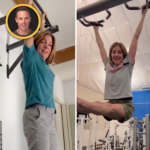
When 63-year-old April Nading decided to challenge herself to dead hang every day for a month, she did so with one goal in mind: decompressing her spine.
She’d been dealing with a tingling sensation in her leg and toes caused by an issue with her spinal discs for almost a year.
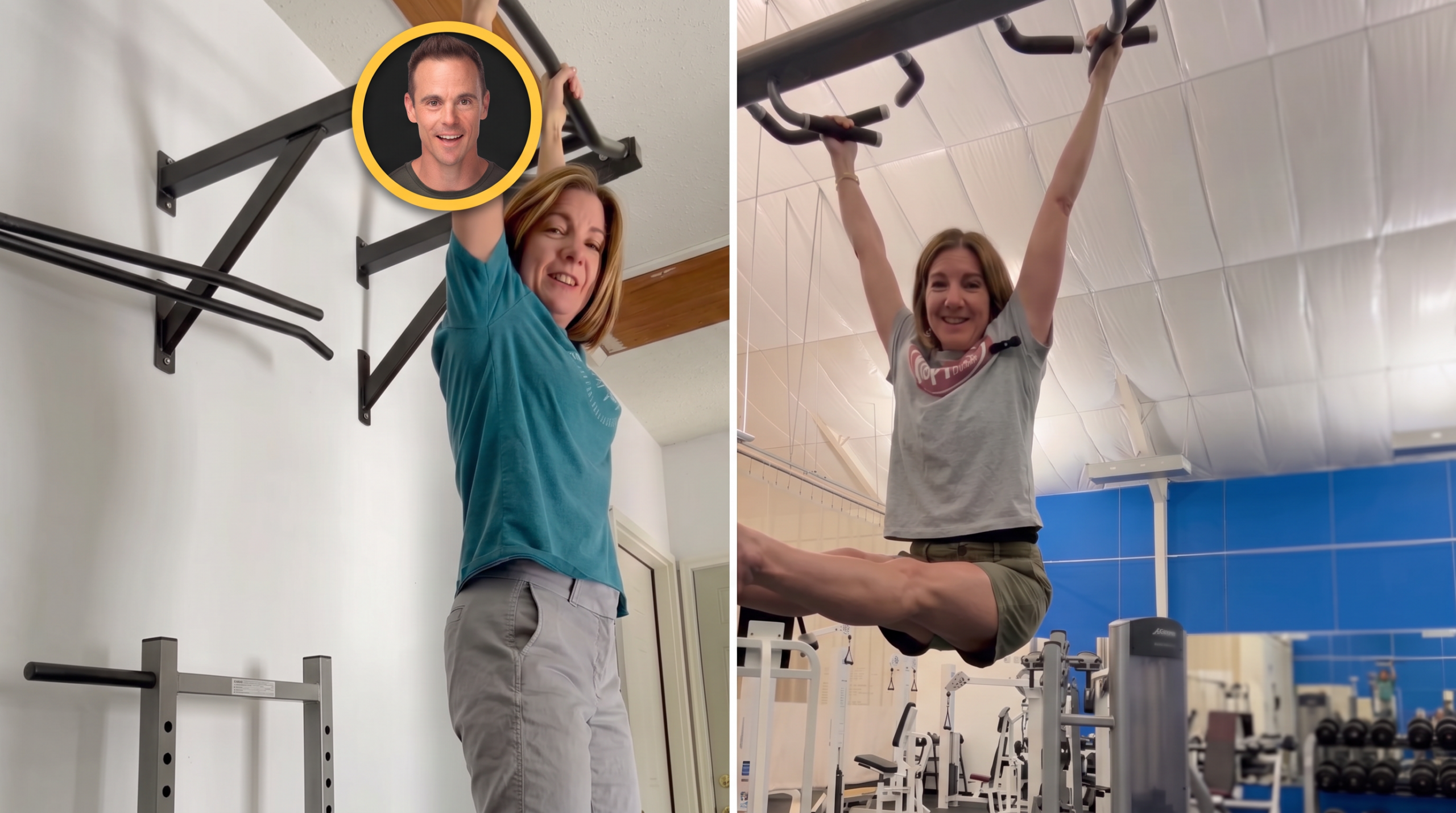
So when a chiropractor mentioned that dead hanging might help, she decided to give it a go.
One month on, and Nading has increased the amount of time she’s able to hang and decided to keep up her new habit—and it’s not just because her symptoms have improved.
Jump to:
Three Major Changes After 30 Days of Dead Hangs
1. Her Shoulders Became More Mobile
Before starting the challenge, Nading had a “slight pinch” in her shoulder and left elbow. By the end of 30 days, all of that discomfort had vanished.
Dead hangs move the shoulders into flexion—a position they rarely experience during day-to-day activities. This unusual range of motion can lead to improvements in overall shoulder flexibility and mobility.
The passive stretch created by hanging allows the shoulder joint to decompress while gently lengthening the surrounding muscles and connective tissue.
2. The Tingling in Her Leg and Toes Got Better
While dead hanging every day for a month hasn’t completely eliminated Nading’s tingling, she says it’s definitely helped—which is one reason why she plans to keep hanging daily.
I’m happy to report that after a month of dead hanging, the tingling in my leg is better. It’s not completely gone, but it’s not as intense or as frequent as it was before I started dead hanging, and I’m hoping it will keep improving with continued hang time.
The improvement likely stems from how hanging can relieve pressure within the spine. Strength and conditioning coach Andy Vincent explains that hanging from a bar allows your spine to elongate with gravity, potentially relieving pressure on vertebrae and discs.
This decompression can alleviate back pain and improve overall spinal health. Nading also noticed that a “tweak” she experienced in her lower back during some yoga poses seems to have gone, which could be related to this spinal decompression effect.
3. She Feels Much Stronger—And Her Muscles Are More Defined
Dead hanging doesn’t just affect your shoulders. It can work and build strength across your upper back, arms, and core too.
This was one of the biggest benefits Nading noticed throughout her challenge.
The more I did it, the stronger I got. Now I can hold for 90 seconds, and I’m a lot stronger than I was before I started. My arms are also more defined!
Her grip strength improved dramatically as well. At the beginning of the challenge, she needed gloves to hold onto the bar, whereas by the end she could hang without them for 90 seconds.
I do have callouses on my hands as a result of hanging—something I’ve never had in my life, and I’m actually kind of proud of. Monkey bars have also gotten easier—I can swing from one bar to the next without pausing!
The Science Behind Dead Hangs
Dead hangs are a deceptively simple exercise that delivers multiple benefits simultaneously.
When you hang from a bar, gravity naturally creates traction on your spine, separating the vertebrae slightly and reducing compression on the discs. This can be particularly beneficial for people experiencing nerve compression or disc-related issues.
The exercise also engages muscles throughout your upper body. Your shoulders, lats, forearms, and grip muscles all work to support your body weight.
Even your core gets involved, working to stabilize your body and prevent excessive swinging.
How to Do a Dead Hang Correctly
Want to start your own dead hang challenge? Proper form is essential for getting results and avoiding injury.
Step-by-Step Instructions
- Find or set up a bar. Make sure it’s secure and can support your full body weight.
- Grip the bar using an overhand grip (palms facing away from you). Your hands should be shoulder-width apart or slightly wider for comfort.
- Don’t jump into position. Set up so you can simply take your feet off the floor or a block, getting into position without excessive swinging.
- Exhale fully to engage your core. Squeeze your glutes, tuck your tailbone, and relax your shoulders. Keep your ribcage down and pelvis slightly tucked to prevent spine hyperextension.
- Maintain steady breathing. Avoid exaggerated swinging—a little movement is normal.
- Hold the position until you feel your shoulders and neck beginning to tense excessively.
Starting Out: Duration and Progression
If you’re new to dead hangs, don’t expect to hold for 90 seconds right away. Start where you are and build gradually.
Beginners might only manage 10-15 seconds initially, and that’s perfectly fine. Focus on maintaining proper form rather than duration.
As you build strength and endurance, you can gradually increase your hanging time. Nading’s progression from needing gloves to hanging for 90 seconds without them demonstrates what’s possible with consistent practice.
Equipment You’ll Need
You’ll need somewhere to hang from, but a pull-up bar is relatively inexpensive and makes a valuable addition to your home fitness setup.
Several options work well for dead hangs:
- Wall-mounted pull-up bars provide the sturdiest option and can support the most weight
- Doorway pull-up bars offer convenience and portability without requiring installation
- Free-standing power racks give you versatility for multiple exercises beyond just hanging
- Outdoor equipment like playground bars or park fitness stations work perfectly if you prefer exercising outside
Who Should Try Dead Hangs?
Dead hangs can benefit nearly anyone looking to improve upper body strength, grip strength, or spinal health.
They’re particularly valuable for people who sit for long periods, as hanging counteracts the forward shoulder position many desk workers develop.
However, if you have shoulder injuries, rotator cuff issues, or certain spinal conditions, consult a healthcare provider before starting a dead hang practice. While hanging can be therapeutic, it’s not appropriate for everyone.
Making Dead Hangs a Habit
Nading’s success came from consistency—hanging every single day for a month. That daily practice allowed her body to adapt and her strength to build progressively.
You don’t need to hang for long periods to see benefits. Even short, frequent hangs throughout the day can yield results.
Try hanging for 10-20 seconds multiple times daily if you work from home, or dedicate a few minutes to hanging practice as part of your regular workout routine.
The key is making it a regular practice rather than an occasional effort.
Beyond Basic Dead Hangs
Once you’ve mastered the basic dead hang, several progressions can add variety and challenge:
- Active hangs: Engage your shoulders by pulling them down and back while hanging
- Scapular pull-ups: From a dead hang, pull your shoulder blades down and together, lifting your body slightly
- Knee raises: While hanging, raise your knees toward your chest to add core work
- L-sits: Hold your legs straight out in front of you at a 90-degree angle while hanging
- One-arm hangs: Advanced practitioners can work toward hanging from one arm at a time
These variations keep your practice interesting while continuing to build strength and mobility.
What to Expect From Your Own Challenge
Results vary based on your starting fitness level, consistency, and individual body mechanics. However, most people who commit to daily dead hangs notice improvements in grip strength, shoulder mobility, and upper body endurance within a few weeks.
You might experience hand discomfort or callouses initially, especially if you’re not used to gripping activities. This is normal and typically becomes more manageable as your hands adapt.
For spinal issues, results are less predictable. While many people report reduced back discomfort and improved posture from regular hanging, individual experiences vary significantly depending on the specific condition involved.
Nading’s experience shows that even at 63, building new strength and habits is entirely possible. Her journey from needing gloves to hanging comfortably for 90 seconds demonstrates what consistent effort can achieve—regardless of age.