A recent deep-dive video has turned conventional wisdom about neck training completely upside down.
Fitness content creator and coach breaks down why avoiding neck exercises might actually be making things worse, not better.
Backed by extensive research including studies on thousands of subjects, the analysis challenges three major myths that keep people from strengthening this critical muscle group.
And the findings reveal that most concerns about injury, sleep apnea, and worsening existing pain are completely unfounded.
Jump to:
The Sleep Apnea Myth Debunked
Massive studies involving tens of thousands of subjects have linked larger neck circumference to sleep apnea. But there’s a critical flaw in most of this research.
Many studies didn’t actually measure sleep quality objectively. Instead, they relied on questionnaires asking subjects if they felt tired during the day.
They just gave them a questionnaire that asked, “Do you feel tired during the day?” And if they said yes, congratulations, you have sleep apnea.
Even legitimate sleep lab studies reveal something important: people with larger necks who have sleep apnea also tend to carry significantly more fat around their airways.
Fat Deposits, Not Muscle, Are the Problem
Research shows that obstructive sleep apnea sufferers have considerably more fat anterior lateral to the airway compared to BMI-matched counterparts without the condition.
Even lean individuals with sleep apnea possess larger parapharyngeal fat pads than lean people without the disorder. The culprit isn’t muscle mass—it’s adipose tissue.
Looking at neck anatomy makes this abundantly clear. The platysma is extremely thin and responsible primarily for facial expressions. Even tripling its size wouldn’t create airway compression.
Where Neck Muscles Actually Sit
The sternocleidomastoid (SCM) originates from your clavicle and sternum, wrapping around to behind your ear. It sits nowhere near your airway.
Scalene muscles originate on cervical vertebrae and attach to your first and second ribs. Again, they bypass the airway entirely.
The trapezius, despite its impressive size, sits on the posterior neck. Also not a concern.
Moral of the story, increasing the size of any of those is not going to add any compression to your airway.
Deep cervical flexors are type-one dominant stabilizers with architectural design similar to rotator cuff muscles. They exist to hold structures in place, and they’re resistant to hypertrophy even with direct training.
Interestingly, therapy centered around training these muscles for sleep apnea has been shown to cut apnea-hypopnea index scores in half.
Neck Pain Doesn’t Mean You Should Avoid Training
Conventional advice suggests taking it easy with any disc herniation or bulge. Maybe perform some chin tucks occasionally and hope for improvement.
Research involving MRI imaging of thousands of completely pain-free necks tells another story entirely.
By age 40, two-thirds of people show some disc degeneration. By age 60, that number jumps to 90 percent.
Translation: your “dysfunctional” MRI isn’t necessarily the source of pain. It’s often just a sign of aging.
Loading Problems, Not Structural Issues
Chin tucks have their place, particularly for peripheral radicular nerve pain that feels like lightning running down your arm. This motion creates space in the foramen, relieving compression.
But the majority of neck issues stem from a loading problem. Neck muscles simply can’t handle the constant mechanical stress placed upon them because they’re weak.
Central sensitization may also play a role—when your central nervous system gets stuck in heightened alert, even minor neck tweaks trigger intense pain responses.
Whether you developed altered muscle activation patterns that led to pain, or experienced acute injury that changed your movement patterns, the solution remains identical: identify major movement patterns and actually train the supporting muscles.
One study comparing 180 women found that strength training produced significantly better outcomes than endurance work or stretching for neck pain relief.
How to Train Your Neck Properly
Research using robotic spine testing apparatus on cadaver specimens provides exceptional insight into optimal neck training protocols.
Flexion Training: Form Is Everything
The SCM muscles dominate flexion movements. Most people get the form completely wrong by tilting their chin down toward their chest, which primarily trains deep cervical flexors instead.
The correct approach: lead with your chin. Think about raising your face upward while keeping your neck engaged.
Pretend like you’re at a strip club and there’s a nice lady dancing above you who’s a little past her prime and obviously had a few kids because of the length of her nipples and you’re a gentleman, so you’re going to keep your hands to your side, but you’re going to try to get that face as close to her starfish as possible.
Programming should include two approaches:
- Full range of motion flexion starting from neutral or slightly extended position
- Isometric holds at neutral especially for those experiencing pain or movement restriction
Strength gains from isometric training carry over 15 to 30 degrees past the trained position.
Progressive Flexion Protocol
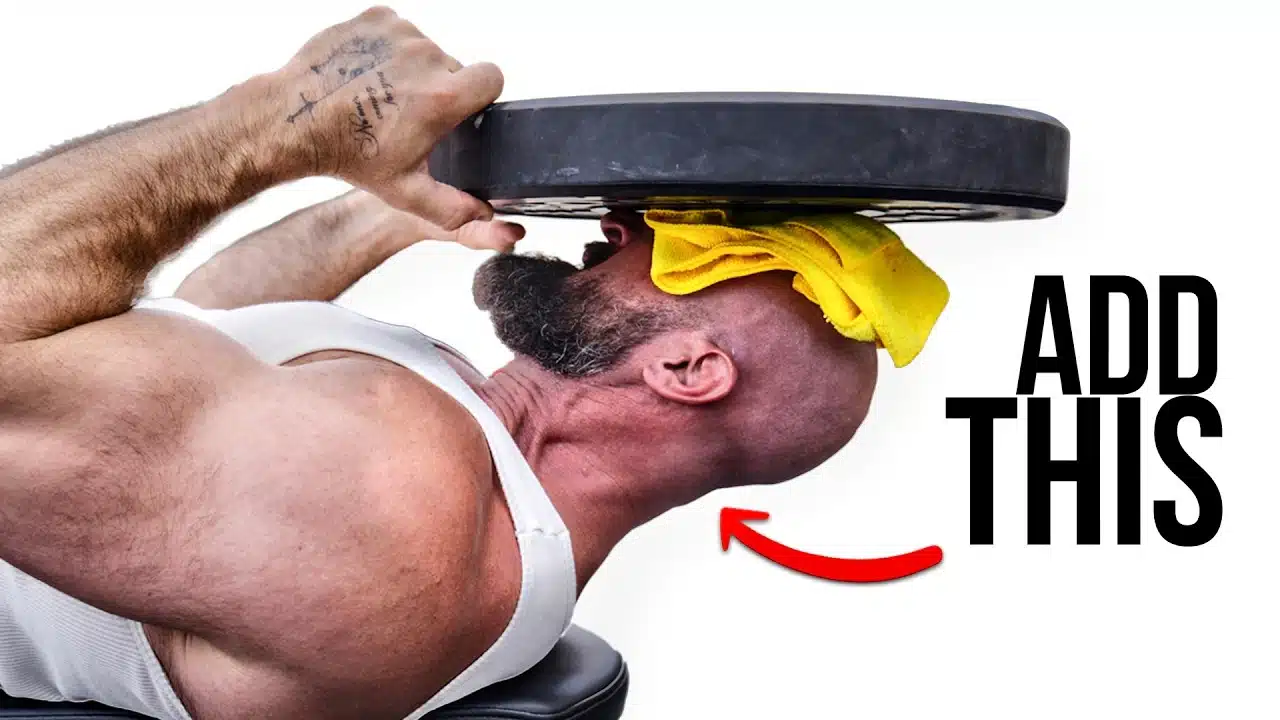
- Bodyweight on bench, head off edge, leading with chin
- Band resistance around head, same form
- Plates on head or cable-based setup
- Isometric holds: 5 seconds max effort, three to five sets
Those dealing with significant dysfunction should start with isometric band work and progress gradually.
Extension: Upper and Lower Cervical
Both upper and lower cervical extension require attention. Forward head posture creates chronically shortened, weak muscles that need loading through full range of motion—not just stretching.
For upper cervical extensors, using resistance bands while forcing lower cervical muscles into isometric contraction works exceptionally well. Focus on movement at the atlanto-occipital joint without letting your chin drive forward.
Lower cervical extension splits into two categories: progressive overload with restricted range (for safety when using heavy loads) and full range of motion work.
Setting up on a bench prevents compensating with shoulders. Pull from deep flexion to neutral for safe overload. For full extension work, lying face-down with head off the bench provides optimal resistance curve matching.
Lateral Flexion Without Compensation
Most people raise their shoulder toward their ear when performing lateral flexion. Lying on your side eliminates this compensation pattern.
Important: bend the entire cervical column and avoid chasing exaggerated range of motion. Most people have only 40 to 45 degrees of lateral flexion, less with age.
Rotation: The Missing Link
When turning your head left, your right trap and SCM contract on the contralateral side. On the ipsilateral side, your splenius capitis, rectus capitis posterior major, and obliquus inferior engage.
Most rotational training tools provide only isometric contraction, not full range of motion loading. Using an inexpensive karate belt attached to a cable system solves this problem.
Seated position prevents compensations. If your left side faces the cable, you’re working right rotations. Turn head left, wrap strap around right side, maintain square shoulders throughout the movement, and rotate smoothly.
Your shoulders stay square the entire time, and you rotate.
Train both sides equally to maintain balance and prevent developing new dysfunctions.
Don’t Neglect Upper Traps
Superior trap fibers run vertically and require unilateral work for proper development. Avoiding upper trap training can lead to functional weakness despite aesthetic concerns.
Incorporating these protocols systematically addresses the major movement patterns while building resilient, pain-free neck musculature capable of handling daily demands.