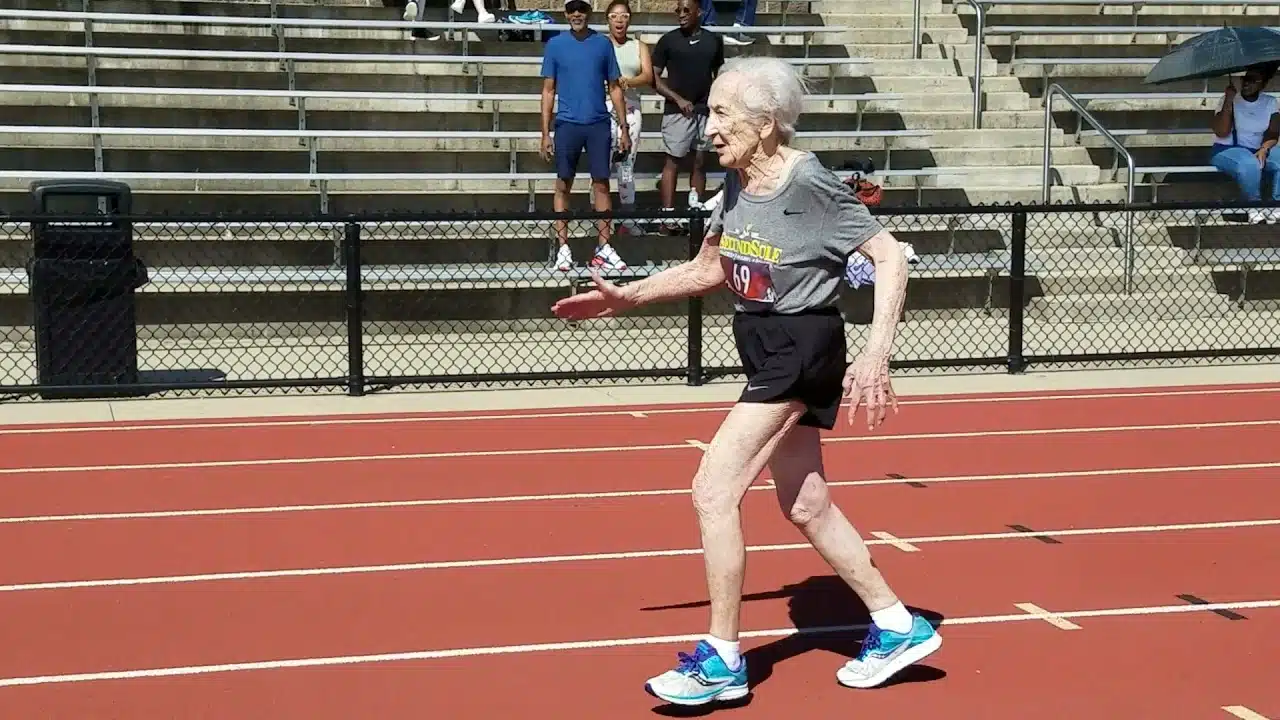
Diane Friedman isn’t here to slow down. At 100 years old, she’s setting world records on the track, outlifting people half her age, and showing the world what aging can look like when purpose, passion, and movement collide.
If you’re wondering whether it’s too late to start exercising, Diane’s story is the wake-up call.
If you’re already active but questioning how long you can push your limits, she’s the blueprint for what’s possible — even decades from now.
Her message is clear: you’re never too old to chase greatness.
Jump to:
Breaking Records at 100 — and Not Looking Back
On August 15, 2021, at the Michigan Senior Olympics, Diane Friedman became the fastest woman over 100 years old in the world.
She shattered the 100-meter dash world record with a time of 36.71 seconds, beating the previous mark set by Julia “Hurricane” Hawkins by nearly three seconds. Moments later, she broke the 200-meter world record in 1:29.78, and launched a 6.25-meter javelin throw to claim the American record in that event too — all in the 100–104 age group.
“I’ve won a lot of medals. I’ve won a lot. I’m just so accustomed to it,” Friedman told Growing Bolder. “When I’m running, I don’t think of anything except keep my eyes forward and move.“
She doesn’t just run fast — she competes hard. Her sprinting form is tight, her focus intense, and when the starting gun fires, says her coach Dr. Bruce Sherman, “Her body knows that means race. She’s the ultimate competitor.”
The Comeback That Stunned Everyone — Except Diane
Diane wasn’t always a centenarian superstar.
She started competing in masters track meets in her 70s. After her husband passed away around 2000, she stepped away from competition. But in 2017, at 95 years old and living alone, she began working with Dr. Sherman — initially for basic fitness.
That changed the day he asked her to run down the hallway of her apartment building.
“She didn’t just shuffle,” he recalled. “She ran.”
Soon, gym sessions turned into structured training, and Diane was officially back on the track — not just as a participant, but a world-record threat.
At 96, she reset the 100m and 200m world records in the 95–99 age group. At 98, she beat the 400m world record by over a minute. And by 99, she was banging out 100 chair-based dips in under 3 minutes.
All while living independently.
How She Trains: Strength, Speed, and Variety
Dr. Sherman, a former nationally ranked triathlete, designed a program rooted in full-body conditioning, not just sprint drills. Diane trains year-round, focusing on:
- Aerobic fitness: Recumbent biking, treadmill walks (including uphill)
- Power & balance: 4-lb medicine ball tosses, lateral walking with weights
- Strength: Dumbbells, dips, chair work
- Sprints: Technique, coordination, and pacing
Six weeks before competitions, she pivots to event-specific drills.
“Even at the century mark,” Sherman says, “her body still responds.”
Friendly Rivalries, Fierce Motivation
One of Diane’s most well-known competitors — and friends — is Julia “Hurricane” Hawkins, the previous 100+ record holder.
In an interview with Growing Bolder, the two traded warm jabs and mutual respect.
“I think she would win,” Hawkins said.
“No, no, no, no!” Friedman shot back. “That’s why we should meet. Because we’re going to be competitive. I’m going to beat the devil out of you!”
This friendly fire isn’t just entertaining — it’s motivating. It keeps both women looking forward to the next finish line. Hawkins planned to compete again later that year, aiming to become the first 105-year-old to complete the 100-meter dash.
More Than Medals: A Movement for Aging with Power
Diane’s achievements have earned her the nickname “Flash” Friedman from the National Senior Games Association (NSGA). But her biggest impact may be what she symbolizes.
“She’s a coach’s dream,” says Sherman.
She’s also the dream of every mid-lifer hoping that vitality in their later years is still possible. As Del Moon, NSGA’s communications director, puts it: “We don’t want people to just say, ‘Isn’t it great what she’s doing?’ — we want them to internalize it. To say: ‘Maybe I can do something like that.’”
It’s not about becoming a record holder. It’s about staying active, connected, and healthy — with joy in the process.
Friedman’s advice to those who hesitate?
“They’ll say to me, ‘Oh, but I get so tired.’ Well, then, get tired. You’ll only get tired once, and then the second time you’ll feel even better. Don’t say you can’t. Do whatever you can.”
Why This Matters for You
Whether you’re 40, 60, or 90, Diane’s story proves that:
- Starting late is not a disadvantage.
- Physical decline is not inevitable.
- Movement improves mindset, health, and longevity.
- Age is not an excuse — it’s a challenge to rise to.
Her achievements challenge societal ideas about aging, fitness, and what’s “normal” in later life.
You don’t need to be a sprinter to follow in Diane’s footsteps. Start by walking. Pick up a light weight. Do one push-up or squat. Show up again tomorrow. The road to extraordinary health later in life starts with ordinary consistency now.
Keep Moving — and Keep Competing
Diane Friedman is a walking, sprinting, strength-training example of what happens when passion meets persistence.
She trains like an athlete.
She competes with heart.
She inspires everyone who watches her.
And for those of us who haven’t yet broken a world record — she reminds us there’s still time.
As her coach yells from the sideline, and the track world echoes in agreement:
“Faster, Diane, faster!”
We should all be chasing that energy.