Push-ups and dips stand as pillars of bodyweight training, but choosing between them isn’t always straightforward.
Each exercise brings distinct advantages to your training program, from accessibility to loading potential.
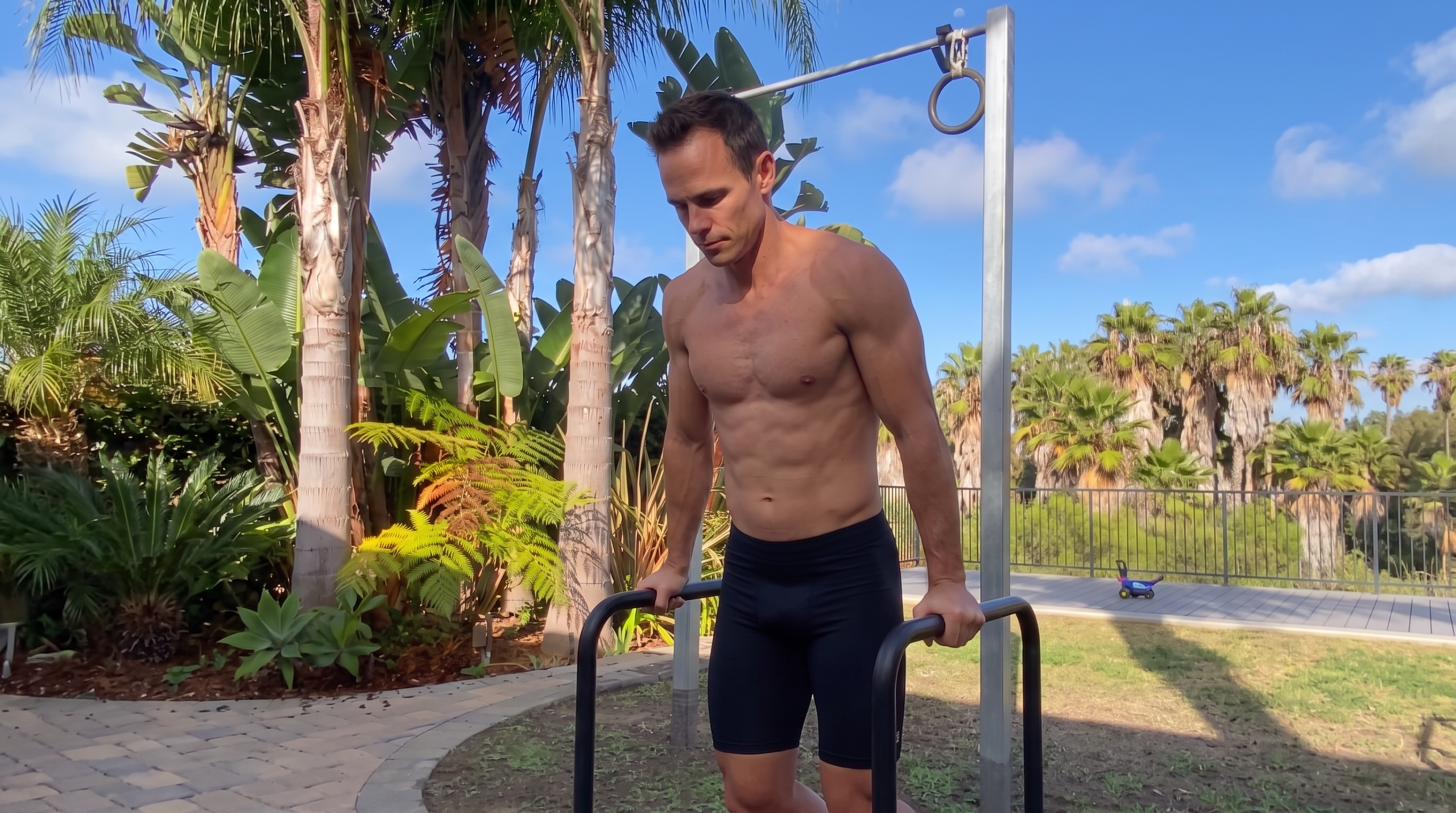
In a recent video, popular calisthenics coach and content creator broke down exactly what separates these two pressing movements.
Understanding their unique trade-offs can help you build a stronger, more resilient upper body—without wasting time on the wrong progression.
Jump to:
Push-Ups: Accessibility Meets Versatility
Push-ups require nothing but floor space and your own body.
That makes them unmatched for accessibility. You can perform them anywhere, anytime, with zero equipment investment.

If you want something simple that actually works, this is one of the most effective tools I’ve used to build strength, conditioning, and endurance without needing a full gym setup.
- Full-body training with one weight using swings, squats, and presses
- Solid cast iron build that feels stable and lasts for years
- Comfortable grip that makes high-rep workouts easier to handle
But accessibility is just the beginning. The real power of push-ups lies in their adaptability.
Nearly Endless Variations
Changing grip width, hand orientation, foot elevation, or range of motion opens up practically endless variation options.
This versatility makes push-ups exceptional for working around injuries or targeting specific muscle groups with precision.
- Wide-grip push-ups emphasize chest activation
- Diamond push-ups shift focus toward triceps
- Decline push-ups increase upper chest and shoulder involvement
- Deficit push-ups extend range of motion for greater muscle stretch
Looking to ramp up intensity without adding external weight? Unilateral variations like archer push-ups and one-arm push-ups offer realistic progressions for anyone seeking advanced bodyweight challenge.
Loading Limitations Worth Knowing
Push-ups handle added weight well—to a point.
I think for most people a weight vest with, you know, 40 to 70 lb or something like that is going to be toward the upper end of what’s going to be workable.
Beyond that range, getting into position becomes cumbersome. Heavy loads can restrict shoulder and arm movement, making reps feel awkward rather than challenging in productive ways.
If you want something simple that actually works, this is one of the most effective tools I’ve used to build strength, conditioning, and endurance without needing a full gym setup.
- Full-body training with one weight using swings, squats, and presses
- Solid cast iron build that feels stable and lasts for years
- Comfortable grip that makes high-rep workouts easier to handle
Push-ups simply aren’t designed for maximal loading. But here’s the thing: you don’t need massive weight to make them brutally effective.
If you can’t find a variation that’s really tough for you when you’re wearing a 45 lb weight vest, then you really have nothing to worry about anyway cuz you’re already crazy strong.
Core Strength as Bonus—and Limitation
Push-ups demand significant core stability throughout each rep.
That’s fantastic for building integrated strength. Your abs, obliques, and lower back all work overtime to maintain plank position while your chest, shoulders, and triceps handle pressing duties.
But during heavy, high-intensity sets, core fatigue can compromise pressing performance. Your midsection might give out before your pressing muscles reach true failure, limiting maximal strength development in upper body pushing patterns.
Dips: Raw Pressing Power Unleashed
When pure pressing strength is the goal, dips deliver.
While dips offer fewer variations than push-ups, they compensate with superior loading potential.
If you want something simple that actually works, this is one of the most effective tools I’ve used to build strength, conditioning, and endurance without needing a full gym setup.
- Full-body training with one weight using swings, squats, and presses
- Solid cast iron build that feels stable and lasts for years
- Comfortable grip that makes high-rep workouts easier to handle
Load Them Heavy, Keep Them Natural
Weight vests work for dips just as they do for push-ups. But when you’re ready to go heavier, a dip belt changes everything.
It’s super simple and it allows you to basically load the heck out of the movement and make it challenging in all the right ways without making it awkward or unnatural.
One-rep max dips become entirely practical. The movement pattern remains clean and natural even under substantial external load.
Compare that to one-rep max push-ups, which present positioning challenges and form breakdown risks that make them less practical for testing absolute strength limits.
Less Core, More Pressing Focus
Dips won’t build core strength and stability the way push-ups do.
But that’s not necessarily a drawback. With minimal core involvement, your pressing muscles dictate performance limits, not your midsection’s ability to maintain position.
But on the other hand your performance won’t be limited by your core strength either. So there’s that.
This isolation allows for more targeted chest, shoulder, and triceps overload without secondary muscle groups becoming bottlenecks.
If you want something simple that actually works, this is one of the most effective tools I’ve used to build strength, conditioning, and endurance without needing a full gym setup.
- Full-body training with one weight using swings, squats, and presses
- Solid cast iron build that feels stable and lasts for years
- Comfortable grip that makes high-rep workouts easier to handle
Surprising Transfer to Other Lifts
Dips show up consistently in training programs across strength disciplines—and for good reason.
Elite calisthenics athletes and gymnasts emphasize them heavily, as expected. But powerlifters and Olympic weightlifters program them regularly too.
They’re considered by many to be one of the best if not the best bench press assistance exercises.
While this claim is based largely on anecdotal evidence from coaching circles, dips do share movement patterns with bench pressing—both involve horizontal adduction and elbow extension under load. That mechanical similarity likely contributes to their reputation as effective bench press builders.
Equipment and Injury Considerations
Unlike push-ups, dips require equipment—parallel bars, dip station, or gymnastics rings at minimum.
Accessibility takes a hit. You need access to appropriate apparatus, which may limit when and where you can train them.
Dips also present higher injury risk for certain individuals. The position places significant stress on shoulder joints and sternum, particularly during bottom-range eccentric loading.
If you want something simple that actually works, this is one of the most effective tools I’ve used to build strength, conditioning, and endurance without needing a full gym setup.
- Full-body training with one weight using swings, squats, and presses
- Solid cast iron build that feels stable and lasts for years
- Comfortable grip that makes high-rep workouts easier to handle
People with existing shoulder issues or limited shoulder mobility may find dips uncomfortable or aggravating. Proper form and gradual progression become non-negotiable for safe execution.
Which One Should You Choose?
The answer depends less on which exercise is objectively “better” and more on your individual context.
Choose push-ups if:
- You need equipment-free training options
- You want maximum exercise variety and progression options
- You’re working around shoulder or chest injuries that dips aggravate
- Building integrated core strength is a priority
- You prefer training movements with lower injury risk
Choose dips if:
- You have access to appropriate equipment
- Maximal pressing strength is your primary goal
- You want superior loading potential for progressive overload
- You’re looking to improve bench press strength
- Your shoulders tolerate the movement pattern well
Better Yet, Do Both
These movements aren’t mutually exclusive.
If you can do both do both. But if you prefer one over the other or if one is a better fit for you for whatever reason, you’re not going to go wrong by getting good at either one of these exercises.
Programming both exercises provides complementary benefits. Push-ups build core integration and offer injury-resistant variety. Dips develop raw pressing power with heavy loading potential.
If you want something simple that actually works, this is one of the most effective tools I’ve used to build strength, conditioning, and endurance without needing a full gym setup.
- Full-body training with one weight using swings, squats, and presses
- Solid cast iron build that feels stable and lasts for years
- Comfortable grip that makes high-rep workouts easier to handle
Together, they create a more complete pressing foundation than either alone.
Mastery Matters More Than Selection
Ultimately, exercise selection matters far less than execution quality and consistent practice.
It’s less about which one you do and more about the time and effort and care you put into your practice.
Becoming genuinely proficient at either movement—mastering form, progressing intelligently, training with intention—delivers impressive upper body development and functional pressing strength.
Stop agonizing over which exercise is “optimal.” Pick the one that fits your equipment access, injury history, training goals, and preferences.
Then get really, really good at it.
That’s where results come from—not from choosing the theoretically perfect exercise, but from committing to deliberate practice over time. Whether you’re cranking out weighted dips or grinding through one-arm push-up progressions, consistency and quality build the physique and strength you’re after.
If you want something simple that actually works, this is one of the most effective tools I’ve used to build strength, conditioning, and endurance without needing a full gym setup.
- Full-body training with one weight using swings, squats, and presses
- Solid cast iron build that feels stable and lasts for years
- Comfortable grip that makes high-rep workouts easier to handle