Sciatica strikes millions of people each year with shooting pain that travels from the lower back all the way down to the foot.
But here’s what most people don’t realize: the source of that leg pain usually isn’t in the leg at all.
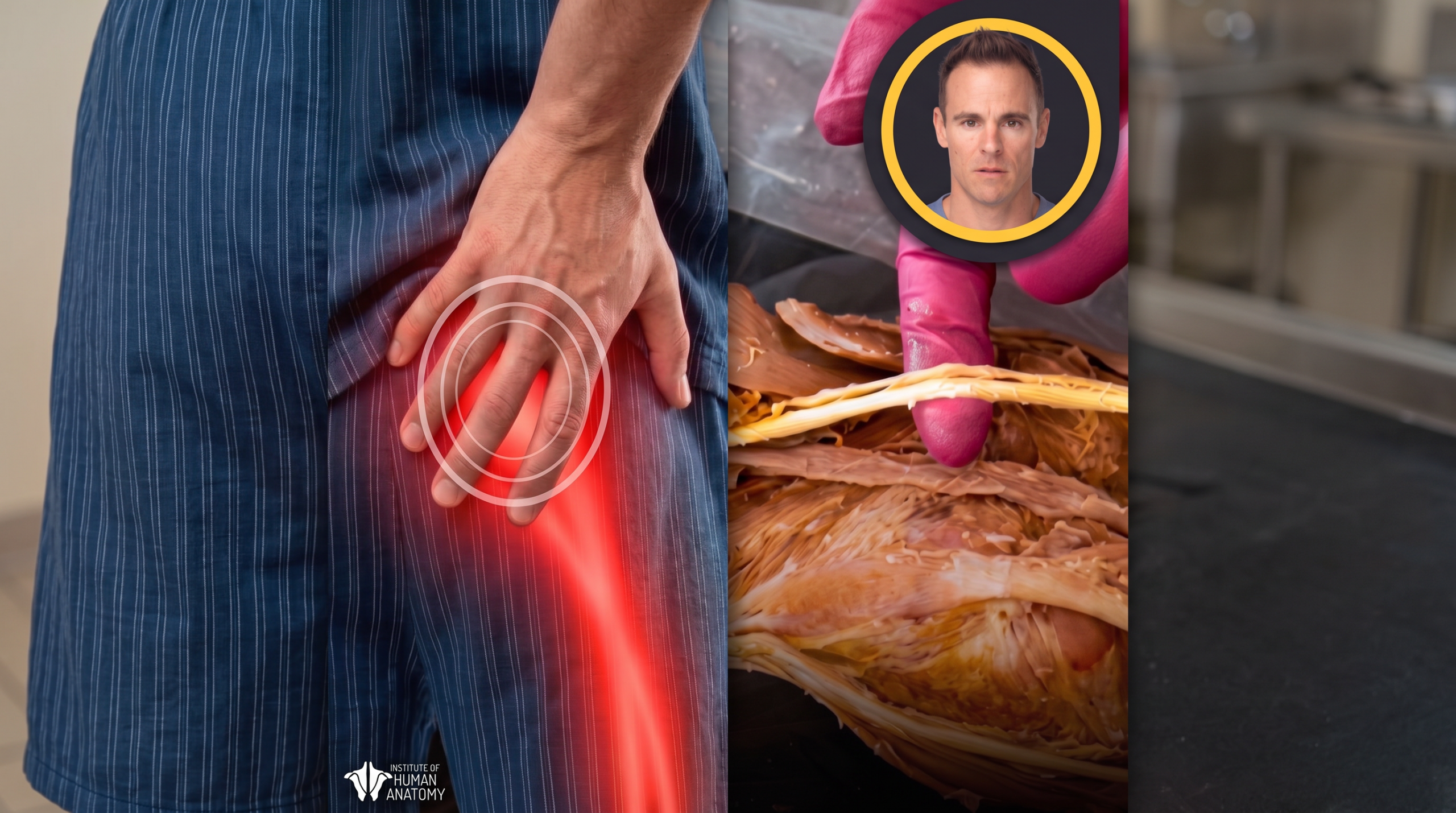
In a recent educational video, anatomy educator and physical therapist Jonathan Reisman used cadaver dissections to reveal exactly what happens inside the body when sciatica occurs—and why the real problem often starts in a completely different location than where you feel the pain.
Understanding this disconnect between pain location and actual cause could change how you approach treatment and prevention.
Jump to:
- The Body’s Longest Nerve and Why It Matters
- Where Sciatica Really Starts
- Bulging Discs and Nerve Root Compression
- How Doctors Identify Which Nerve Is Affected
- When the Problem Isn’t in Your Back
- The Challenge of Healing Discs
- Conservative Treatment: The First Line of Defense
- When Conservative Treatment Isn’t Enough
- Different Treatment for Gluteal Region Problems
- Prevention: Your Best Defense
- Sources
The Body’s Longest Nerve and Why It Matters
The sciatic nerve holds the distinction of being the largest nerve in the human body. It travels an impressive distance, running from the lower back through the gluteal region, down the entire length of the back of the thigh, and eventually branching into the lower leg and foot.
“The largest nerve in the human body is this nerve that you can see here called the sciatic nerve,” Reisman explains while showing a cadaver dissection. “Look at how long this thing is, traveling all the way down the back of the leg and eventually into the foot.”
No products found.
This nerve’s impressive size makes it visible even to the untrained eye during dissection. But size also means vulnerability—the longer the pathway, the more opportunities for compression or irritation.
The sciatic nerve enters the gluteal region by passing underneath a muscle called the piriformis. From there, it continues down the posterior thigh before dividing into two major branches: the tibial nerve and the common fibular nerve.
The tibial nerve continues down the back of the lower leg to the bottom of the foot, while the common fibular branch moves to the front of the lower leg and top of the foot.
Where Sciatica Really Starts
Sciatica describes pain radiating along the pathway of the sciatic nerve. The discomfort typically begins in the lower back or gluteal region and travels down the back of the leg, sometimes reaching all the way to the foot.
Depending on which nerve roots are affected, people can also experience numbness, tingling, and even muscle weakness.
What’s interesting about sciatica is that even though you can experience pain that travels all the way down the back of the leg and sometimes into the foot, the actual problem often isn’t occurring anywhere near the part of the sciatic nerve that I’m actually showing you.
The culprit usually lies much higher up: in the lower back itself.
No products found.
The sciatic nerve receives contributions from five different spinal nerve levels: L4, L5, S1, S2, and S3. These spinal nerves emerge from the spine and converge to form the sciatic nerve before it passes underneath the piriformis muscle.
The critical structures in this story are the intervertebral discs—the cushions sitting between the vertebral bodies that help distribute forces and absorb compression throughout the spine.
Bulging Discs and Nerve Root Compression
Each intervertebral disc has two main components: a tough outer ring of fibrocartilage called the annulus fibrosus and a softer, almost gelatinous center called the nucleus pulposus.
Disc herniation can happen suddenly—such as when lifting something heavy while bending or twisting—causing the annulus fibrosus to tear and allowing the nucleus pulposus to herniate outward. But herniation can also occur gradually as discs lose water content and structural integrity with age.
The direction of the herniation matters enormously. When bulging occurs toward the back and slightly to the side (posterolateral direction) or even more to the side (far lateral herniation), the protruding disc material can compress the spinal nerve roots sitting right next to it.
Two Herniation Scenarios
Reisman explains two common patterns:
No products found.
Far lateral herniations are less common but can compress the nerve root exiting at that specific level. For example, a far lateral herniation of the disc between L4 and L5 could compress the L4 nerve as it exits through the intervertebral foramen.
Posterolateral herniations are much more common and follow a counterintuitive pattern. They often miss the nerve root exiting at that level and instead compress the nerve root below it.
A posterolateral herniation at L4 will often miss the L4 nerve and hit the L5 nerve root because… you can see nerve roots passing behind the actual disc.
This explains why someone can have S1 nerve problems even though there isn’t a disc between S1 and S2—a herniation between L5 and S1 can compress the S1 nerve root as it passes behind the disc.
Large herniations can sometimes create a “double whammy,” compressing more than one nerve root simultaneously.
How Doctors Identify Which Nerve Is Affected
Two people with sciatica can experience symptoms in completely different locations depending on which nerve root gets compressed. This happens because spinal nerves contain both sensory and motor nerve fibers.
Medical professionals use two mapping systems to pinpoint the problem:
No products found.
Dermatomes: Mapping Skin Sensation
A dermatome is an area of skin receiving sensory innervation primarily from a specific spinal level. When a nerve root gets compressed, pain, numbness, or tingling travels along its associated dermatome.
Compressing the L5 nerve root produces symptoms along the L5 dermatome, while compressing S1 affects the S1 dermatome. The location of symptoms provides clues about which nerve root is involved.
Myotomes: Testing Muscle Function
A myotome is a group of muscles receiving motor innervation primarily from a specific spinal nerve root. Doctors know which muscles receive contributions from L4, L5, or other levels.
Testing specific movements that activate these muscles can reveal weakness patterns pointing to particular nerve root involvement.
An experienced clinician can get a strong idea of which nerve root is affected by testing dermatomes and myotomes. MRI imaging then confirms the diagnosis and reveals whether a bulging or herniated disc is compressing that nerve root.
When the Problem Isn’t in Your Back
While most sciatica originates in the lower back around nerve roots, the sciatic nerve can become irritated or compressed at other locations along its path.
No products found.
One common site is in the gluteal region where the sciatic nerve typically passes underneath the piriformis muscle. Irritation or compression here is often called piriformis syndrome, though some clinicians prefer the broader term deep gluteal syndrome since other structures in this region can also irritate the sciatic nerve.
Anatomy varies between individuals. In some people, the sciatic nerve or one of its components actually pierces through the piriformis rather than passing completely underneath it.
Reisman demonstrated this variation on a cadaver dissection, showing the common fibular component passing directly through the piriformis muscle while the tibial component traveled underneath it. Having part of the nerve pass through the muscle could potentially make it more susceptible to irritation or compression.
The Challenge of Healing Discs
Intervertebral discs are avascular, meaning they have essentially no direct blood supply. They must obtain nutrients from blood vessels in surrounding tissues.
This anatomical reality means discs don’t heal as well as highly vascular tissues like muscles or skin.
However, healing isn’t impossible. The body can sometimes gradually break down and reabsorb herniated disc material, reducing irritation and pressure on nerve roots. This natural process takes time, and treatment strategies can support it.
No products found.
Conservative Treatment: The First Line of Defense
Treatment for disc-related sciatica almost always starts conservatively rather than jumping straight to injections or surgery. The approach allows the body to do what it can naturally while adding supportive interventions.
Initial Management
If sciatica resulted from an acute injury, the first step involves avoiding movements and activities that significantly aggravate symptoms while maintaining some level of activity as tolerated.
This may be paired with over-the-counter pain medications to manage discomfort during the initial healing phase.
Core Strengthening
When tolerated, strengthening the core becomes a priority. Improving strength and stability around the spine can potentially reduce the risk of future problems.
Effective exercises target the obliques, transversus abdominis, and spinal extensors.
Some people can implement these exercises independently, while others benefit from guidance from a physical therapist for more stubborn cases.
No products found.
Weight Loss for Mechanical Relief
For individuals carrying excess body weight, losing weight may help by reducing mechanical loading on the lumbar spine and potentially decreasing the risk of future problems.
When Conservative Treatment Isn’t Enough
If someone continues struggling after exhausting conservative treatment options, the next step might involve injections.
Steroid injections decrease inflammation around the irritated nerve root, but they come with their own set of pros and cons that must be weighed carefully.
Other types of injections are being used or studied, including platelet-rich plasma (PRP), though evidence for some newer treatments is still evolving.
Surgery becomes a consideration if symptoms don’t improve or if significant neurological involvement exists. Surgical options include:
- Discectomy: Removing or trimming the portion of herniated disc compressing the nerve
- Decompression: Removing a small amount of bone to create more space around the affected nerve root
Different Treatment for Gluteal Region Problems
When the sciatic nerve is irritated in the gluteal region—as with piriformis syndrome or deep gluteal syndrome—treatment looks different because the problem isn’t originating from the spine.
No products found.
Treatment still usually starts conservatively but focuses more specifically on muscles and structures around the hip:
- Stretching: Figure-four stretch or half-pigeon stretch for the piriformis and deep gluteal muscles (as long as they don’t aggravate symptoms)
- Strengthening: Bridges, clamshells, and resisted hip abduction to strengthen muscles around the hip
- Nerve mobilization: Physical therapists may use sciatic nerve glides, where specific movements gently mobilize the nerve relative to surrounding tissues
Prevention: Your Best Defense
Whether sciatica stems from nerve root compression or problems as the nerve passes through the gluteal region, individuals have significant control over managing symptoms and reducing future risk.
Key prevention strategies include:
- Using proper lifting mechanics
- Strengthening the core
- Maintaining proper range of motion throughout the spine and hips
- Managing body weight to reduce spinal loading
- Avoiding prolonged positions that aggravate symptoms
These strategies can reduce the risk of developing sciatica in the first place and minimize flare-ups in those who’ve experienced it before.
The take-home message is clear: understanding where sciatica actually originates—often far from where the pain is felt—empowers better treatment decisions and more effective prevention strategies. Most cases respond well to conservative treatment when given adequate time and proper guidance.
Sources
No verifiable external sources were provided in the research brief for this content.
No products found.