Most people think they’re sleeping well when they’re actually sabotaging their rest every single night.
One content creator spent an entire year experimenting with eight simple changes to transform sleep quality—and the results were dramatic.
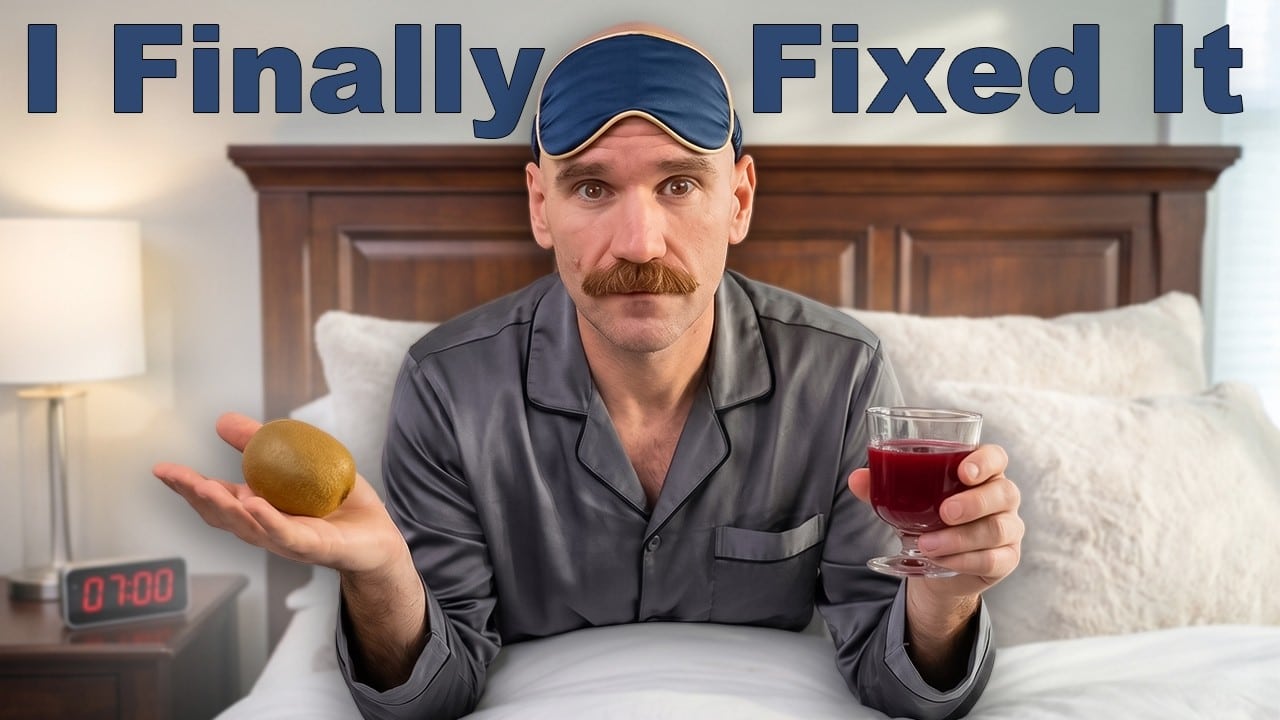
No expensive gadgets required, no $5,000 mattress covers, just strategic adjustments that work with biology instead of against it.
What started as a personal experiment to combat midday fatigue and slow workout recovery turned into a complete sleep overhaul that made him feel ten years younger.
Jump to:
- The Wake-Up Call: When “Good Sleep” Wasn’t Good Enough
- Eight Changes That Transformed Sleep Quality
- 1. Dim Everything When Darkness Falls
- 2. Magnesium Glycinate: The Relaxation Signal
- 3. Tart Cherry Juice: Nature’s Melatonin Source
- 4. Two Kiwis Before Bed: Unexpected Science
- 5. Sleep Mask: Eliminating Light Leaks
- 6. No TV One Hour Before Bed
- 7. Phone Banishment: Breaking Engagement Loops
- 8. Strategic Room Cooling: Working With Physiology
- The Transformation: Three Weeks of Consistency
- The Essential Three: Where To Start
- Implementation Strategy: Gradual Integration
The Wake-Up Call: When “Good Sleep” Wasn’t Good Enough
For years, this mid-40s athlete believed seven to eight hours in bed equaled quality sleep. The reality? He was waking up two to three times every night, blaming his dog Walker, and still clocking sleep scores between 70-80%.
So, I used to think that I was sleeping fine. 7 hours, sometimes 8. I’d close my eyes, I’d wake up, that was it. Sleep. I got good sleep. Except I was terrible at it.
Persistent fatigue, slower recovery from workouts, and waking up tired became the norm. Sleep tracking revealed the problem, but solving it required systematic experimentation over twelve months.

If you want something simple that actually works, this is one of the most effective tools I’ve used to build strength, conditioning, and endurance without needing a full gym setup.
- Full-body training with one weight using swings, squats, and presses
- Solid cast iron build that feels stable and lasts for years
- Comfortable grip that makes high-rep workouts easier to handle
Eight Changes That Transformed Sleep Quality
1. Dim Everything When Darkness Falls
Bright overhead lights at 9 p.m. send a powerful signal to your brain: it’s still daytime. Melatonin production depends on darkness, and artificial lighting actively suppresses it.
The solution involved dimming every light source at sunset—lamps, overheads, screens. Smart bulbs made automation simple through phone apps, requiring zero daily effort once programmed.
By keeping your lights bright at night, you’re fighting your own biology and wondering why you can’t sleep. I did this for years.
Within days, falling asleep became noticeably easier. Nighttime drowsiness returned—something absent for years. Even couch naps reappeared, signaling proper circadian alignment.
2. Magnesium Glycinate: The Relaxation Signal
Not all magnesium supplements work equally for sleep. Magnesium glycinate specifically contains glycine, which research shows lowers core body temperature and promotes relaxation.
Taking 400mg (two capsules) thirty minutes before bed created an immediate effect—drowsiness within half an hour, deep relaxation, and a mental signal that bedtime approached.
Unlike sleeping pills, there’s no grogginess the next morning. Individual responses vary, but consistency matters more than dosage experiments.
If you want something simple that actually works, this is one of the most effective tools I’ve used to build strength, conditioning, and endurance without needing a full gym setup.
- Full-body training with one weight using swings, squats, and presses
- Solid cast iron build that feels stable and lasts for years
- Comfortable grip that makes high-rep workouts easier to handle
3. Tart Cherry Juice: Nature’s Melatonin Source
Tart cherries rank among the few natural food sources containing melatonin, plus tryptophan and anti-inflammatory compounds that improve sleep duration and quality.
Research from small but solid studies shows tart cherry juice increases sleep time by approximately 84 minutes on average. Four ounces of 100% tart cherry juice (not from concentrate) thirty minutes before bed became part of the nightly routine.
There’s 25 g of sugar in this for 8 oz, so you know, 12 and 1/2 g for four. But, there is solid science here.
Yes, it contains carbohydrates—about 12.5 grams per serving—but the sleep benefits outweighed concerns about evening sugar intake.
4. Two Kiwis Before Bed: Unexpected Science
This addition seemed quirky until examining the research. Studies from Taipei Medical University found participants eating two kiwis one hour before bed experienced remarkable improvements over four weeks.
- 35% faster sleep onset
- 17% increase in total sleep time
- Immediate effects observed in New Zealand research—better sleep the same night
Kiwis work through different pathways than other sleep aids: high serotonin content plus antioxidants. They’re complementary rather than redundant with magnesium and tart cherry juice.
Sleep scores jumped to the high 90s consistently after adding this simple fruit. Plus, they’re delicious—a bonus when building sustainable habits.
If you want something simple that actually works, this is one of the most effective tools I’ve used to build strength, conditioning, and endurance without needing a full gym setup.
- Full-body training with one weight using swings, squats, and presses
- Solid cast iron build that feels stable and lasts for years
- Comfortable grip that makes high-rep workouts easier to handle
5. Sleep Mask: Eliminating Light Leaks
Resistance to wearing sleep masks stemmed from assumptions about discomfort and looking silly. Reality proved different after pushing through two awkward nights.
Even minimal light exposure—TV LEDs, charging phone notifications, street lights through curtains—suppresses melatonin in sensitive individuals. Brains detect these signals even with eyes closed.
Basic masks cost just a few dollars. Snug fit around the nose prevents light leakage. Within days, sleeping through the night became standard instead of rare.
Waking naturally then removing the mask to daylight felt refreshing—a pleasant morning ritual that reinforced proper circadian rhythm.
6. No TV One Hour Before Bed
This change proved hardest to implement. Television stimulates brain activity precisely when winding down should occur—blue light aside, the content itself triggers engagement, excitement, tension.
If you’re watching something tense or something funny, it’s probably something that your brain wants to keep processing.
Replacing screens with physical books took approximately one week before the TV wasn’t missed. Reading paper pages signals rest rather than stimulation.
If you want something simple that actually works, this is one of the most effective tools I’ve used to build strength, conditioning, and endurance without needing a full gym setup.
- Full-body training with one weight using swings, squats, and presses
- Solid cast iron build that feels stable and lasts for years
- Comfortable grip that makes high-rep workouts easier to handle
Occasional exceptions happen—watching until thirty minutes before bed—but eliminating television from the final hour made noticeable differences in sleep onset speed.
7. Phone Banishment: Breaking Engagement Loops
Phones pose greater threats than televisions because content algorithms specifically engineer engagement. There’s always another video, another comment, another scroll.
One hour before bed, phones go on chargers in another room. Not on nightstands. Not within reach. Completely away.
This single change dramatically reduced middle-of-night wake-ups. When waking did occur, absence of phone access meant falling back asleep within minutes instead of losing hours to screens.
Massive difference. Significant, undeniable impact on sleep continuity.
8. Strategic Room Cooling: Working With Physiology
Core body temperature must drop 2-3 degrees Fahrenheit for quality sleep—physiological fact, not opinion. Room temperature at 72°F forces bodies to work harder achieving this drop, delaying sleep onset.
If you want something simple that actually works, this is one of the most effective tools I’ve used to build strength, conditioning, and endurance without needing a full gym setup.
- Full-body training with one weight using swings, squats, and presses
- Solid cast iron build that feels stable and lasts for years
- Comfortable grip that makes high-rep workouts easier to handle
Rather than spending thousands on cooling mattress pads, a smart window AC unit solved the problem. Automated to cool the bedroom to 64-65°F one hour before bed while keeping the rest of the house at normal temperature.
Initial adjustment took weeks—65°F feels genuinely cold at first. But sleep onset became nearly instantaneous, and sleep duration extended dramatically.
Pairing room cooling with magnesium glycinate (which lowers internal temperature) creates synergistic effects: external and internal temperature drops working together.
The Transformation: Three Weeks of Consistency
After maintaining all eight changes consistently for three weeks, three major improvements emerged clearly.
First: Rapid sleep onset. Previously spending 20-30 minutes with racing thoughts, now falling asleep felt like flipping a switch. Head hits pillow, lights out.
Second: Uninterrupted nights. Middle-of-night bathroom trips vanished. No more 2 a.m. or 3 a.m. disruptions. No more blaming the dog. What seemed normal—frequent night waking—stopped completely.
If you want something simple that actually works, this is one of the most effective tools I’ve used to build strength, conditioning, and endurance without needing a full gym setup.
- Full-body training with one weight using swings, squats, and presses
- Solid cast iron build that feels stable and lasts for years
- Comfortable grip that makes high-rep workouts easier to handle
I really didn’t realize how often I was doing it until it stopped, and it is stopped, over.
Third: Enhanced performance and energy. Running improved. Workouts got better. Midday fatigue disappeared entirely—no afternoon energy crashes requiring willpower to push through.
Sleep enables muscle repair, physical recovery, and memory consolidation. Shortchanging rest every night compounds over time, creating deficits most people don’t recognize until addressed.
The Essential Three: Where To Start
Eight changes feel overwhelming. Starting requires prioritization. Three categories deliver maximum impact with minimal investment.
Category One: Control Light Exposure
Dim lights at sunset. Turn off TV one hour before bed. Put phones away completely. These cost nothing and work immediately because they align with circadian biology.
Category Two: Temperature Management
If you want something simple that actually works, this is one of the most effective tools I’ve used to build strength, conditioning, and endurance without needing a full gym setup.
- Full-body training with one weight using swings, squats, and presses
- Solid cast iron build that feels stable and lasts for years
- Comfortable grip that makes high-rep workouts easier to handle
Cool sleeping environments dramatically improve sleep quality. Even without smart AC units, opening windows, using fans, or adjusting thermostats downward helps bodies reach optimal temperature for rest.
Category Three: Choose One Sleep Aid
Magnesium glycinate, tart cherry juice, or kiwis—pick one based on preference and availability. They’re supplementary enhancements that work only when foundational habits exist.
Sleep aids without light control and temperature management provide minimal benefit. Foundation matters more than supplements.
Implementation Strategy: Gradual Integration
Attempting all changes simultaneously invites failure. Start tomorrow with two modifications. Assess after one week. Add another change. Repeat.
Individual responses vary—what created dramatic improvements for one person might produce subtle effects for another. Experimentation reveals personal optimization.
If you want something simple that actually works, this is one of the most effective tools I’ve used to build strength, conditioning, and endurance without needing a full gym setup.
- Full-body training with one weight using swings, squats, and presses
- Solid cast iron build that feels stable and lasts for years
- Comfortable grip that makes high-rep workouts easier to handle
I feel like a new person. I de-aged myself by 10 years, easily.
Sleep affects everything: cognitive function, physical performance, mood regulation, immune system strength, metabolic health. Most people underestimate its importance until experiencing truly restorative rest.
The excuse of “no time for sleep routines” reveals misunderstanding. These changes don’t require extra time—they require intentional choices about existing evening hours.
Dimming lights, avoiding screens, and cooling rooms cost nothing. Supplements and kiwis cost minimal amounts. Smart bulbs and AC units represent optional upgrades, not requirements.
Quality sleep isn’t luxury—it’s foundational human biology functioning properly. Small adjustments compound into transformative results when sustained consistently over weeks.
Pick two changes. Start tonight. Track how you feel after one week. Then decide what comes next.