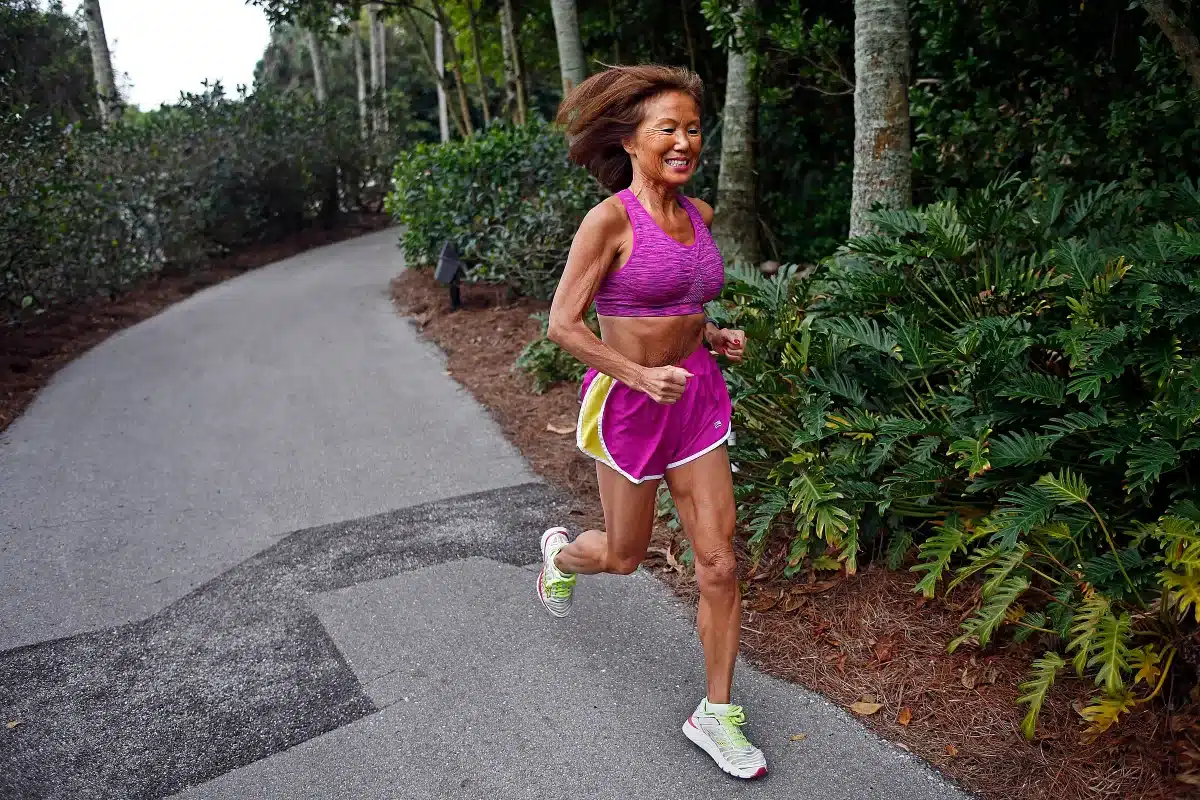
At an age when most people are told to slow down, Jeannie Rice is picking up speed — and setting world records while she’s at it.
At 77, Rice’s cardiovascular fitness rivals that of a woman five decades younger. Her ability to defy age-related decline is so remarkable, scientists are studying her to understand how lifestyle choices can rewrite the rules of aging.
But what makes her truly extraordinary isn’t just her speed — it’s what her body reveals about how we can all stay healthy, active, and fulfilled well into our later years.
Jump to:
Breaking Records — and Expectations
Jeannie Rice, who turned 77 in April, has obliterated age group records from the mile to the marathon.
After clocking a 3:33:27 finish at the 2024 London Marathon, her VO2 max — a clinical measure of aerobic capacity — matched that of an average 25-year-old woman. For context, that kind of fitness is practically unheard of in someone her age. In fact, most women in their 70s have a VO2 max that’s 45% to 65% lower.
“She exemplifies how consistent training, and perhaps favorable genetics, can partly defy conventional aging processes,” said Bas Van Hooren, assistant professor at Maastricht University and co-author of a recent case study on Rice published in the Journal of Applied Physiology.
Rice’s performance defies not only norms but expectations. In the same race group, she often outruns men and women alike. “Her unique physiology allows her to be extremely competitive in any distance running event from the track to the road, a rare feat at the world-class level,” said Michele Zanini, a co-researcher and lecturer in exercise science.
A Late Start, but Lifelong Commitment
Rice didn’t lace up her first pair of running shoes until she was 35. Like many new runners, her goal was modest: shed a few pounds after a trip to Korea. But what began as a weight-loss plan quickly became a lifelong passion.
Within a year, she ran her first marathon — finishing in 3:45 with minimal training. By her second marathon, she’d shaved off nearly 30 minutes, qualifying for the Boston Marathon.
Now, more than 130 marathons later, Rice shows no signs of slowing. Though she’s currently managing a hamstring injury, she plans to run the Boston Marathon again — albeit at an easier pace.
What Her Body Tells Us About Aging
So, what’s her secret? Researchers say Rice offers a real-time case study on how movement, mindset, and metabolism intersect as we age. Here’s what they’re learning from her remarkable physiology:
1. Cardiovascular Fitness Can Be Maintained — Even Into Your 70s
VO2 max is the gold standard of aerobic fitness. For most adults, it peaks in their 20s and steadily declines. But Rice’s results challenge this trajectory.
Her levels remain comparable to someone 50 years younger. That means her heart and lungs are exceptionally efficient at delivering oxygen to working muscles, even under marathon-level stress.
2. Muscle Health Doesn’t Have to Decline Dramatically
Rice undergoes regular blood lactate testing — a way to gauge how the body transitions from aerobic to anaerobic effort. Her results show an unusually delayed lactate threshold, meaning she can sustain faster paces without “hitting the wall.”
She also maintains lean muscle mass and favorable fat distribution, traits that typically decline with age. Consistent weight training and high weekly mileage (50–75 miles) help her retain that muscular efficiency.
3. It’s Not Just Genetics — It’s Daily Habits
Though she may have been born with some physiological advantages, Rice’s consistency is key.
- Weekly mileage: 50 miles minimum, 70–75 when marathon training
- Cross-training: Lifting light weights for upper body strength, three times per week
- Diet: Rice avoids fried foods and sweets. She loads up on veggies, rice, fish, and nuts — but isn’t afraid to indulge in cheese now and then.
“She may be genetically predisposed,” said Van Hooren. “But it’s her dedication, structure, and recovery that allow those advantages to shine.”
The Lifestyle Habits Behind the Records
Rice’s fitness is only part of her secret. Equally important are her outlook, social habits, and emotional well-being.
She Trains Smart — and Avoids Injury
Despite decades of high mileage, Rice has rarely suffered overuse injuries.
That’s thanks to a balanced training routine, sufficient recovery, and a body awareness that prevents small problems from becoming serious setbacks.
She Finds Joy and Purpose in Her Pursuit
“I love running and being an example for younger athletes,” Rice told researchers. She also loves inspiring her peers. When someone in their 50s or 60s tells her they’re too old to start, she pushes back: “You’re not.”
This sense of purpose fuels her longevity. Studies show that passion and meaning are powerful buffers against the effects of aging — physically, mentally, and emotionally.
She Stays Social and Fun-Loving
Rice splits her time between Ohio and Florida, maintains a vibrant social life, and even enjoys going out dancing — just not the week before a race. “A lot of runners are so serious they don’t do anything socially,” she said. “But I like to have fun. I’m the last one to go home.”
This balance between intensity and enjoyment may be the most underrated aspect of healthy aging.
What We Can Learn From Her
Jeannie Rice proves that age is not a barrier — it’s an invitation to reimagine what’s possible. Here are some takeaways for anyone looking to age more like her:
- Start where you are. Rice didn’t run her first mile until age 35.
- Be consistent. Longevity isn’t built in months — it’s built over decades.
- Listen to your body. Avoiding burnout and injury is more important than chasing every personal best.
- Fuel well. Whole foods, lean proteins, and plant-based fats form the foundation of her diet.
- Make it fun. Whether it’s running, dancing, or socializing — joy keeps you moving.
As Scott Trappe, a leading human performance expert, put it: studying Rice “helps scientists better understand the potential limits of human performance as we age — especially when exercise is performed at a high level over the adult lifespan.”
In other words, she’s not just breaking records. She’s redefining what healthy aging looks like — one stride at a time.