Fast-twitch muscle fibers (Type II) atrophy with age, while slow-twitch fibers often linger longer.
That shift erodes jump, sprint, and deceleration ability, which drives fall risk and loss of independence.
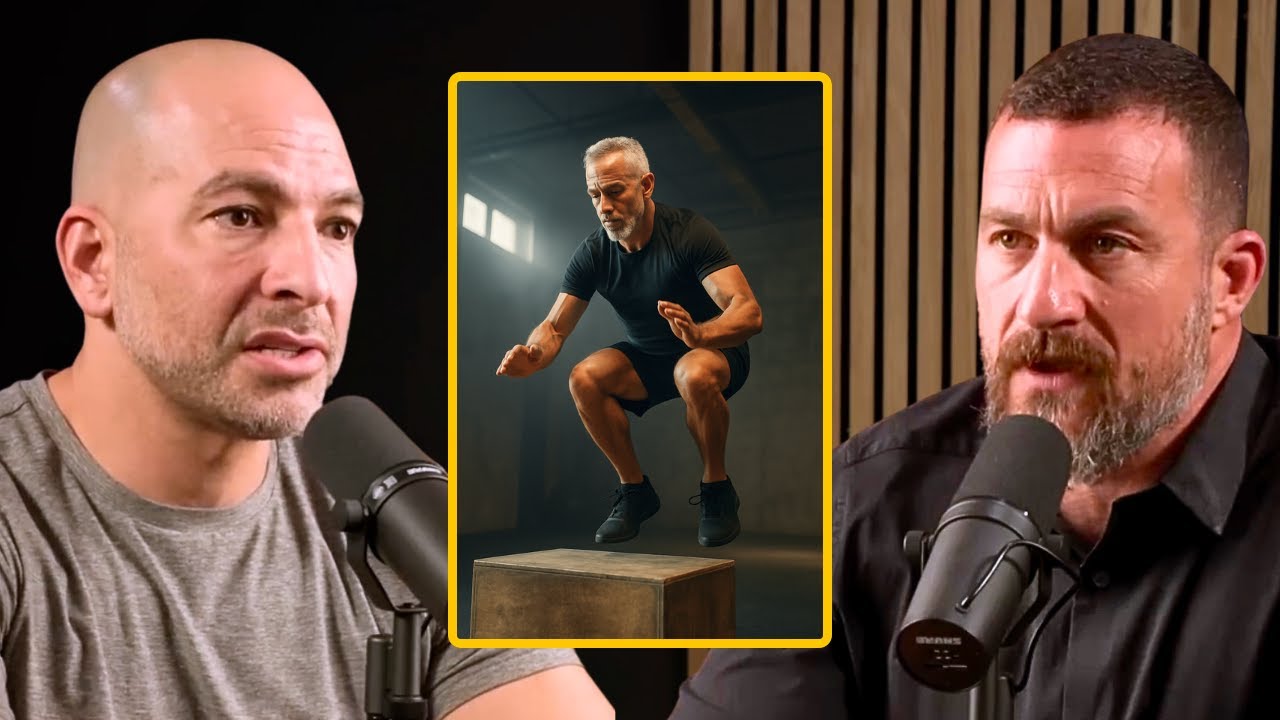
“What is the hallmark of aging on the muscle? It is atrophy of the type two muscle fiber.”
In podcast conversations, Peter Attia and Andy Galpin have emphasized this repeatedly.
“You cannot age well if you are not doing the type of training that is there to strengthen…your type two fibers.”
Jump to:
- Why this matters: fewer falls, more life
- What changes in muscle with age
- The four pillars for longevity training
- Build the brakes: eccentric strength and safe landings
- Simple at-home status checks
- A weekly template that covers all bases
- Safety first: how to personalize and progress
- Machines vs real-world control
- Bottom line: power, brakes, and balance keep you doing what you love
Why this matters: fewer falls, more life
Power declines faster than maximal strength and far faster than muscle size during aging.
That means speed goes first, then strength, with size often trailing last.
Hip fractures carry roughly 20–30% one-year mortality in older adults, and many never return to prior function.
Immobilization accelerates muscle loss, which compounds the problem after injuries and hospitalizations.
What changes in muscle with age
Fast units produce high force quickly, while slow units specialize in endurance.
Aging skews the balance toward endurance fibers, trimming explosive capacity.
| Feature | Type I (slow) | Type II (fast) | Age-related trend |
|---|---|---|---|
| Primary job | Endurance | Power | Power capacity declines early |
| Fatigue resistance | High | Lower | Explosive output drops more |
| Atrophy risk | Lower | Higher | Selective Type II loss common |
Preserving fast-twitch function requires targeted strength, power, and deceleration training.
Cardio builds healthspan too, though it cannot fully replace fiber-specific work.
The four pillars for longevity training
1) Strength: lift heavy enough to recruit fast-twitch units
Use multi-joint patterns like squats, deadlifts, presses, rows, and carries.
Choose loads that feel challenging within 3–8 reps, while maintaining crisp technique and full control.
- Effort target: stop 0–3 reps shy of failure on most sets.
- Tempo focus: lower with intent, stand or press with authority.
- Frequency: 2–3 sessions weekly, 6–12 hard sets per major movement each week.
- Options for beginners: machines are fine early; progress toward free weights and cables for carryover.
Machines can jump-start progress safely.
Free weights and cables demand more whole-body control, which better reflects real life.
2) Stability and reactivity: train balance, coordination, and landing
Real-world movement needs lateral steps, pivots, and quick stops.
Training should challenge posture, feet, ankles, hips, trunk, and vision together.
- Balance drills: single-leg stands, head turns, eyes-closed holds, and uneven surfaces.
- Reactive steps: quick lateral steps to tags or cones, random partner cues, or light band pulls.
- Change of direction: gentle zigzags, karaoke steps, and side shuffles.
- Landing mechanics: soft knees, hips back, quiet feet, trunk braced, eyes forward.
Even heavy deadlifts require stability but do not mimic stepping off curbs or catching missteps.
Specific drills for deceleration close that gap.
3) Aerobic efficiency: build a wide Zone 2 base
Work at a steady pace where conversation stays possible yet slightly labored.
Heart rate often sits around 60–70% of maximum for many people.
- Weekly target: 150–300 minutes distributed across 3–6 days.
- Modes: brisk walking, cycling, rowing, swimming, or hiking.
- Goal: more mitochondria, better metabolic health, improved recovery.
A broad aerobic base supports harder sessions and life outside the gym.
Energy throughout the day improves with consistent practice.
4) Aerobic peak output: push VO2 max with intervals
Add short bursts weekly once a base is in place.
Hard efforts raise the ceiling for heart, lungs, and muscles.
- 1–2 sessions weekly: for example, 4–6 rounds of 2 minutes hard, 2–3 minutes easy.
- Alternate option: 10–12 sprints of 20–30 seconds hard, with full easy recovery.
- RPE guide: hard zones should feel 8–9 out of 10, never all-out early on.
Higher fitness correlates with lower mortality across large cohorts.
Intervals deliver that boost efficiently.
Build the brakes: eccentric strength and safe landings
More people get hurt stepping down than stepping up because deceleration is tougher to control.
Training the “brakes” prepares the body for curbs, stairs, and uneven ground.
- Step-downs: stand on a box, tap the heel to the floor slowly (3–5 seconds down), then return.
- Tempo squats: descend for 4 seconds, pause 1 second, stand with intent.
- Nordic hamstring lowers: partner or anchored, resist on the way down as far as possible.
- Calf eccentrics: raise with both feet, lower on one for 3–4 seconds.
- Downhill walks: controlled descents build quad braking strength quickly.
Introduce gentle plyometrics as capacity improves.
Quality landing always comes first.
Low-to-high impact jump progression
- Phase 1: pogo hops, ankle bounces, line hops in place, 2–3 sets of 10–20 reps.
- Phase 2: small box jumps up, step down between reps, and medicine-ball chest passes.
- Phase 3: low broad jumps with “stick” landings, 1–3 reps per set, long rests.
- Phase 4: higher boxes, longer broad jumps, light bounds if pain-free and cleared.
Land softly with knees tracking over toes and hips absorbing force.
Maintain tall posture and braced trunk on every landing.
Simple at-home status checks
- Broad jump and stick: measure distance and ability to freeze the landing without wobble or pain.
- 30-second chair stands: count controlled sit-to-stands without using hands.
- Single-leg balance: hold for 20–30 seconds per side; progress with head turns or eyes closed.
- Step-down quality: check slow control, knee alignment, and silent foot contact.
- Fast 10-meter walk: time a safe, brisk effort; faster times generally correlate with better function.
Track trends monthly rather than chasing daily changes.
Consistency tells the real story.
A weekly template that covers all bases
- Monday: Strength A + stability drills + 10–20 minutes Zone 2 cooldown.
- Tuesday: 45–60 minutes Zone 2 + balance practice.
- Wednesday: Intervals (VO2) + light mobility.
- Thursday: Strength B + eccentric focus + short walk.
- Friday: 30–45 minutes Zone 2 + landing practice.
- Weekend: One active day outdoors, one full rest or gentle mobility.
Rotate movements to cover pushing, pulling, hinging, squatting, and carrying.
Gradual progression beats hero days every time.
Safety first: how to personalize and progress
- Medical clearance: needed for new programs after major illness, surgery, or with cardiac concerns.
- Bone health: people with osteoporosis should start with lower impacts and emphasize controlled eccentrics.
- Joint pain: adjust depth, tempo, and range; swap jumps for medicine-ball throws if painful.
- Footwear and surfaces: stable shoes and non-slip floors reduce risk during landing drills.
- Progression rule: add only one variable at a time—load, volume, or speed.
Any sharp pain, dizziness, or unusual shortness of breath warrants stopping and reassessing.
Professional guidance accelerates progress while minimizing setbacks.
Machines vs real-world control
Selectorized machines can be invaluable for beginners and for isolating weak links safely.
However, life demands control in awkward planes, during turns, and while braking.
Blending machines with free weights, cables, carries, and perturbation drills creates fuller transfer.
That combination supports confidence on trails, stairs, and sidewalks.
Bottom line: power, brakes, and balance keep you doing what you love
Strength training that recruits fast-twitch units, combined with reactivity, landing skills, and aerobic work, builds a resilient body.
Guarding those capacities protects independence, reduces fall risk, and preserves the freedom to enjoy family, hobbies, and daily adventures.
Selected research and resources
- Power declines faster than strength with aging: Reid KF, Fielding RA. Clin Geriatr Med. 2012.
- Type II fiber atrophy in aging muscle: Lexell J. J Gerontol A Biol Sci Med Sci. 1995.
- Eccentric training benefits in older adults: LaStayo PC et al. J Appl Physiol. 2014.
- Hip fracture one-year mortality: Panula J et al. Aging Clin Exp Res. 2011.
- Cardiorespiratory fitness and mortality: Kodama S et al. JAMA. 2009.
- ACSM guidelines for aerobic activity: American College of Sports Medicine Position Stand.
As Peter Attia summarized, “We lose speed first… then strength, and the last thing you lose is size.”
Train accordingly, and aging looks very different.