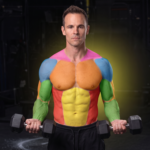
In a recent YouTube video, fitness creator Jeremy Ethier documented a 30-day forearm transformation experiment that revealed surprising insights about grip strength training.
After over a decade of lifting weights, he discovered his forearms had become the second smallest part of his body—a wake-up call that led him down a research rabbit hole.

What he found was shocking: weak forearms aren’t just an aesthetic issue, but they’re linked to shorter life expectancy, can hold you back in the gym, and have even been shown to decrease your odds of being hired.
To find the most effective training method, he recruited two friends to test three completely different approaches: science-based gym exercises, daily hand gripper training, and the viral rice bucket method.
Jump to:
- The Alarming Decline in Grip Strength
- Understanding the Three Types of Grip
- Three Distinct Training Methods Put to the Test
- The Daily Training Dilemma
- The Lifting Strap Revelation
- Week Three Crisis and Plateau
- The Midpoint Farmer’s Carry Challenge
- The 30-Day Results
- Unexpected Strength Transfer
- The Top Three Forearm Exercises
- The Optimized Forearm Workout
- Key Takeaways
The Alarming Decline in Grip Strength
Before diving into training protocols, the trio established baselines using three distinct grip strength tests. The results were humbling across the board.
Multiple studies have found that average grip strength today is far weaker than it was just 20 years ago. This decline isn’t merely cosmetic—researchers have found a strong correlation between weak grip and early death.
Grip strength serves as one of the best predictors of overall strength and activity level, making it a crucial biomarker for longevity and health.
Understanding the Three Types of Grip
Grip strength breaks down into three distinct categories, each requiring different training approaches.
Support grip involves hanging from a bar or holding heavy objects for extended periods. This type is essential for rock climbing, deadlifting, and carrying groceries. Most beginners should manage 10-20 seconds on a dead hang, with 90-plus seconds considered elite.
Crush grip measures your ability to squeeze objects forcefully—think crushing an apple with your bare hand. This type gets tested with hand dynamometers and correlates strongly with handshake strength.
Pinch grip focuses on finger and thumb strength, measured by holding weight plates between your digits. This often-neglected grip type proved the most challenging for the participants.
Three Distinct Training Methods Put to the Test
Each participant committed to training only their left forearm daily for 30 days, leaving the right arm as a control.
Method 1: Hand Gripper Protocol (Robin)
Robin’s approach was simple: 100 daily repetitions using adjustable hand grippers. Starting on the lowest resistance, he progressively increased difficulty as he adapted.
This method required zero gym access and minimal time investment—perfect for someone new to resistance training.
Method 2: Rice Bucket Training (Dennis)
Dennis followed a popular online protocol involving submerging his hand in a bucket of uncooked rice and performing various gripping, twisting, and squeezing movements.
As resistance increased, he added metal bowls to the rice and eventually upgraded to a wooden spoon for additional challenge.
Feels kind of nice.
Dennis was the only participant not struggling through the early days of training.
Method 3: Science-Based Gym Exercises (Jeremy)
Jeremy designed a comprehensive program targeting all three major forearm areas with specific exercises for each.
Understanding forearm anatomy proved crucial for exercise selection:
- Flexors – The beefiest part of your forearms, trained through wrist curls with dumbbells and cables
- Extensors – Muscles on top of your forearm that create impressive striations when developed, trained through wrist extensions
- Brachioradialis – The prominent muscle near your elbow crease, arguably the most visually impressive forearm muscle
The brachioradialis required special attention. Unlike other forearm muscles, it doesn’t cross the wrist joint and won’t develop through wrist movements alone.
To target this muscle effectively, Jeremy used hammer grip variations and incline positions that disadvantaged the biceps, forcing the brachioradialis to work harder.
The Daily Training Dilemma
Training any muscle group every single day contradicts conventional wisdom about recovery. However, recent research suggests otherwise.
A study had well-trained lifters bench press every single day for 34 consecutive days. Rather than burning out, participants made insane strength gains—adding an average of 40 pounds to their one-rep max.
For experienced lifters, such progress would normally require over a year to accomplish.
Jeremy hypothesized that short daily forearm sessions shouldn’t impede recovery and might actually accelerate results. By day two, however, reality set in.
My forearms have never been this sore before. Clearly, I don’t train them. I don’t know if I’m going to be able to do this for 30 days.
The Lifting Strap Revelation
Jeremy identified a major culprit behind his underdeveloped forearms: excessive reliance on lifting straps.
After discovering research showing straps instantly increase deadlift performance by around 40 pounds, he’d begun using them for all back and biceps exercises. His forearms simply stopped getting challenged.
During the experiment, he tested whether improved grip strength would translate to better performance on exercises like incline biceps curls—movements where grip often becomes the limiting factor.
Week Three Crisis and Plateau
Around week three, Jeremy hit a concerning plateau. His forearms felt exhausted, and workout performance tanked.
I am frustrated. My lifts this week have been horrible. My forearm strength has tanked. I’m a little worried because my forearms feel exhausted.
Looking back at the daily bench press study data provided reassurance. Participants experienced fluctuating daily performance—some days stronger, some weaker—but ultimately ended significantly stronger than baseline.
Meanwhile, Robin was crushing his hand gripper progression, reaching the hardest resistance setting. Dennis had upgraded his rice bucket with metal bowls and wooden implements for added difficulty.
The Midpoint Farmer’s Carry Challenge
Halfway through the experiment, participants attempted a standard fitness benchmark: carrying 50% of body weight for 30 seconds using only their training arm.
This 30-second test reliably assesses functional grip strength. Passing indicates adequate grip performance; failing signals serious work needed.
Jeremy and Dennis both passed. Robin failed, giving him two weeks to bring his support grip up to par.
The 30-Day Results
After completing the full month, participants retested all baseline measurements. Results varied dramatically based on training method.
Crush Grip Outcomes
Jeremy’s science-based approach won this category with measurable improvements in hand dynamometer scores. Dennis’s rice training showed minimal change, while Robin—surprisingly—actually decreased slightly in performance.
Dead Hang Performance
Dennis’s rice bucket training dominated the support grip category, improving his dead hang time from 5 seconds to 14 seconds—a nearly 3x improvement.
Jeremy’s time remained essentially unchanged. Most shocking: Robin’s hand gripper training actually decreased his dead hang performance from 12 seconds to just 5.59 seconds.
This revealed a critical insight: hand grippers don’t transfer well to support grip endurance.
Pinch Grip Surprise
Robin absolutely crushed the pinch grip test, improving from 6 seconds to 20 seconds—more than triple his baseline.
Jeremy improved modestly by one second. Dennis showed slight improvement but nothing compared to Robin’s dramatic gains.
Size Measurements
When measuring average growth across upper, middle, and lower forearm points:
Third place: Dennis’s rice training – Modest upper forearm growth, zero growth in middle and lower regions
Second place: Jeremy’s gym protocol – Significant growth in upper and middle forearm, but lower forearm (near wrist) remained unchanged
First place: Robin’s hand grippers – Minimal upper forearm change but highest growth around middle and lower forearm
Robin’s beginner status likely contributed to enhanced hypertrophy response, as this marked his first-ever structured exercise program.
Unexpected Strength Transfer
Perhaps the most interesting finding came from retesting biceps curl performance.
Both Jeremy and Dennis experienced greater strength improvements on their trained left side compared to their untrained right side—suggesting stronger forearms may boost performance in other lifts.
Robin showed no change, but his lack of regular weight training likely explains this absence of transfer.
The Top Three Forearm Exercises
After experimenting with dozens of movements, Jeremy narrowed his recommendations to exercises that maximized growth while minimizing joint stress:
- Cable wrist extensions – Superior to dumbbell variations for targeting extensors without elbow aggravation
- Incline hammer curls – Placing arms on an incline bench disadvantages biceps and forces brachioradialis to work harder
- Cable wrist curls – Consistent tension throughout the movement for maximum flexor activation
As a bonus, Jeremy recommended farmer’s carries at workout completion, especially for beginners developing foundational grip strength.
The Optimized Forearm Workout
Based on his findings, Jeremy developed a twice-weekly protocol performed on leg days or rest days:
- Three sets to failure for each major forearm area (flexors, extensors, brachioradialis)
- Total workout time: under 10 minutes
- Easily integrated between other exercise sets
- Reduced reliance on lifting straps during back and biceps work
For complete beginners, starting with a simple hand gripper provides low barrier entry with measurable progress—potentially even stimulating growth in lower forearm regions.
Key Takeaways
Each training method excelled in different areas, suggesting grip strength is highly specific to training stimulus.
Hand grippers built pinch strength and lower forearm size but failed to improve support grip. Rice bucket training dramatically enhanced endurance-based support grip. Science-based gym exercises delivered balanced development across all forearm regions with moderate improvements in multiple grip types.
Daily training proved viable for forearm development, though temporary plateaus are normal and shouldn’t cause concern.
Perhaps most importantly: your forearms deserve direct attention. Assuming compound lifts will handle everything leaves this crucial muscle group—and important health marker—underdeveloped.