What if getting in shape no longer required grinding hours in the gym, strict diets, and the discipline of a monk? What if achieving a lean, muscular physique and optimal health became less about willpower—and more about access to the right tools?
Welcome to the future of fitness, where artificial intelligence, pharmaceutical breakthroughs, and data-driven optimization are fundamentally changing what it means to “work out” and be fit.
This transformation is not hypothetical. It’s already happening.
Jump to:
Fitness, Reimagined: From Sweat Equity to Scientific Precision
For decades, fitness has been framed as a simple—but brutally hard—equation: eat less, move more. Results were earned through effort, sweat, and time. But today, a growing number of thinkers, scientists, and biohackers are pushing a new narrative: fitness can—and should—be efficient, sustainable, and personalized.
Bryan Johnson, tech entrepreneur and founder of Blueprint, is one of the most visible figures in this movement. “We are in the early stages of moving from a world of I tried my best to a world of I ran the protocol,” he said in a recent interview. Johnson spends millions each year optimizing his biological age, tracking over 100 biomarkers, and following a lifestyle that some call extreme—but many view as the blueprint for the future.
His goal? Not just to be fit—but to slow, stop, or even reverse aging.
The Rise of GLP-1s: Rethinking Fat Loss
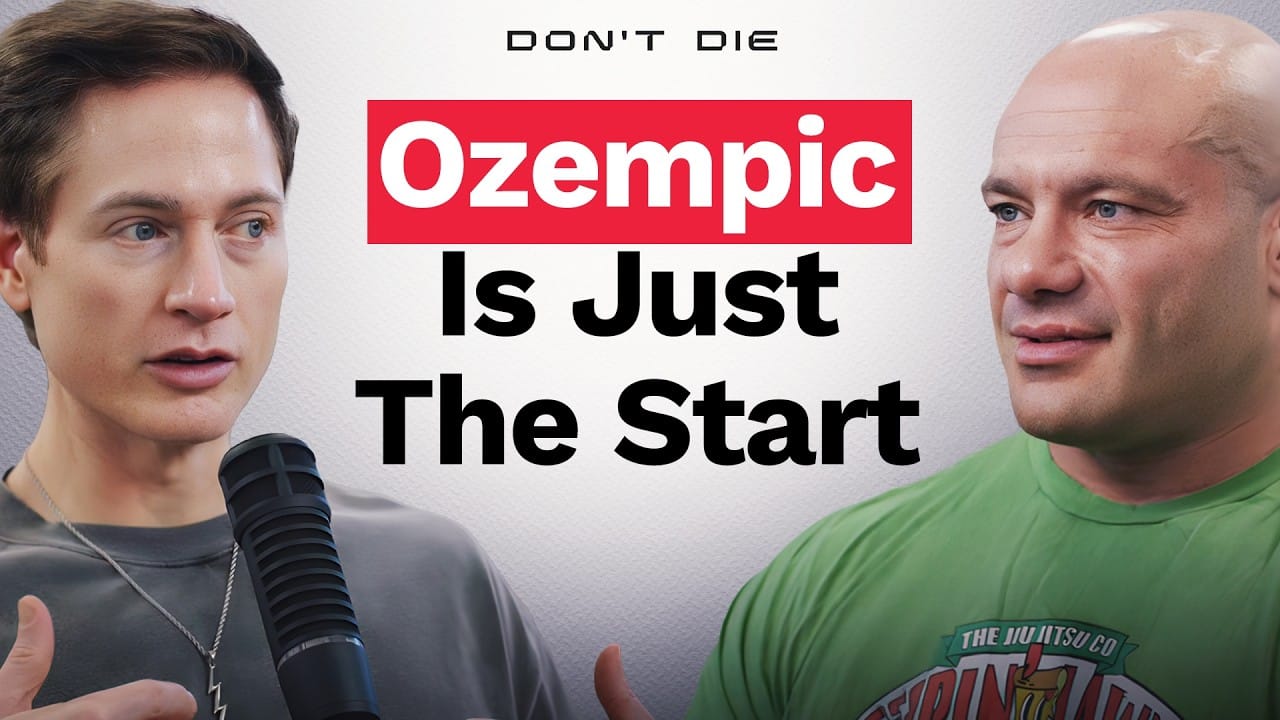
At the center of this revolution are GLP-1 receptor agonists—medications like Ozempic and Wegovy that were initially developed for diabetes but are now transforming weight loss.
Unlike previous weight loss drugs that often came with harsh side effects or marginal benefits, GLP-1s are clinically proven to reduce appetite, improve blood sugar regulation, and help users shed significant body fat. Some patients report losing 15–20% of their body weight.
Dr. Mike Israetel, a Ph.D. in Sports Physiology and co-founder of Renaissance Periodization, acknowledges their power but cautions against viewing them as a cure-all.
“GLP-1s are tools, not magic,” he says. “If someone uses them to create better habits, they can be life-changing. But without lifestyle change, the weight can come right back.”
Still, these drugs represent a dramatic shift. For the first time, science is giving people a viable alternative to years of caloric restriction and failed diets.
AI Coaching and Personalized Training Protocols
Beyond medication, artificial intelligence is playing a larger role in guiding people’s fitness journeys. Platforms are now offering hyper-personalized workout and nutrition plans based on an individual’s goals, body type, genetics, and lifestyle.
This shift from generalized advice to algorithmic precision is already visible in apps like Future, Tonal, and even Apple’s growing health ecosystem. But some pioneers are taking it further.
Bryan Johnson, for instance, refers to his daily routine as a “self-operating protocol,” based on over 2,000 measurements from wearables, bloodwork, ultrasounds, and microbiome analysis. Every bite of food, every supplement, every rep in the gym is optimized to delay aging and maintain peak physical condition.
“I want to be the most measured human in history,” Johnson says. “And use that data to help humanity understand how to maximize healthspan.”
Discipline vs. Downloads: The Ethics of Effort
As science makes it easier to get in shape, a growing debate is emerging: Does removing the struggle also remove the value?
Traditional fitness culture has long glorified effort. Pain was a rite of passage. Progress was slow. Transformation was hard-won.
But today, people can achieve visible results with far less effort. A well-calibrated protocol that includes GLP-1s, moderate exercise, high-protein nutrition, and recovery tools can deliver dramatic outcomes without suffering.
“There’s still room for hard training and pushing your limits,” says Israetel. “But now we also have a choice. You can work smarter. You can use tools. That doesn’t make you lazy—it makes you modern.”
This doesn’t mean fitness is becoming effortless. But the levers of change have shifted. Precision and strategy are replacing brute force.
Biomarkers: The New Six-Pack
In this new paradigm, aesthetics are no longer the only goal. Instead, longevity, energy, and internal health are becoming the metrics that matter most.
Biological age—the age of your cells and systems, not your birth certificate—is now trackable via bloodwork, epigenetic testing, and wearable data. And it’s possible, with the right protocol, to lower it.
Johnson claims to have slowed his pace of aging by the equivalent of 31 years. In other words, his organs, skin, and systems are functioning more like those of a man in his twenties.
The implications are massive. In the near future, looking good may be less impressive than having the inflammation markers of a teenager and the VO2 max of a triathlete.
The Gym Is Optional, Not Obsolete
Despite all these advances, physical activity still matters. Resistance training, cardio, and mobility are foundational to long-term health.
But the way people train is evolving.
Shorter, more efficient workouts are in. Recovery and sleep are seen as performance-enhancing tools. And for many, the gym is no longer a requirement—it’s a choice. Home workouts, resistance bands, blood flow restriction cuffs, and AI coaching make fitness more accessible than ever.
“We’re not replacing hard work,” says Israetel. “We’re just being smarter about where we apply it.”
A New Definition of Fit
In this emerging world, fitness is not about discipline, deprivation, or punishment. It’s about systems. Protocols. Optimization.
It’s about choosing the most effective levers—whether it’s nutrition, supplements, medication, sleep, or training—to achieve a goal. That goal could be fat loss, muscle gain, energy, or longevity.
And increasingly, that choice is personalized. What works for one person may not work for another—and that’s okay. Data, not dogma, is the new compass.
As Bryan Johnson puts it: “We no longer need to rely on subjective judgment or anecdotal advice. We can build evidence-based, personalized health protocols that work for our unique biology.”
The Bottom Line
The future of fitness isn’t about abandoning effort—it’s about upgrading it. Through GLP-1s, AI, wearable data, and bio-optimization, we now have access to tools that can fast-track results, sustain progress, and even reverse aging.
The grind isn’t gone—but it’s being redefined.
Fitness is becoming less about who can suffer the most—and more about who can adapt the best. And for many, that shift may be the key to finally achieving the results they’ve been chasing for years.
Welcome to the new era of fitness. The question is no longer can you do it? It’s how will you choose to get there?