When Gal Gadot landed the role of Wonder Woman in 2013, skeptics flooded the internet with doubt.
At 5’10” and coming straight from a modeling career, critics questioned whether she could embody an Amazonian warrior princess whose comic book physique had been illustrated as essentially superhuman for over eighty years.
What those doubters failed to account for was Gadot’s military background—two years of mandatory service in the Israel Defense Forces—and the transformative capabilities of trainer Magnus Lygdback, who would spend the next six months sculpting one of Hollywood’s most believable action heroes.
The result? Seventeen pounds of lean, functional muscle that redefined what a female superhero could look like on screen.
Jump to:
The Philosophy Behind an Amazonian Warrior
Lygdback—a Swedish trainer who would go on to work with Ben Affleck’s Batman and multiple DC Extended Universe actors—approached Wonder Woman preparation with a concept he calls “athletic beauty.”
Diana Prince isn’t a bodybuilder. She’s a warrior-athlete trained in combat, archery, sword fighting, and Amazonian military arts since childhood.
The physical expression of that history is lean, dense, functional muscle—the kind built by decades of varied athletic training rather than years of isolation exercises in a commercial gym.
This European athletic training tradition emphasizes movement quality and power development over American bodybuilding methods that prioritize size and symmetry above all else.
Six Months of Warrior Training
Preparation for the first Wonder Woman film involved six months of intensive work before cameras rolled, continuing throughout the entire production.
Gadot trained with Lygdback six days per week in sessions combining fight choreography with strength and conditioning—a necessity given the film’s extended action sequences.
Central to the transformation was what Lygdback termed “warrior training”—a combination of traditional strength work, martial arts conditioning, and functional athletic movements.
Gadot incorporated kickboxing, sword training, horseback riding preparation, and rock-climbing exercises that developed the grip strength and upper body pulling capacity necessary for iconic shield-and-sword sequences.
This breadth of athletic preparation gave her adaptable athleticism that reads as authentic warrior capability on screen rather than manufactured gym aesthetics.
Starting From Military Fitness
Gadot’s baseline was more athletic than many assume.
Israeli military service involves genuine physical conditioning, and Gadot maintained fitness throughout her modeling career. However, transitioning from fit civilian to warrior princess required fundamental shifts in training volume, intensity, and specificity.
Adding seventeen pounds of muscle to a 5’10” frame—from approximately 120 to 137 pounds—represented a significant transformation that demanded consistent heavy training and a caloric surplus during building phases.
This wasn’t accidental weight gain. Every pound was strategically added muscle tissue that contributed to Diana’s physical presence.
The Training Split
Lygdback structured Gadot’s program around compound movements that built functional strength while developing the aesthetic qualities necessary for an Amazonian warrior.
Lower Body Power Development
Barbell hip thrusts formed the foundation of posterior chain development—building the glutes and hamstrings that generate explosive power in combat movements.
Four sets of 10-12 reps with progressive loading developed the kind of hip extension strength that translates to jumping, kicking, and ground-based power generation.
Front squats built quad dominance and core stability simultaneously—four sets of eight reps with substantial loading that demanded perfect posture and trunk control.
Unlike back squats, front-loaded variations force upright positioning that translates directly to athletic movement patterns.
Bulgarian split squats addressed unilateral leg strength and hip flexor mobility—three sets of twelve reps per leg that built single-leg stability crucial for fight choreography.
Upper Body Pulling Strength
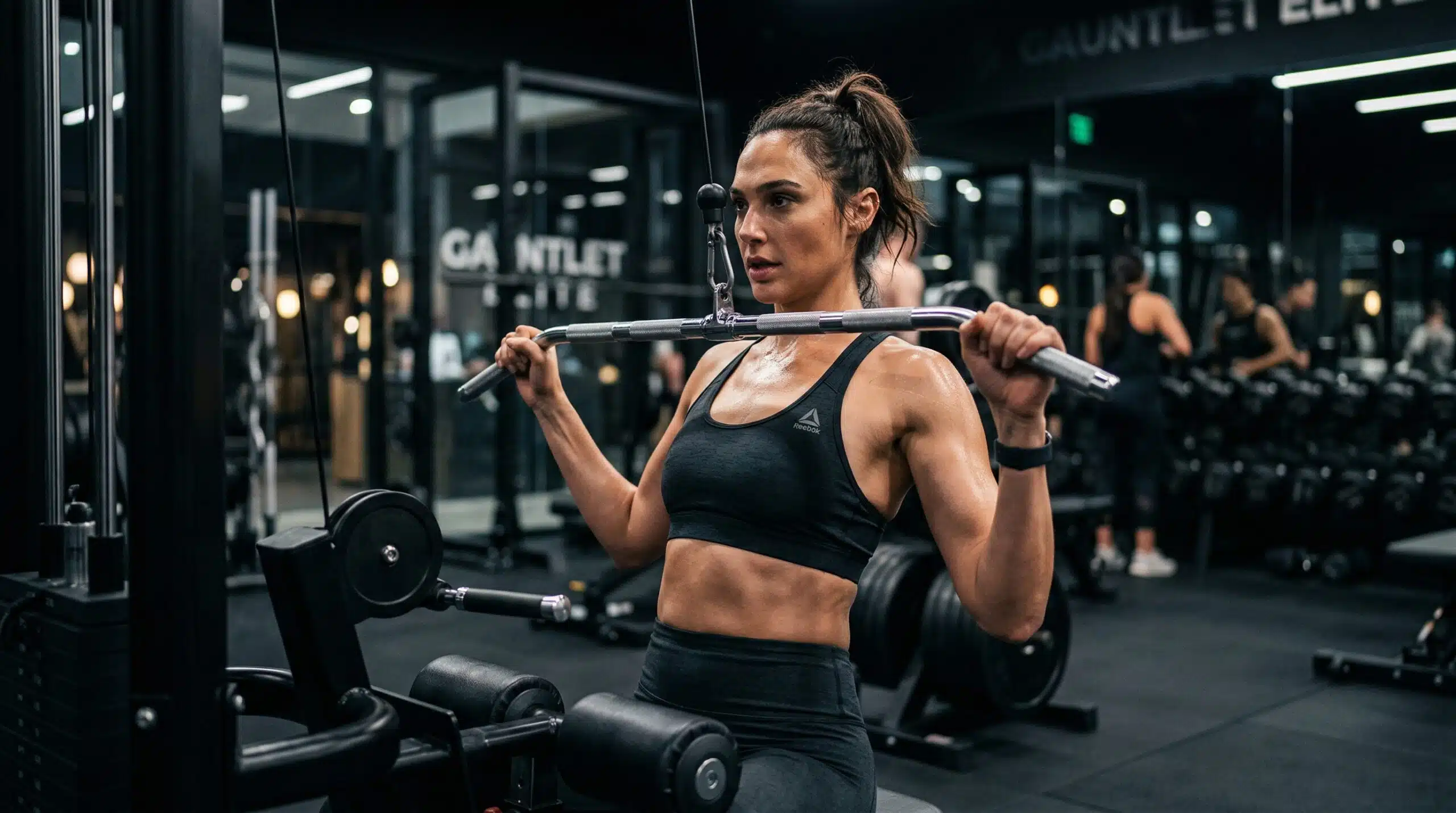
Weighted pull-ups developed the lat width and pulling strength visible in every shield-grabbing sequence—four sets of eight reps that progressively added external load as bodyweight reps became insufficient.
This movement built the V-taper and shoulder-to-waist ratio that gives Diana her imposing silhouette in costume.
TRX inverted rows provided high-rep horizontal pulling that balanced the vertical pull-up work—three sets of fifteen reps emphasizing scapular retraction and upper back thickness.
Rotational Power and Core Integration
Landmine rotational presses developed the anti-rotation core strength and shoulder stability required for sword fighting—three sets of ten reps per side that trained power transfer from ground through core to upper body.
This movement pattern directly mimics combat mechanics where force generated in legs must transfer through a stable trunk to hands holding weapons.
Posterior Chain Specialization
Nordic hamstring curls—one of the most brutally effective hamstring builders available—three sets of 6-8 reps that developed eccentric strength and injury resilience.
This exercise builds the kind of hamstring development visible in athletic populations but rarely seen in general gym-goers who rely exclusively on leg curls.
Conditioning and Explosive Power
Battle rope waves provided metabolic conditioning that maintained cardiovascular fitness without the joint stress of distance running—four sets of thirty seconds on, thirty seconds off.
This conditioning approach built the shoulder endurance and work capacity necessary for extended fight scenes while developing visible shoulder and arm definition.
Nutrition Periodization
Lygdback’s nutritional approach involved cycling between building and leaning phases.
During building phases, Gadot consumed a slight caloric surplus with emphasis on protein (1.6-2.2g per kilogram bodyweight) and carbohydrates timed around training sessions.
This created the metabolic environment necessary for muscle protein synthesis and tissue growth.
Leaning phases involved modest caloric deficits while maintaining protein intake to preserve muscle mass—allowing strategic fat loss before sequences where Diana’s physique would be most visible on camera.
This periodization approach maximized muscle gain without excessive fat accumulation, then revealed that development through targeted deficit periods.
The Fight Choreography Component
What separates Gadot’s transformation from typical gym-based physique development is the thousands of hours spent learning combat sequences.
Working with choreographers to develop Wonder Woman’s distinctive fighting style—a blend of Amazonian warrior tradition and modern martial arts—Gadot built movement qualities that purely strength-based training cannot replicate.
Shoulder stability, hip mobility, and reflexive athleticism developed through actual movement training rather than static strength work.
Sword work built grip endurance and forearm development. Kickboxing improved hip flexibility and generated leg conditioning. Shield combat created shoulder stabilization and core bracing capacity.
The integration of these elements produced a physique that looks like it fights rather than simply lifts—a crucial distinction for believability in an action role.
Challenging Assumptions About Female Training
Gadot’s seventeen-pound muscle gain challenges persistent myths about female physique development.
Adding quality muscle tissue to a 5’10” frame required consistent progressive overload in compound movements, adequate protein consumption, sufficient sleep, and long-term commitment that most abandon after six weeks.
Lygdback’s approach rejects the common tendency to train women differently from men—specifically the habit of prescribing light weights and high reps out of fear of “excessive” muscle development.
Women build strength and lean muscle; they do not bulk up the way men do from the same stimulus.
His female clients follow identical progressive overload principles as male clients, with hormonal differences producing different aesthetic outcomes from the same training stimulus.
The result isn’t bodybuilder mass—it’s athletic density and functional capacity that reads as powerful grace rather than bulk.
Practical Application for Non-Actors
Achieving comparable body composition changes with part-time training requires extending the timeline.
Someone training four days weekly can expect to see similar transformations over 12-18 months that Gadot achieved in six months of full-time preparation.
The programming principles remain identical—compound movements, progressive overload, adequate protein, periodized nutrition—but training frequency determines speed of adaptation.
Key elements to prioritize:
- Heavy compound movements emphasizing legs, back, and pulling strength
- Progressive overload systematically increasing weight, reps, or sets over time
- Protein intake around 1.6-2.2g per kilogram bodyweight daily
- Strategic surplus and deficit phases rather than continuous bulking or cutting
- Movement-based conditioning instead of exclusively steady-state cardio
Beyond Aesthetics to Athleticism
What makes the Wonder Woman transformation instructive isn’t just the visual result—it’s the functional capacity developed in pursuit of that aesthetic.
Gadot didn’t simply look like a warrior. She developed genuine athletic capabilities: pulling strength, explosive power, movement coordination, and work capacity that allowed her to perform extended action sequences.
This represents a fundamental shift from physique development divorced from performance—the difference between training to look athletic versus training to be athletic.
The distinction matters because performance-focused training produces superior aesthetic results while building actual capability rather than purely cosmetic adaptations.
Building a body that can perform generates the kind of muscle quality, density, and proportion that reads as authentically powerful rather than artificially constructed.
That’s the lesson from Gadot’s Wonder Woman preparation: train like a warrior, look like a warrior, become a warrior.