Dr. Mike Israetel of Renaissance Periodization recently broke down the strategic role of cardio in fat loss, and his approach might surprise anyone who thinks endless treadmill sessions are the answer.
In a detailed lecture, he explained why cardio isn’t primarily about burning calories—it’s about sustaining the deficit your diet creates.
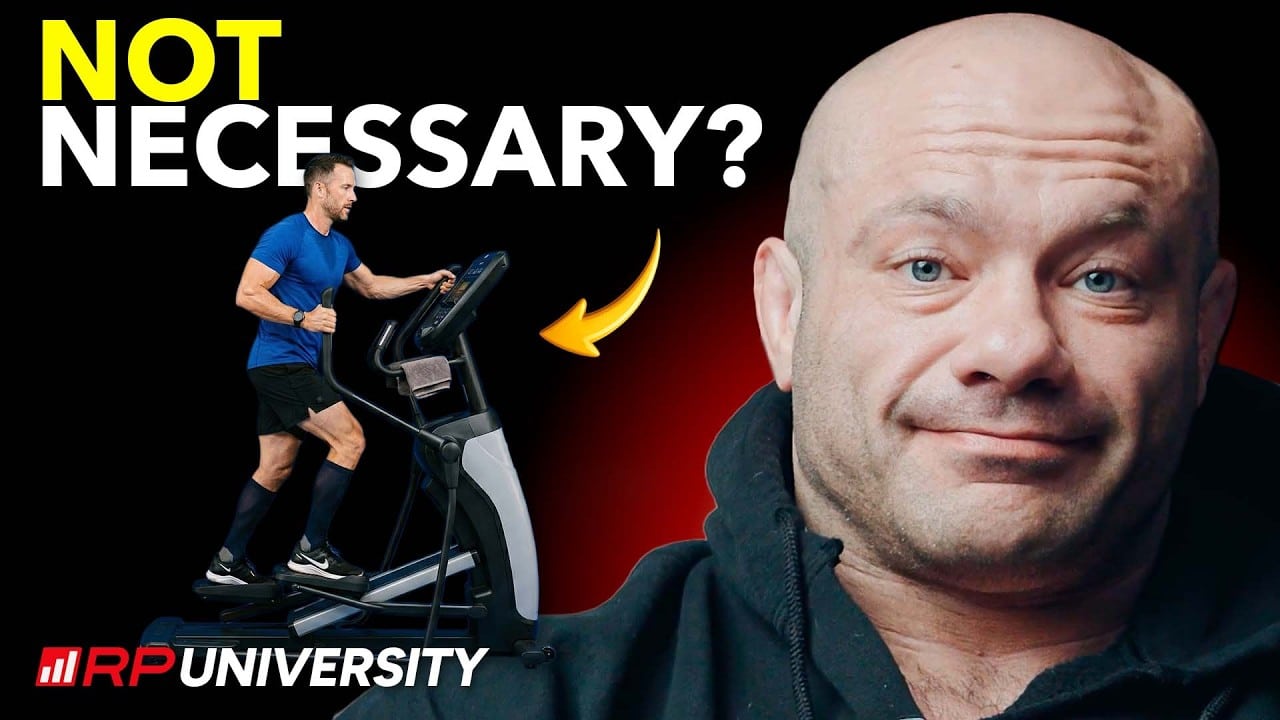
For fitness professionals and anyone struggling with stubborn fat loss, understanding this hierarchy could be the difference between sustainable results and frustrating plateaus.
Here’s how to structure training, nutrition, and movement for maximum fat loss with minimum misery.
Jump to:
The Three Pillars of Fat Loss (And Their Priority Order)
Dr. Israetel outlined three critical components for engineering fat loss, emphasizing that order matters tremendously.
Lifting Weights: The Muscle Protector
Weight training during a cut serves one primary purpose: muscle retention.
In a fat loss phase, lifting is not primarily a way of burning extra calories and burning extra fat. It is primarily a modality by which we retain muscle.
This distinction is crucial. While lifting does burn some calories, its real value lies in sending a powerful signal to your body: this muscle is still needed.
For clients following intelligent programming over 8-12 weeks, Dr. Israetel noted that trainers can “nearly guarantee that they will lose zero muscle the entire time.” The result? Pure fat loss, not the muscle-and-fat combination seen in typical weight loss studies.
Diet: The Primary Deficit Creator
Caloric restriction through diet is the biggest lever for creating a deficit. Once maintenance calories are established and strength training locks muscle mass in place, reducing food intake becomes the main driver of fat loss.
But there’s a critical threshold to respect—cut calories too aggressively, and the entire system breaks down.
Physical Activity: The Deficit Sustainer
This is where Dr. Israetel’s framework diverges from conventional wisdom. Cardio and daily movement don’t create most of the deficit—they sustain it.
If you set your physical activity to a certain minimum level and get the client moving at or above that physical activity level, then all of the food reductions you are imposing actually will have the intended effect.
Without activity tracking, clients unconsciously reduce movement as calories drop, sabotaging the deficit without realizing it.
Why Your Body Fights Against Fat Loss
Understanding evolutionary biology explains why fat loss feels so difficult.
Dr. Israetel used a vivid analogy: when you see a coyote with ribs showing, you don’t admire its leanness—you recognize it’s starving. In ancestral environments, weight loss signaled danger, triggering automatic energy conservation.
Without exception, almost without exception, every organism, every animal on Earth, when their food intake falls, they move less.
This adaptation is hardwired. As diets progress, clients naturally become less active—fidgeting less, walking slower, sitting more—often without conscious awareness. This non-exercise activity thermogenesis (NEAT) reduction can completely eliminate a caloric deficit.
The solution? Tracking activity ensures clients maintain baseline movement even as their bodies push back.
The Fatal Flaw of Extreme Approaches
Both ends of the spectrum—very low food with minimal activity, or very high food with excessive cardio—create problems.
The Low-Food, Low-Activity Trap
Clients eating 1,000 calories daily while taking only 2,000 steps might lose weight on paper, but the experience is miserable:
- Intense hunger and discomfort
- Increased muscle loss, especially in legs
- Devastated energy levels that disrupt work and social life
- Unsustainable adherence
The High-Food, High-Activity Delusion
The opposite extreme sounds appealing—eat more, just move more to compensate. Reality check: one apple contains about 100 calories, requiring roughly 20 minutes of treadmill work to burn off.
Dr. Israetel highlighted the mathematics problem: “If I have an extra sandwich per day, that is like an hour of treadmill time extra that I have to do in order to burn off that sandwich.”
Clients attempting 20,000+ steps daily to offset higher food intake face:
- Profound physical fatigue
- Reduced NEAT as the body compensates by decreasing non-exercise movement
- Lifestyle disruption from excessive time spent exercising
- Potential injury from overuse
The 80/20 Solution for Sustainable Fat Loss
Dr. Israetel’s recommendation strikes a careful balance using two principles.
Food: Cut Significantly, Not Extremely
Reduce calories to about 80% of the threshold where clients would start feeling genuinely miserable. This creates substantial deficit without triggering extreme hunger or metabolic shutdown.
The reasoning involves biological thresholds. Like a weightlifting set with five reps in reserve feeling manageable while pushing to failure feels exponentially harder, there’s a caloric reduction point where discomfort skyrockets disproportionately.
There is a point which you can lower calories and be pretty decent. And a very close to that point, just a little further in caloric reduction away, in which you feel real, real shitty.
Staying conservative protects adherence—the most important variable in long-term success.
Activity: Maintain Moderate-High Movement
Target activity levels in the “moderate-high zone,” typically 10,000-12,000 steps daily for most people. This keeps clients moving more than average without approaching athlete-level training volumes.
The strategy works because:
- It prevents NEAT reduction that would sabotage the deficit
- It feels sustainable—clients perceive themselves as active but not obsessive
- It maintains productivity rather than crushing energy for daily tasks
- It creates consistency without excessive fatigue
Rather than dramatically increasing activity, simply establish baseline movement before dieting begins, then maintain or slightly elevate it by about 20%.
Why Formal Cardio Isn’t Mandatory
Despite the lecture series focusing on cardio for fat loss, Dr. Israetel emphasized an important truth: clients don’t need formal cardio sessions to lose fat.
What they do need is activity tracking and awareness. Whether through structured cardio sessions, daily step counts, or active hobbies, the goal remains consistent: maintain moderate-high movement that sustains the caloric deficit created primarily through diet.
Step tracking provides objective feedback that prevents the unconscious activity reduction that derails progress. An 8,000-step baseline maintained consistently throughout a diet works better than sporadic high-intensity sessions that leave clients exhausted.
Practical Implementation
Applying Dr. Israetel’s framework requires specific steps.
First, establish baseline activity before reducing calories. Track steps for one week to determine natural movement patterns.
Second, implement resistance training focused on muscle retention, not calorie burning. Progressive overload remains important even during cuts.
Third, reduce calories substantially but conservatively—enough to create a meaningful deficit without triggering extreme hunger or fatigue.
Fourth, maintain or slightly increase activity to 10,000-12,000 steps daily, monitoring consistently to prevent unconscious reduction.
This system creates a “locked” framework where muscle retention is guaranteed through lifting, activity expenditure is stabilized through tracking, and food reduction creates the deficit with minimal resistance from biological compensation mechanisms.
Moderate food reduction, coupled with slight activity elevation above baseline, is the secret sauce of properly running a fat loss diet.
The result? Fat loss that feels sustainable rather than punishing, protects hard-earned muscle, and respects real-world lifestyle demands. By prioritizing hierarchy correctly—lifting for muscle, diet for deficit creation, activity for deficit maintenance—clients achieve results without the misery that typically accompanies aggressive cuts.