Running fast guarantees Hyrox success, right? That’s what conventional wisdom suggests—lace up your shoes, log miles, sprinkle in minimal strength work, and victory is yours.
But what if that’s only half the story?
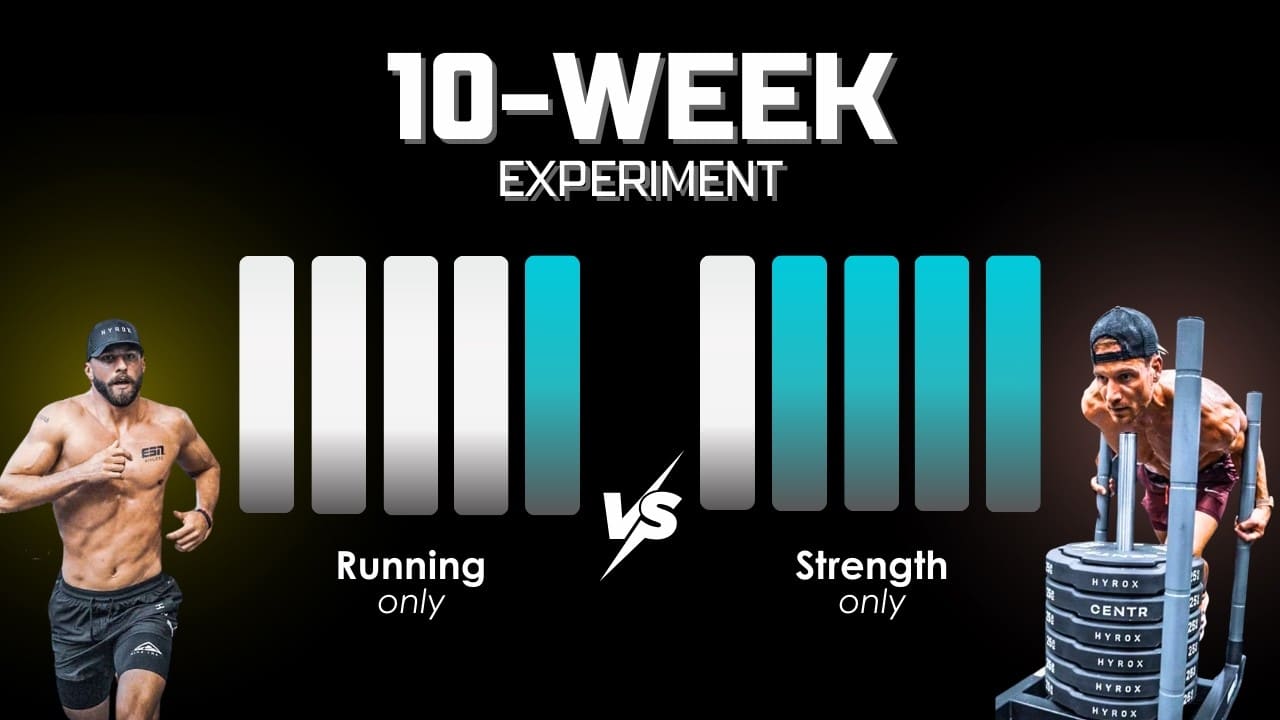
Exercise scientist Gomar, a senior researcher at ETH Zurich, recently completed a 10-week study comparing two radically different Hyrox training approaches. One group prioritized running with minimal gym work, while the other flipped the script—heavy strength and power training with barely any running.
The results challenge everything athletes thought they knew about preparing for this explosive fitness competition.
Jump to:
- The Study Design: Two Paths, One Goal
- The Testing Protocol: No Mercy
- The Shocking Results: Both Groups Won
- Individual Variation: Why Some Athletes Soared While Others Stalled
- The Training Specificity Principle: You Get What You Train For
- Practical Applications: Programming Your Hyrox Training
- Study Limitations and Future Research
- The Bottom Line: Strategic Training Beats Generic Programming
The Study Design: Two Paths, One Goal
When Gomar’s team advertised the “Hyrox Blueprint Study” in September 2024, 347 people expressed interest within two weeks. By the time pre-testing concluded, 94 participants completed the brutal assessment week.
The dropout rate was significant—only 43 people finished all pre-tests, post-tests, and at least 80% of training sessions. This 55% attrition rate is typical for remote studies, Gomar explains, particularly when participation is voluntary and free.
The remaining participants weren’t beginners. These were experienced athletes aged 30-40 with six to seven years of sport-specific experience, training five to seven hours weekly. About 32% came from CrossFit backgrounds, 22% specifically from Hyrox, and 12% from triathlon or endurance sports.
Group A: The Runners
Twenty-one participants (including five females) trained with three to four weekly running sessions plus one strength and power development session in the gym. Their running followed the classic three-zone model: 70% easy aerobic work (Zone 1), 15% threshold work (Zone 2), and 15% high-intensity intervals (Zone 3).
Group B: The Affiliate Athletes
Twenty-two participants (including nine females) did the opposite—four weekly gym sessions focused on strength, conditioning, power development, and Hyrox-specific movements, with only one conditioning session (not running) per week.
Critically, both groups maintained identical total training loads. Gomar’s team calculated this using session RPE (Rate of Perceived Exertion) multiplied by training volume, producing what’s called “TRIMP” or training impulse.
If I do a Hyrox session, it’s a 40-minute session, I can go back the next day and be perfectly fine. If I do a 50-minute soccer practice at RPE 8, I cannot walk for the next two days. It’s called training specificity and it depends really on what you’re used to before.
The Testing Protocol: No Mercy
Before and after the eight-week training block, participants endured a comprehensive assessment week that would break most casual fitness enthusiasts.
- Tuesday: Complete Hyrox simulation in their own gym
- Thursday: 7-minute AMRAP of burpees immediately followed by a 3-minute max-distance sled push (one category below competition weight)
- Friday: Karen—150 wall balls for time (9kg or 6kg ball)
- Sunday: 5K time trial run
Importantly, participants repeated these tests mid-study after four to five weeks. This addressed the learning bias problem—when athletes improve simply from test familiarity rather than actual fitness gains.
Maybe some people who have been watching this have done the CrossFit Open. If you do on Friday evening the CrossFit Open workout and then on Sunday without getting fitter, without doing any training, you repeat that workout, most of the time you get better.
The Shocking Results: Both Groups Won
Here’s where things get interesting. Both training approaches produced nearly identical Hyrox simulation improvements—approximately 8-10%.
The affiliate group that barely ran still shaved significant time off their Hyrox performance. The running-focused group also improved substantially. No statistical difference existed between groups in overall Hyrox time improvement.
But the devil lives in the details, and that’s where training specificity revealed its power.
Speed and Power: Affiliate Athletes Dominated
When examining individual performance markers, clear patterns emerged. The affiliate Hyrox group improved their 7-minute burpee AMRAP by 9%, while runners improved only 3% (not statistically significant). Statistical analysis confirmed the affiliate group’s superiority in this test.
For the Karen test (150 wall balls), results mirrored the burpee findings. Affiliate athletes crushed it with a 15% improvement, dropping from perhaps 8 minutes to 6-7 minutes. Runners improved marginally at 3.7%, which wasn’t statistically significant.
The sled push results proved inconclusive—neither group improved. Gomar suspects this stemmed from the test design, with athletes performing it immediately after burpees, potentially creating pacing issues that skewed data.
Endurance: Runners Take the Crown
The 5K time trial told a different story. Only the running group significantly improved their times—by 4.6%. The affiliate athletes showed no meaningful improvement in running performance.
Notably, this 4.6% running improvement was smaller than the functional movement improvements seen in the other group. Gomar attributes this to physiological reality: cardiovascular fitness adaptations require more time than neural adaptations for movement patterns.
Don’t be too down if you have been training for 12 weeks, 16 weeks on your running and you only see a 30-second improvement in your running time. This is also what we saw here in our results and I think physiologically completely explainable.
Individual Variation: Why Some Athletes Soared While Others Stalled
Not everyone responded equally to training. Some participants improved their Hyrox time by over 10%, while others showed minimal gains or even regressed slightly.
Gomar’s analysis revealed a crucial pattern: athletes with slower pre-test Hyrox times improved the most. A Pearson correlation of 0.61 demonstrated that beginners experienced significantly greater gains—the classic “newbie gains” phenomenon validated by data.
More experienced athletes with faster baseline times had less room for improvement during the eight-week period. This doesn’t mean advanced athletes can’t improve—it simply requires longer training cycles and more sophisticated programming.
The Training Specificity Principle: You Get What You Train For
The study’s most important takeaway transcends Hyrox. Training specificity reigns supreme.
Focus on running? Your endurance improves dramatically, but don’t expect wall ball mastery. Prioritize strength and power? Your functional movements soar, but running performance stagnates.
This principle has profound implications for program design. Athletes coming from endurance backgrounds need strength and power emphasis. Those with CrossFit or weightlifting experience require dedicated conditioning work.
Many roads lead to Rome, as Gomar puts it. Both training approaches produced similar overall Hyrox improvements, just through different mechanisms.
Practical Applications: Programming Your Hyrox Training
For athletes and coaches, these findings offer clear direction. Assess your current weaknesses and build programming around them.
If you’re an experienced runner with solid aerobic capacity but struggle with sleds and wall balls, minimal running maintenance combined with heavy strength focus makes sense. Conversely, strong CrossFit athletes who gas out on runs need dedicated aerobic development despite their gym prowess.
The “best of both worlds” approach likely exists somewhere between these extremes, though this study couldn’t definitively prove optimal ratios. What’s certain is that balanced programming addressing actual weaknesses trumps blindly following conventional wisdom.
Study Limitations and Future Research
The 55% dropout rate, while typical for remote studies, limits conclusions. The sled push test design needs refinement—separating it from burpees would provide clearer data. The relatively low female participation (30-40% of groups) prevented gender-specific analysis.
Gomar’s team plans to publish detailed findings in scientific journals, including multivariate analysis identifying which specific variables best predict Hyrox improvement. This deeper statistical work will help coaches understand whether wall balls, running, or other factors most influence overall performance.
The eight-week training window, while substantial, may not capture long-term adaptation patterns. Longitudinal studies tracking athletes over six months to a year would reveal whether training approach superiority emerges with extended timelines.
The Bottom Line: Strategic Training Beats Generic Programming
Running ability matters for Hyrox success—but it’s not the only path forward. This study demolishes the myth that Hyrox athletes must primarily log road miles to compete effectively.
Gym-focused training with minimal running produced identical overall Hyrox improvements compared to run-heavy programming. The difference lies in which specific capacities improve.
Smart athletes and coaches will use these insights to build periodized programs targeting genuine weaknesses rather than following one-size-fits-all templates. Training specificity isn’t just theory—it’s measurable, powerful, and essential for maximizing Hyrox performance regardless of your starting point.