Yes, you read that right. Strength phenom Larry Wheels just ripped 675 pounds off the floor with one arm.
The jaw-dropping lift, shared on his Instagram, looks almost unreal — like someone swapped out a barbell for a prop.
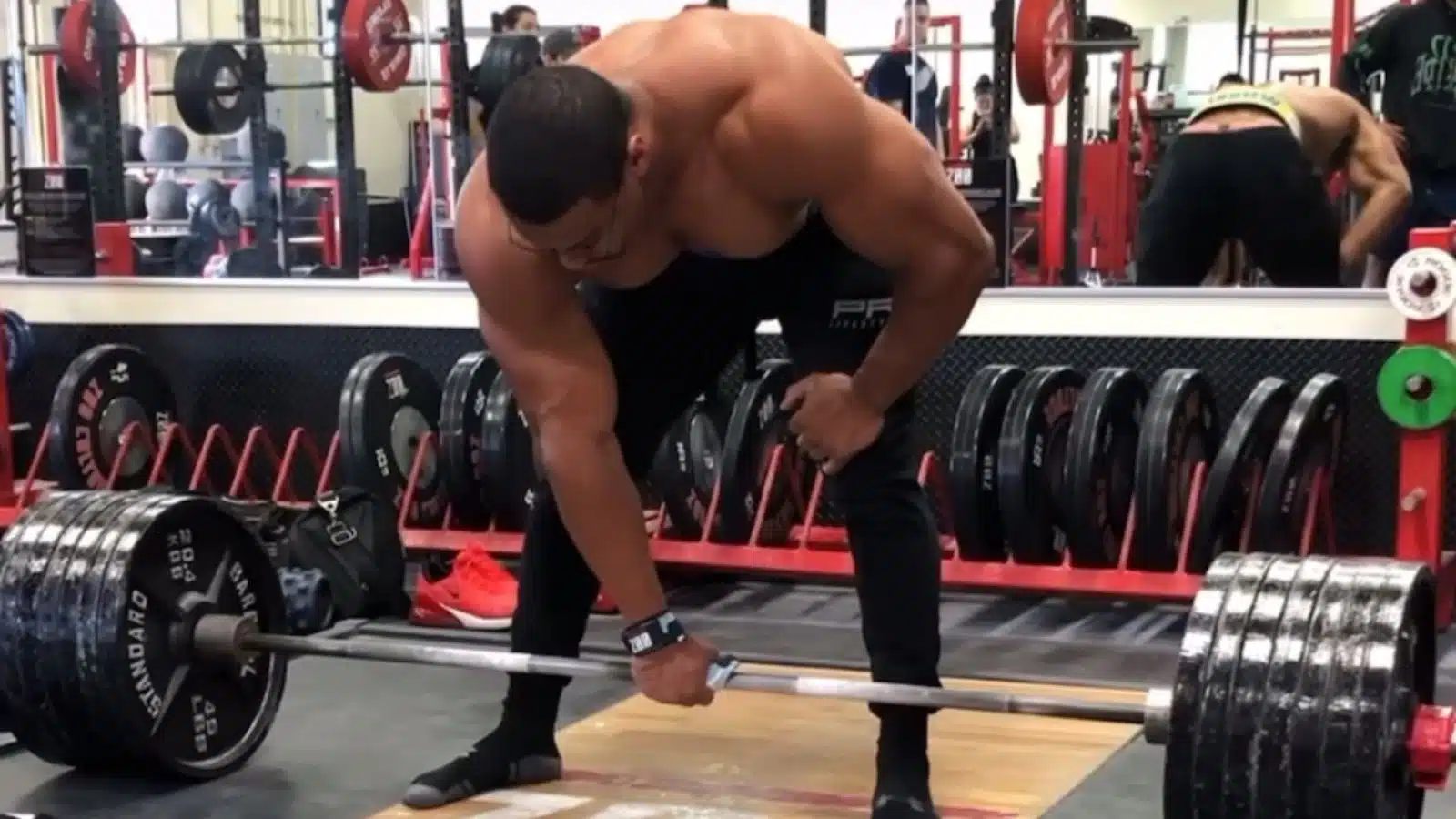
But it’s 100% legit, and it’s reignited interest in one of the most underrated lifts in strength training: the one-arm deadlift.
Beyond the spectacle, there’s real utility behind this old-school lift. Whether you’re chasing strength PRs or just trying to fix your deadlift form and bulletproof your lower back, the one-arm deadlift can be a game-changer.
Let’s break down what makes this lift so unique, and why you might want to include it in your training — even if you never plan to lift almost 700 pounds with one hand.
Jump to:
What Is the One-Arm Deadlift?
The one-arm deadlift is exactly what it sounds like: picking up a barbell from the floor with one hand.
While it might seem like just a party trick, it’s a legitimate strength movement with roots in old-school strongman training. Athletes like Hermann Görner (who allegedly pulled 727 lbs one-handed) helped popularize the lift in the early 1900s, and it’s still practiced today by grip athletes, strongmen, and powerlifters looking to develop next-level tension and full-body control.
There are two main ways to perform it:
- Conventional stance: Facing the bar as in a normal deadlift, just using one hand.
- Straddle stance: Standing with the bar between your legs for more stability and easier lockout.
Both are legal in competition, but the straddle stance typically allows for heavier loads.
Why This Lift Deserves Your Attention
It Exposes Weak Links in Your Chain
Deadlifting with one arm demands total-body coordination.
Unlike the two-handed version, where the barbell remains balanced, the one-arm deadlift introduces a rotational force — trying to twist your torso and tip the bar sideways. To fight that, your core, lats, glutes, grip, and even your obliques need to fire in perfect sync.
If something’s off — whether your lat isn’t engaged or your glutes aren’t firing — the bar will wobble or roll right out of your grip. That makes it a diagnostic tool for coaches and lifters alike.
“If any part of this kinetic chain is off, the bar will fail to stay stabilized and tip over,” says one strength coach. “That’s why I’ll use it with patients recovering from back pain — it forces proper bracing and sequencing before moving to full deadlifts.”
It Helps Fix Low Back Pain from Deadlifting
Back pain during deadlifts is often a symptom of poor stability, not just a lack of strength. Many lifters fail to properly brace, link their upper and lower body, or lock in their lats.
Enter the one-arm deadlift.
It’s a self-limiting exercise. The second your setup isn’t dialed in — core loose, shoulders out of position, grip lazy — the bar tells you. You can’t fake your way through it.
Used as a warm-up or accessory, it helps retrain that full-body tension in a safer, lighter way.
It Builds Brute Grip and Upper Back Strength
A 675-pound one-arm pull isn’t just a testament to Larry Wheels’ overall strength — it also highlights insane grip and upper back development.
- Grip strength: Most one-arm deadlifters use a hook grip — wrapping the thumb around the bar and locking it down with the fingers. It’s painful but effective, and it demands serious tendon resilience.
- Lat and trap engagement: Because the bar tries to rotate out of alignment, your lats must contract harder than in a two-arm deadlift. The result is significant overload for the entire upper posterior chain.
Even if you’re not chasing elite numbers, training one-arm deadlifts builds a stronger, more stable back — and can indirectly boost your conventional deadlift too.
How to Add It to Your Program
You don’t need to go heavy to reap the benefits.
Start with a moderate load (50–60% of your conventional deadlift) and focus on perfect form. Use it in your warm-up or as a primer before your main deadlift work.
Here’s how:
🔄 One-Arm Deadlift Warm-Up Sequence
- Light kettlebell suitcase deadlifts (2 sets of 10 each side)
- Barbell one-arm deadlifts (3 sets of 5 reps each side)
- Focus on: lat engagement, core brace, glute drive, solid grip.
- Move into your regular deadlift sets — you’ll likely feel tighter and more connected.
Common Mistakes to Avoid
- Using too much weight too soon
This lift taxes your thumbs, tendons, and connective tissue. Progress slowly — especially if you’re new to hook grip. - Ignoring setup
The bar should be centered and taped for consistency. Offset your stance slightly to match the natural hand position. - Skipping both sides
Always train both arms to maintain balance. Asymmetries can sneak in fast with unilateral loading. - Over-focusing on grip alone
While grip is essential, this lift is about total-body tension. Don’t get tunnel vision on the hand.
Final Thoughts: More Than Just a Cool Feat
Larry Wheels’ one-arm 675 lb deadlift is mind-blowing — but it’s also a showcase of what the human body can do when everything works in unison.
You may never match that weight, but the one-arm deadlift still has a place in your training. Whether you’re chasing PRs, recovering from injury, or just want to build real-world strength and resilience, this lift checks the boxes.
Try it out. Start light. Focus on tension. And see how much better your regular lifts start to feel.
Because sometimes, the best way to get stronger with two hands… is to train with just one.