For many people starting their fitness journey, the sheer volume of conflicting advice can feel overwhelming.
But what if someone who’s spent years studying the science of movement and experienced the dramatic physical changes of midlife could break it down into a clear, actionable plan?
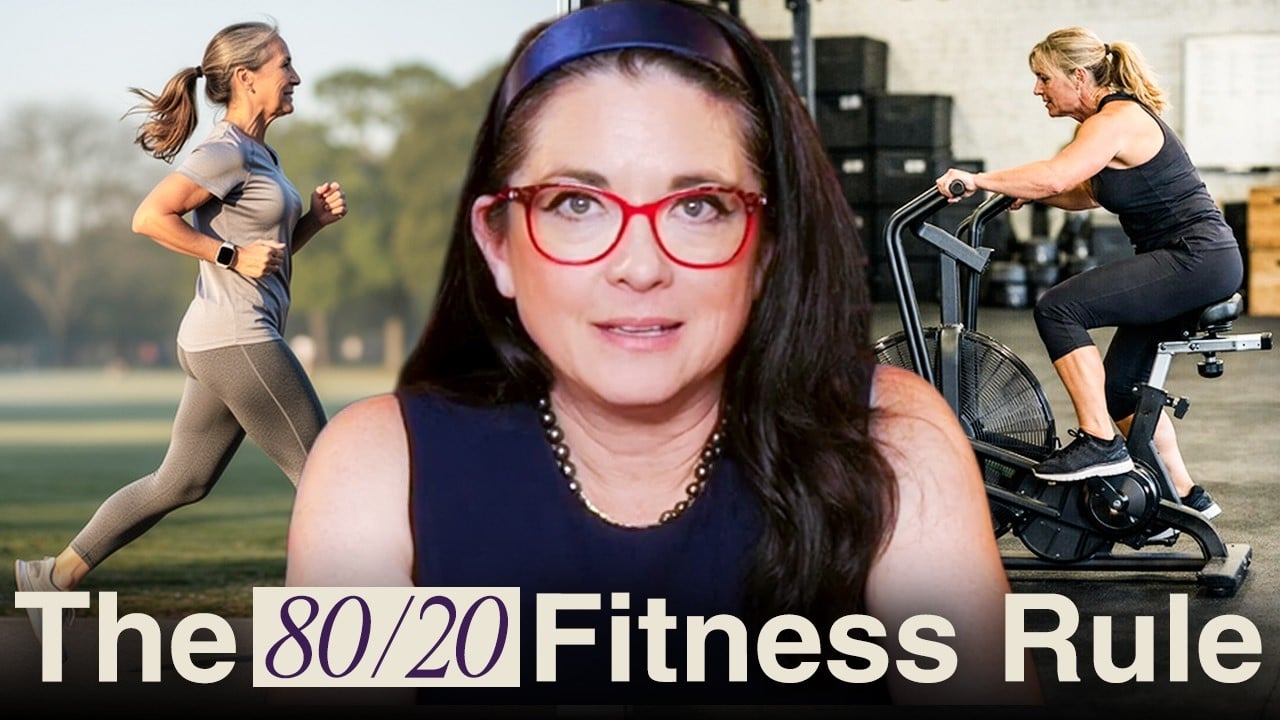
In a recent conversation, a health expert shared her complete weekly training routine—and more importantly, explained exactly why each component matters for building strength, burning fat, and maintaining independence as we age.
Her approach challenges common fitness myths and offers a refreshingly honest roadmap that prioritizes results over hustle.
Jump to:
The Foundation: Daily Mobility Work
Before diving into intense workouts, the expert emphasizes something most people skip entirely: flexibility and mobility training.
She performs a dynamic warm-up nearly every day—a 10-minute series of movements designed to activate every major joint and the surrounding tendons and ligaments. “If I do the inchworm motion, it warms up my ankles, my knees, my hips. If I do hamstring extensions, it gets my hips and my knees,” she explains.

If you want something simple that actually works, this is one of the most effective tools I’ve used to build strength, conditioning, and endurance without needing a full gym setup.
- Full-body training with one weight using swings, squats, and presses
- Solid cast iron build that feels stable and lasts for years
- Comfortable grip that makes high-rep workouts easier to handle
This isn’t Pilates or yoga, though those work beautifully for the same purpose. It’s a targeted routine outlined in her book that ensures the body is genuinely prepared for the demands ahead.
She does this before every workout, not first thing in the morning—a strategic choice that maximizes readiness when it matters most.
The Aerobic Shift: Why 80/20 Changed Everything
Like many fitness enthusiasts, she used to believe in middle-distance, moderate-intensity cardio. Marathon running. Getting her heart rate up into those middle zones constantly.
Then she discovered the 80/20 method—and her body composition transformed.
What Is 80/20 Training?
The concept is elegantly simple: 80% of aerobic training happens at low heart rates, while 20% pushes maximum intensity.
She commits to three hours per week of low heart rate “zone 2” training, broken into 45-minute sessions. This might mean walking home from work (a 2.5-mile journey) or hopping on her home treadmill.
If you want something simple that actually works, this is one of the most effective tools I’ve used to build strength, conditioning, and endurance without needing a full gym setup.
- Full-body training with one weight using swings, squats, and presses
- Solid cast iron build that feels stable and lasts for years
- Comfortable grip that makes high-rep workouts easier to handle
80% of the time I am in lower heart rate base training heart rate zone which is very metabolically efficient. It helps my mitochondria be flexible with what fuel source I’m using whether it’s protein, carbs or fat, and it burns more fat than the middle distance, middle high-intensity exercising.
For those without access to lab testing for lactate threshold, she offers practical guidance: 181 minus your age gives an estimated target heart rate. Even simpler? It’s brisk walking where you can still talk, but someone on the phone would know you’re working.
By session’s end, she breaks a light sweat as metabolism revs up—but crucially, cortisol doesn’t spike. Recovery is easy. The body stays in a fat-burning, metabolically flexible state.
The Middle Zone Trap
She’s witnessed countless people grinding through medium-intensity circuit training—working incredibly hard but seeing minimal results and frequent injuries.
They don’t get the results they want. They’re working hard. They don’t get the results they expect and they’re injured a lot every 3 weeks or so, which and then they have to take time off and their brains go crazy because they don’t have the dopamine spikes.
These workouts aren’t low enough for recovery and metabolic efficiency, yet not high enough to trigger the powerful physiological adaptations of true sprinting.
Sprint Intervals: The Secret Weapon for Body Recomposition
Twice weekly, after her low-intensity walk, she sprints. But “sprinting” doesn’t mean track-star speed.
It means driving heart rate as high as personally possible for 30-second bursts, followed by complete recovery (typically 2-3 minutes). Just four rounds total.
If you want something simple that actually works, this is one of the most effective tools I’ve used to build strength, conditioning, and endurance without needing a full gym setup.
- Full-body training with one weight using swings, squats, and presses
- Solid cast iron build that feels stable and lasts for years
- Comfortable grip that makes high-rep workouts easier to handle
Her typical protocol on a treadmill: maintain 4-5 incline and 4-5 speed for base training (heart rate around 130), then crank it to 11 for sprinting—heart rate soaring over 180.
I’m just trying not to fly off the back of this treadmill, but I’m moving so fast that my heart rate goes up over 180 and I can sustain that for about 30 seconds.
After each sprint, she reduces speed to 2 and walks until heart rate drops to around 140 before repeating.
Why Sprint Training Matters for Women
Sprint interval training triggers benefits impossible to achieve through walking alone:
- Muscle satellite cell replication
- Enhanced mitochondrial division
- Superior fat burning
- Improved body recomposition
If we’re trying not to be skinny fat, but lean, it is the sprinting and the lifting that will get you there. Because working out in the middle zone is not going to get you lean.
She candidly shares that adding sprint intervals was the key factor in reaching 22% body fat—even though she was already doing baseline cardio and strength training.
Resistance Training: Heavy Weights, Low Reps
Her advice here challenges conventional wisdom, especially for women in midlife.
I often say flippantly, put down the namby pamby pink weights.
Lifting 3-5 pound weights for 30 reps builds endurance—nothing wrong with that if endurance is the goal. But in midlife and beyond? The goal shifts to strength and power.
If you want something simple that actually works, this is one of the most effective tools I’ve used to build strength, conditioning, and endurance without needing a full gym setup.
- Full-body training with one weight using swings, squats, and presses
- Solid cast iron build that feels stable and lasts for years
- Comfortable grip that makes high-rep workouts easier to handle
The 4×4 Protocol
Strength requires heavy weights with lower reps. She uses a precise formula: four reps to failure, four sets.
This protocol focuses on four compound lifts—movements using multiple joints:
- Bench press (upper body push)
- Pull-ups (upper body pull)
- Squats (lower body)
- Deadlifts (lower body)
She can complete four reps, maybe five—but not six without dropping the weight. That’s the sweet spot for building genuine strength.
Supporting exercises (biceps, triceps, lats, delts) use slightly higher reps at 8-10. Core work happens whenever schedule allows.
Her weekly split: four lifting days total, with 2-3 focused on legs and 1-2 on upper body, depending on the week’s demands.
Real Results: From Perimenopause Weight Gain to Lean
She doesn’t just preach this approach—she lived the transformation.
If you want something simple that actually works, this is one of the most effective tools I’ve used to build strength, conditioning, and endurance without needing a full gym setup.
- Full-body training with one weight using swings, squats, and presses
- Solid cast iron build that feels stable and lasts for years
- Comfortable grip that makes high-rep workouts easier to handle
During perimenopause, she gained 20-30 pounds, a shocking change for someone who’d maintained 19% body fat as an athlete. Facing the decision to buy an entirely new wardrobe or commit to the science she knew worked, she chose the latter.
Over about a six to nine-month period, using the things you’re asking me about is how I cite in the book, I gained 8 pounds of muscle. I lost all this body fat. I was leaner.
The Grace Factor: Life Happens
Perhaps most importantly, she emphasizes self-compassion throughout.
Currently on a book tour across time zones, she’s not doing everything outlined above—and she’s okay with that.
I want people to give themselves grace because sometimes when people say what I’m about to say, they’re like, oh, I could never. It’s not about that. Start where you are.
For beginners, reaching this level might take 6-9 months. Learning proper form—correct hinging, joint stacking, allowing tendons and ligaments to adapt—takes time. That’s not just acceptable; it’s essential.
The Complete Weekly Framework
Here’s how everything fits together:
- Daily: 10-15 minutes dynamic warm-up/mobility work
- Weekly aerobic: 3 hours of zone 2 training (four 45-minute sessions)
- Sprint intervals: Twice weekly, 4 rounds of 30 seconds maximum effort
- Resistance training: 4 sessions weekly (2-3 lower body, 1-2 upper body)
- Core work: Integrated throughout the week
On busy weeks, she combines cardio and lifting into single longer sessions when time allows.
If you want something simple that actually works, this is one of the most effective tools I’ve used to build strength, conditioning, and endurance without needing a full gym setup.
- Full-body training with one weight using swings, squats, and presses
- Solid cast iron build that feels stable and lasts for years
- Comfortable grip that makes high-rep workouts easier to handle
This isn’t about perfection. It’s about understanding what actually works—then applying it with consistency and self-compassion to build a body that’s strong, powerful, and capable of independent living for decades to come.