After 17 years of silence, the American College of Sports Medicine has released a major new position stand on resistance training.
Hosts of the Fit for Science podcast, two biological data scientists, recently unpacked its findings in episode 21.
Spoiler: you probably need far less gym time than influencers claim.
Which popular lifting “rules” got quietly busted?
Stick around for a surprisingly simple weekly template.
Jump to:
The Core Message: Consistency Crushes Complexity
Researchers behind the paper built an umbrella review, meaning a review of reviews. Starting from 5,751 candidate reviews, strict criteria left 137 systematic reviews covering over 30,000 participants.
Eligible studies involved healthy adults over 18 following programs lasting 6 to 52 weeks. Goals: muscle size, strength, and physical performance.
One sentence from the accompanying press release captured everything, according to the hosts:
The best resistance training program is the one you will actually stick with.
Important caveat: findings target general health and longevity. Elite athletes and highly trained lifters still need specialized, sport-specific programming.
Why Muscle Deserves Your Attention
Before diving into the paper, the hosts made a case for strength training as a pillar of long-term health. Muscle does far more than look good.
- Metabolic health: lean mass largely determines basal metabolic rate, and muscle is the part you can actually change through training.
- Glucose storage: muscle stores carbohydrate as glycogen, acting as a glucose sink that may ease pressure on blood sugar regulation.
- Brain support: working muscles release signaling molecules called myokines, which have been linked to better memory and cognitive function.
- Injury resilience: stronger muscles protect bones and tendons, and help you catch yourself during a slip.
- Hospital buffer: after illness, muscle loss hits fast, so extra reserves work like an insurance policy.
- Sleep: exercise tends to boost deep sleep, though intense late sessions may backfire.
Started late? One host stressed it is never too late.
It just gets harder and the return of investment is lower, but there’s always a return of investment.
Myths the Paper Quietly Retired
Gym lore took a beating. According to the hosts, the evidence suggests several things many lifters obsess over matter far less than assumed:
- Training to failure is not required.
- Periodization is not essential, provided you progressively overload.
- Equipment type does not decide results, so a commercial gym is optional.
- Long rest periods, like five minutes between sets, show no special edge.
- Repetition tempo and exercise order do not meaningfully change growth.
Progressive overload simply means increasing total work over time. Total work equals reps times sets times weight.
Training closer to failure also demands nonlinear recovery. Soreness can leave you unable to repeat sessions, or demotivated.
Five Takeaways From the Infographic
- Consistency beats perfection: prioritize regularity over complexity.
- Match training to your goal: details below.
- Make it personal: choose something enjoyable. Overly demanding plans lose effectiveness.
- You don’t need a gym: calisthenics, bands, and home weights all count.
- Advanced techniques are optional: think blood flow restriction cuffs.
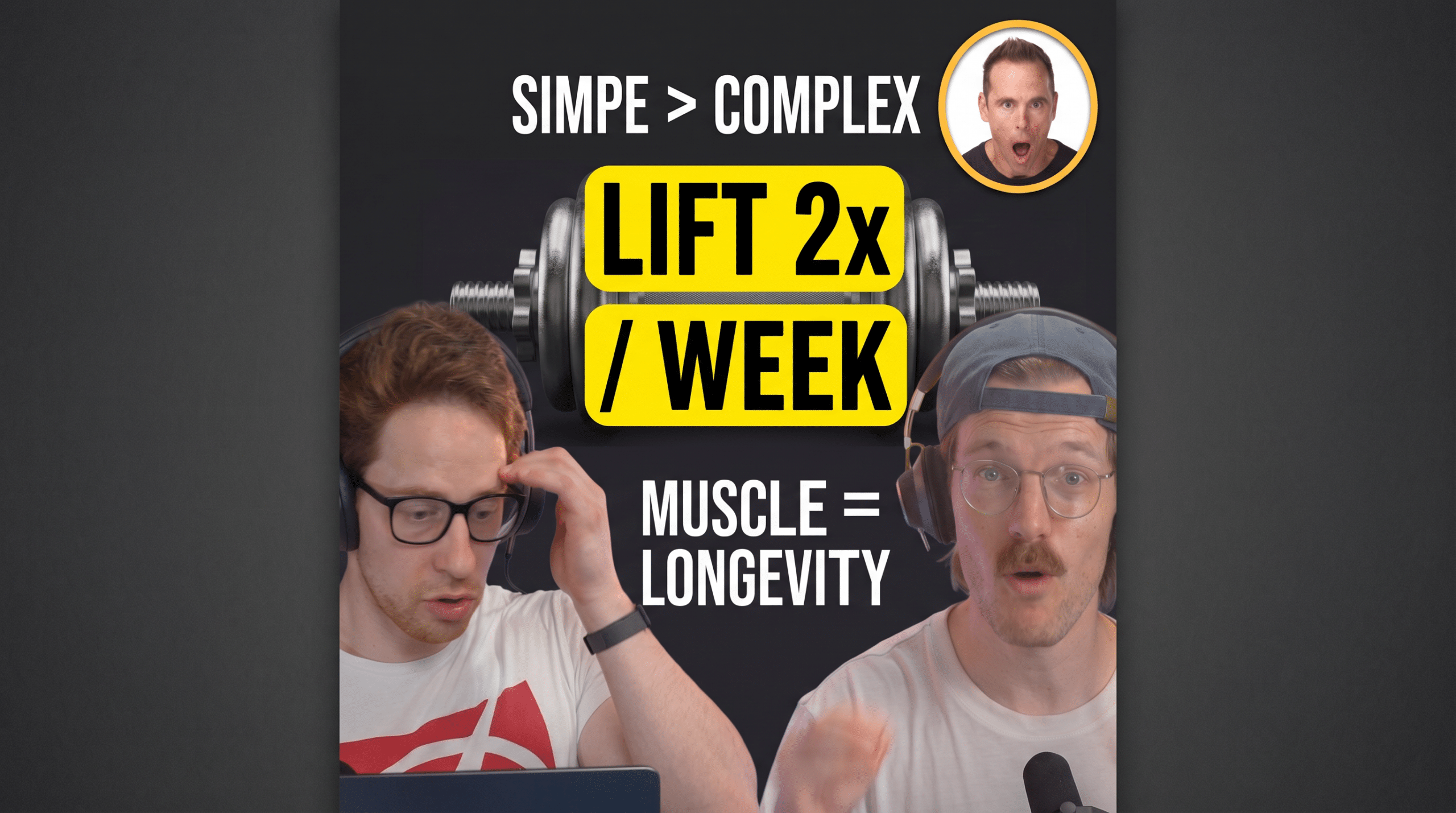
Train all major muscle groups at least two days weekly. That means two full-body sessions can suffice, a notable departure from the classic push/pull/legs split.
Matching Your Goal
- Strength: lift heavier, using two to three sets per exercise.
- Muscle size: aim for roughly 10 weekly sets per muscle group.
- Power: use moderate loads, moving weight as fast as possible on the lifting phase.
Power measures how fast force is produced. Strength is about how much you can move, and partly reflects the nervous system learning to send stronger signals.
A Minimal Effective Dose
A 2023 Bayesian network meta-analysis, titled “Resistance training prescription for muscle strength and hypertrophy in healthy adults,” reached a similar conclusion. Researchers compared many combinations of load, sets, and weekly frequency.
One group stood out as a Goldilocks protocol: lighter loads (under 80% of one-rep max), multiple sets, twice weekly. The hosts translated that into a practical recipe:
- Frequency: two sessions weekly
- Load: weight you can lift 8 to 12 times
- Volume: three to four sets
- Effort: moderate to high, no failure needed
- Exercises: compound, multi-joint moves like the back squat
Nobody becomes Arnold Schwarzenegger on this plan. Higher quality of life and healthier aging are the realistic payoffs.
Is There a Perfect Rep Range?
Evidence-focused YouTuber Layne Norton argues no. According to the hosts, research shows anywhere from 3 to 30 reps can drive muscle growth.
Trade-offs remain. Higher reps cut joint load but fatigue more and take longer, while heavy, low-rep sets save time.
Real-Life Proof From the Hosts
One host once lifted three times weekly for two hours each. Today: two sessions of 30 to 50 minutes, roughly maintaining muscle, with cardio on top.
Genetics matter, though. The other host noted that identical routines will not produce identical physiques for everyone.
Also worth flagging: the hosts openly said they are data scientists, not sports scientists, and one admitted to skimming rather than reading the full paper.
The Golden Rule: Safety First
Never do anything in the gym or anywhere today that prevents you from working out tomorrow.
One lifter dropped overhead barbell squats after judging fatigue-driven risk not worth it. Dumbbell Bulgarian split squats replaced them.
How to Start This Week
- Pick two days and schedule full-body sessions like appointments.
- Choose four to five compound moves: squat variation, push, pull, hinge.
- Stop shy of failure, then add small weight increments when sets feel manageable.
- Train where you enjoy: park, living room, or gym.
- Skip fancy gadgets until basics feel automatic.
Consistency and simplicity beats complexity and heroics every time. And heroics do not scale.
Starting small is fine. Doing something is always infinitely better than nothing, as the hosts put it.