Benching 225 lbs sits at the top of most lifters’ bucket lists, yet data suggests fewer than 2% of gym newcomers ever reach it.
Even among dedicated lifters, only one in five will ever press two plates.
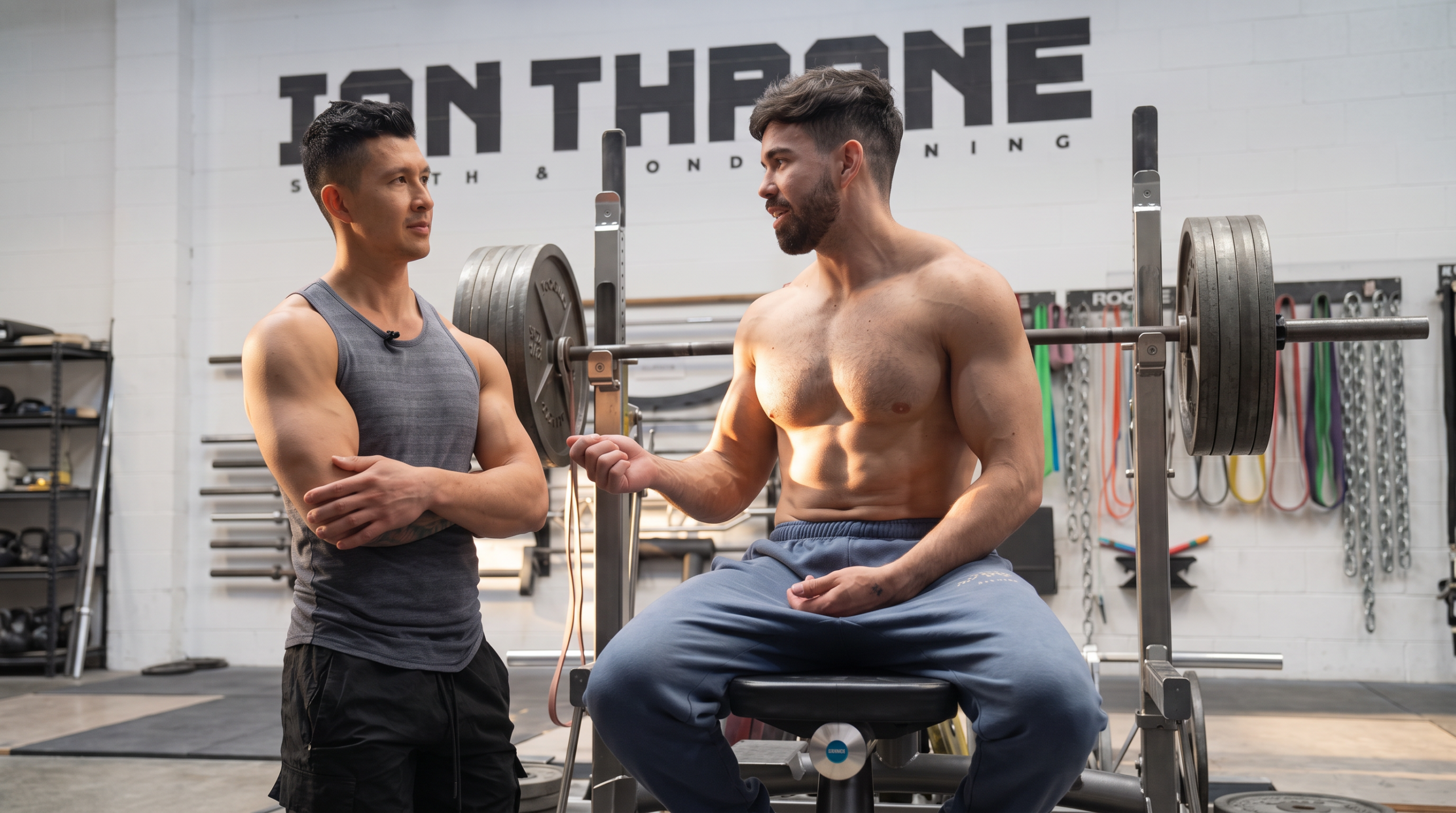
Ryan, a drug-tested bodybuilding professional, hit that milestone in just one year—and didn’t stop there.
He now benches over 400 lbs naturally, a feat so statistically rare it rivals becoming a billionaire, and he’s sharing the system that got him there.
Jump to:
- The Grip Adjustment That Adds Weight Instantly
- Building Your Base Before Touching the Bar
- Why Arching Isn’t Cheating—It’s Biomechanics
- Why Perfect Form Isn’t Enough to Break Plateaus
- Muscle Size Still Predicts Strength
- Track PRs Everywhere, Not Just on the Bench
- Shoulder Health: The Silent Limiter
- Why Benching Less Can Build More Strength
- Progress Is Personal, but the Process Is Universal
The Grip Adjustment That Adds Weight Instantly
Most lifters never revisit one of the simplest variables: hand placement on the bar.
Widening grip width by even an inch or two can make the bar feel lighter immediately. Research shows that a moderately wider grip reduces range of motion and increases pectoral activation, which can boost pressing strength by 5–10% without any additional training.
No products found.
Grip width dictates which muscles bear the load. Narrow grips emphasize triceps, while wider grips shift tension to the chest.
If triceps are your strength, narrow works. If pecs dominate, go wider.
Experiment with different widths and let tension feedback guide your choice—there’s no universal answer.
Building Your Base Before Touching the Bar
Elite lifters like Ryan don’t start with grip. They start with foundation.
First comes foot position. Ryan uses a narrower stance with toes pointing forward, focusing on leg drive—pushing his body backward into the bench to generate force through his upper back.
Think about pulling the bar apart, rather than just pressing it.
He retracts his shoulder blades and engages his lats before unracking. That lat tension stabilizes the bar on its descent and fuels rebound power off the chest.
No products found.
Over time, setup becomes automatic. Early on, though, follow a mental checklist: foot tension, shoulder blade retraction, lat engagement, then unrack.
Why Arching Isn’t Cheating—It’s Biomechanics
Ryan uses a pronounced spinal arch when pressing, which looks extreme but serves a clear purpose: shortening range of motion.
Less distance means better leverage and greater force output. Is it optimal for muscle growth? Not necessarily.
But for lifting more weight, it’s a proven powerlifting technique.
If your goal is raw strength, arching isn’t cheating—it’s using biomechanics intelligently. If hypertrophy is the priority, supplement benching with accessory lifts that stretch and contract the chest through a fuller range.
Why Perfect Form Isn’t Enough to Break Plateaus
Flawless technique alone won’t carry you past every plateau. Ryan divides his training into three components:
No products found.
- Strength Work: Heavy benching at low reps
- Sticking Point Analysis: Observing where the bar slows or stops
- Accessory Work: Targeting weaknesses with supplemental exercises
If the bar fails right off the chest, focus on pec-dominant movements like dips or speed benches to build explosiveness.
Stalling midway up usually signals weak shoulders—overhead presses and paused benches help. Failing near lockout points to triceps—close-grip benching or half-rep spoto presses overload that range.
Muscle Size Still Predicts Strength
Strength improves through heavier loads and better technique. But hypertrophy—muscle size—remains one of the strongest predictors of long-term strength gains.
Interestingly, building muscle doesn’t require heavy weight. Studies show lifting 30–50% of one-rep max with high reps taken close to failure can produce similar muscle growth compared to heavier loads.
Ryan uses high-rep, lighter-weight exercises like dumbbell presses, cable flies, and dips to grow his chest beyond what the bench press alone can stimulate. Then he uses low-rep bench practice to teach his nervous system how to express that new muscle as strength.
Track PRs Everywhere, Not Just on the Bench
At Ryan’s level, progress crawls. He’s thrilled adding 1 lb per month to his bench—yet he still tracks personal records obsessively.
No products found.
When bench PRs stall, he chases them in other lifts: dips, lateral raises, fly variations.
This kind of tracking sustains motivation and keeps progress measurable. If you aren’t already logging workouts—reps, sets, weight lifted—it’s one of the easiest habits separating elite lifters from average ones.
Shoulder Health: The Silent Limiter
Many lifters plateau not from weak pecs or triceps, but poor shoulder mobility. Ryan realized this when his shoulders felt “jammed” mid-rep, despite doing classic rehab moves like band rotations.
Instead, he discovered targeted rotator cuff work with two key exercises:
- Flat Shoulder Presses: Lay on a bench and press light dumbbells upward. Let gravity pull elbows down to open the chest and strengthen rotator cuffs. Start at 5 lbs and build gradually.
- Behind-the-Back Triceps Extensions: This variation forces internal rotation while extending, reducing shoulder tightness and promoting functional strength.
Why Benching Less Can Build More Strength
You’d assume benching more frequently leads to faster gains. That’s true—up to a point.
For beginners, increasing bench frequency from once to twice or three times weekly can double gains. But once you’re pressing over 300 lbs, muscles and joints need more recovery.
No products found.
Ryan benches hard only once per week. Near 400 lbs, he may take two full weeks between challenging sessions.
Eventually, strength hinges not on training volume, but recovery quality. Overtraining kills motivation, damages joints, and slows progress.
If you’re not yet pressing massive weights, try both high and low frequency. Run 6 weeks on each style and compare your rate of strength gain. That’s how you discover what actually works for your body.
Progress Is Personal, but the Process Is Universal
Building a bigger bench isn’t magic—it’s better setup, smarter grip adjustments, strategic frequency, and fixing weak links with accessories.
After applying Ryan’s tips, the author broke a personal record, hitting 245 lbs. Not quite the legendary 315—but far closer than before.
By identifying a sticking point mid-press (suggesting shoulder lag) and adding overhead work back in, the next breakthrough may be just weeks away.
No products found.
Want to start your journey toward a 315 bench? Two free bench programs—one high frequency, one low—are now available. Choose based on your recovery and lifestyle, track your gains, and adjust as needed.
And if you’re looking to build chest size too, not just strength, the next video walks you through two underrated exercises that target your chest from angles the bench press never touches.