Brad Schoenfeld has published close to 400 research papers on muscle growth, making him one of the world’s leading experts on hypertrophy.
But even with that impressive body of work, he’s the first to admit that science continues to evolve—and some of what he believed as a personal trainer in the 1990s has been completely overturned.
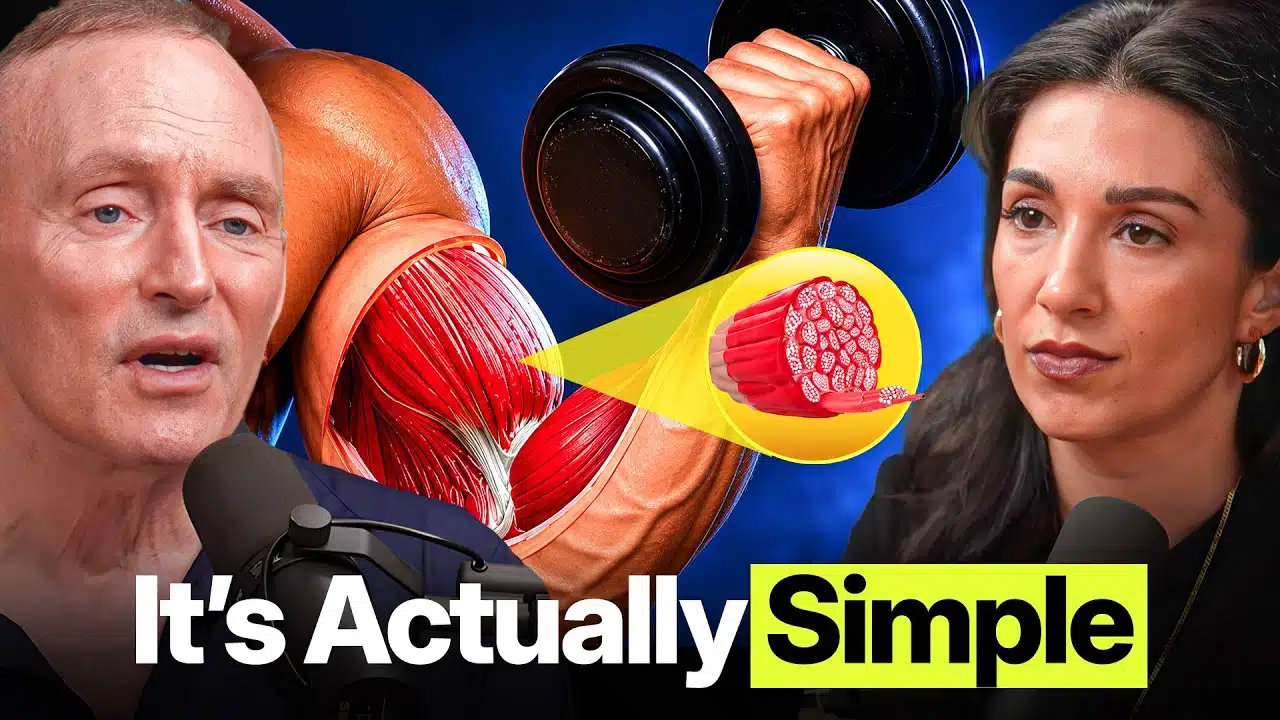
In a recent podcast appearance on The Neuro Experience with Louise Nicola, Schoenfeld opened up about the biggest myths in muscle building, what the research really says about training to failure, and why lighter weights might be just as effective as heavy ones.
His insights challenge decades of gym lore—and offer a more sustainable, evidence-based path to building muscle for life.
Jump to:
- Training to Failure Isn’t Necessary for Muscle Growth
- Light Weights Build Just as Much Muscle as Heavy Weights
- The Lengthened Position Is Where the Magic Happens
- Power Training May Be More Important Than Strength for Longevity
- Rest Intervals: Shorter Isn’t Better
- Protein Needs Are Higher Than the RDA—But Not Sky-High
- GLP-1 Drugs and Muscle Loss: Resistance Training Is the Antidote
- Cold Plunges After Training? Skip Them.
- The Most Dangerous Lie in Fitness Today
- You Don’t Need Hours in the Gym
Training to Failure Isn’t Necessary for Muscle Growth
One of Schoenfeld’s biggest shifts in thinking? You don’t have to train to absolute failure to build muscle.
I came from the old school either you go all out or you go home. If the vein in the side of my head wasn’t bulging at the end of every set, I wasn’t training hard enough.
Now, the research tells a different story. Stopping two or three reps short of failure still produces roughly the same muscle growth—without the extreme discomfort.
That’s not to say training close to failure is easy. As Schoenfeld points out, you’re still working hard. But the psychological and physical toll is lower, which can dramatically improve adherence.
And adherence, he argues, is everything. With 80% of the population still not doing regular resistance training, anything that makes it more approachable is a win.
Light Weights Build Just as Much Muscle as Heavy Weights
This one might be the most surprising revelation in modern hypertrophy research.
For decades, the consensus was clear: lift heavy or go home. But Schoenfeld’s own research—along with studies from colleagues like Stuart Phillips—has flipped that script.
Stu published a paper back in 2012 on untrained subjects just doing leg extensions and he looked at 80% 1RM versus 30% and showed that 30% and 80% had virtually identical growth.
Schoenfeld was skeptical. He thought the results only applied to beginners doing simple movements. So he ran his own study on trained lifters using full-body workouts.
The result? No difference. Light weights produced the same muscle growth as heavy weights—as long as sets were taken close to failure.
Since then, dozens of studies have confirmed the same thing. The key is mechanical tension, which can be achieved with lighter loads if effort is high enough.
But There’s a Catch: Fiber Type Matters
Schoenfeld notes that while whole-muscle hypertrophy is similar, there may be differences at the fiber level.
There’s certainly some research supporting it that type one fibers might be more predisposed to growth with lighter loads and type two fibers might be more predisposed to growth with heavier loads.
Type I fibers are endurance-oriented. Type II fibers are strength- and power-oriented—and they’re also the ones most vulnerable to age-related atrophy.
If you want to maximize muscle growth across all fiber types, combining heavy and light training might be the smartest approach.
The Lengthened Position Is Where the Magic Happens
Another area where the evidence has shifted: range of motion—and specifically, which part of the range matters most.
Schoenfeld explains that training in the lengthened (stretched) position of a movement is far more effective than training in the shortened position.
The majority of literature shows that if you just do a half repetition in the lengthen portion, it’s as effective as doing the full range of motion.
So if you’re doing a shoulder press, the bottom half of the rep—from the stretched position to midpoint—is where most of the growth stimulus occurs.
This has been shown in biceps, triceps, quads, hamstrings, and calves. The reason likely comes down to passive tension—the mechanical load placed on muscle fibers when they’re stretched.
For lifters with joint issues or limited time, this is a game-changer. You can get comparable results with less range—as long as you prioritize the stretch.
Power Training May Be More Important Than Strength for Longevity
Strength is the ability to produce force. Power is the ability to produce force quickly.
And according to Schoenfeld’s meta-analysis on older adults, power training may offer greater functional benefits than traditional slow-tempo strength training.
We found the effect size was about .3. Not a huge difference, but still, in my opinion, that certainly could be practically meaningful for an older individual who’s starting to become functionally dependent.
Why does this matter? Because falls are one of the leading causes of mortality in older adults. Type II muscle fibers—the ones responsible for explosive movement—help you recover from a stumble.
But these fibers atrophy fastest with age. In severe cases of sarcopenia, they can undergo programmed cell death.
The good news? You can make the fibers you have bigger and stronger—even if you can’t regenerate lost ones.
Schoenfeld recommends incorporating some explosive concentric lifts (fast on the way up, controlled on the way down) into your routine, especially as you age.
Rest Intervals: Shorter Isn’t Better
Another myth Schoenfeld has helped debunk: the idea that short rest periods maximize muscle growth.
His meta-analysis found that resting less than 60 seconds between sets can compromise hypertrophy. But once you hit around 90 seconds, there’s no additional benefit to resting longer—at least for muscle growth.
That said, complex movements like squats and deadlifts may require closer to two minutes for full recovery.
Interestingly, when Schoenfeld’s team let participants self-select rest intervals (without their phones), they chose an average of 3.6 minutes—well above the “optimal” range.
I’m sure if we had let them use their cell phones, it would have been five or more minutes.
Resting longer isn’t detrimental to hypertrophy—but it does increase workout time, which can hurt adherence.
Protein Needs Are Higher Than the RDA—But Not Sky-High
The Recommended Dietary Allowance (RDA) for protein is 0.8 grams per kilogram of body weight per day. But Schoenfeld says that’s too low—even for maintenance.
For someone doing resistance training, the evidence points to a minimum of around 1.6 grams per kilogram per day.
I would say kind of the minimum threshold in my opinion in my interpretation of the literature is around 1.6 grams per kilogram per day.
Some research suggests the sweet spot may be closer to 2 grams per kilogram, especially if you’re in a caloric deficit or aiming to maximize muscle growth.
But Schoenfeld is quick to note: training stimulus matters more than protein intake. You can’t out-eat poor programming.
GLP-1 Drugs and Muscle Loss: Resistance Training Is the Antidote
With the rise of GLP-1 medications like Ozempic and Wegovy, concerns about muscle loss have grown.
Schoenfeld acknowledges the issue: these drugs tend to cause rapid weight loss, and rapid weight loss is generally associated with greater muscle loss.
GLP-1s, they tend to induce greater or more rapid weight loss. More rapid weight loss is generally associated with more rapid muscle loss.
But here’s the key: most of the muscle loss data comes from people not doing resistance training.
Schoenfeld is currently collaborating on a study using MRI to measure muscle changes in GLP-1 users who lift weights. His hypothesis? Resistance training will largely mitigate the muscle loss.
Combine that with higher protein intake, and the risk drops even further.
Cold Plunges After Training? Skip Them.
Cold exposure has exploded in popularity. But if your goal is muscle growth, post-workout cold plunges are counterproductive.
Schoenfeld’s meta-analysis found that cold exposure after resistance training hinders hypertrophy.
The likely reason? Cold restricts blood flow, limiting nutrient delivery to muscles when they’re most primed for growth.
On the flip side, heat exposure—like sauna use—showed a modest positive effect, likely due to increased blood flow.
If you love cold plunges, Schoenfeld suggests waiting at least a few hours post-training—though the ideal window isn’t yet clear.
The Most Dangerous Lie in Fitness Today
When asked what misinformation bothers him most, Schoenfeld didn’t hesitate.
One of the things that I think is really counterproductive is that there’s one best way to build muscle and to build strength and just develop the body.
The influencer model—take off your shirt, sell your program, claim it’s the only way—is not only misleading, it’s harmful.
There are many roads to gains. The fundamentals are simple:
- Train hard (close to failure)
- Be consistent
- Train all major muscle groups
- Adjust based on your goals and response
Beyond that, individualization is key. What works for one person may not work for another—and that’s okay.
You Don’t Need Hours in the Gym
Perhaps the most empowering takeaway from Schoenfeld’s work: two 30-minute sessions per week can produce substantial results.
You don’t need to be a bodybuilder. You don’t need to live in the gym. As long as you train hard, stay consistent, and hit all major muscle groups, you’ll see improvements in strength, muscle mass, metabolic health, and even brain function.
For the 80% of people who aren’t currently doing resistance training, that’s a message worth hearing.
Building muscle isn’t just about aesthetics. It’s about longevity, function, and quality of life. And thanks to researchers like Brad Schoenfeld, we now know it’s more accessible than ever.