What happens when one of the most respected voices in natural bodybuilding trains the same upper body workout for 365 days straight?
According to Jeff Nippard, the answer is measurable muscle growth—confirmed by DEXA scans and ultrasound.
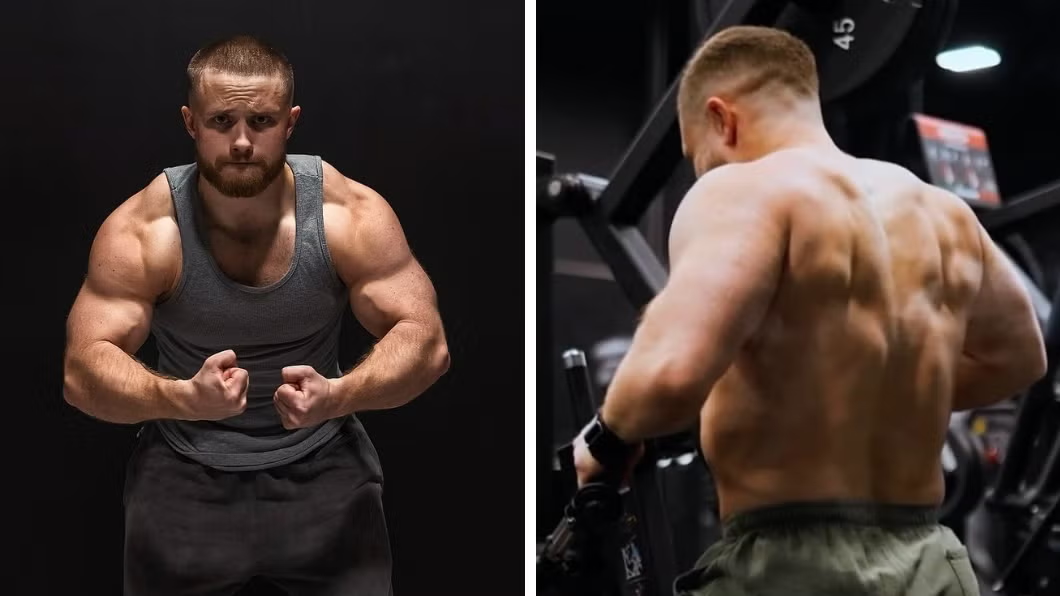
In a recent YouTube video, Jeff broke down the exact exercises, cues, and research that shaped the most productive year of upper body training in his 15-year lifting career.
Whether you’re a seasoned lifter or looking to revamp your routine, Jeff’s science-backed experiment delivers powerful insights into program design, exercise selection, and execution. Here’s what he did—and why it worked.
Jump to:
- Incline Barbell Bench Press: Chest Growth with Overload Potential
- Seated Cable Fly: Precision Chest Isolation
- Weighted Pull-Ups: S-Tier Back Builder
- High Cable Lateral Raises: Delts with Intent
- Deficit Penlay Rows: Posterior Chain Power
- Cable Overhead Triceps Extensions: Total Triceps Activation
- Beijian Cable Curls: Biceps at Length
- Key Takeaways from a Year of Consistent Execution
Incline Barbell Bench Press: Chest Growth with Overload Potential
Out of all the lifts in his year-long routine, Jeff credits the incline barbell bench press as the number one pec builder. Targeting the upper and mid-chest, front delts, and even requiring help from stabilizing side delts, this compound movement brings more to the table than just chest gains.
“With dumbbells, once you get strong, they feel awkward and bulky,” says Jeff. “But a barbell lets you keep stacking on weight more precisely.”
Research supports his preference for the incline angle. A 2020 study by Chavez and colleagues found that a 45° incline bench press stimulates the upper pecs more effectively than flat benching, while still growing the mid and lower pecs similarly.
Technique Tweaks That Made the Difference
- Slightly narrow grip: Increases the range of motion and adds bonus triceps work without compromising chest tension.
- Controlled descent: Jeff emphasizes pausing just slightly on the chest to avoid bouncing, ensuring consistent tension and accurate progressive overload.
- Free weights over machines: While a Smith machine can be effective, Jeff chose the barbell for increased stabilizer engagement.
Every final set was pushed to failure without a spotter. That meant dumping the bar forward onto safety pins when necessary—an intimidating challenge, executed safely and systematically.
Seated Cable Fly: Precision Chest Isolation
To complement the heavy pressing, Jeff turned to the seated cable fly for more precise pectoral activation and an increased stretch.
“The pec deck just doesn’t give me quite the stretch I get with cables,” Jeff explains. “And going seated instead of standing improves stability so tension stays exactly where I want it—on the chest.”
Training Cues for Maximum Chest Tension
- Focus on the elbows: Instead of pressing the hands together, think about pulling the elbows toward one another to keep the load on the pecs.
- Sweep, don’t just pull: Move in an arcing motion to maximize fiber recruitment across the chest.
- Keep elbows high: Dropping them reduces chest engagement and shifts tension to the shoulders or triceps.
Again, Jeff took every final set to failure. No exceptions.
Weighted Pull-Ups: S-Tier Back Builder
After initially underestimating pull-ups, Jeff bumped them into S-tier status following this challenge. And for good reason: there’s almost no back muscle they don’t hit.
Weighted pull-ups activated Jeff’s lats, mid traps, rhomboids, and even spinal stabilizers. Plus, they offer minimal opportunity for cheating compared to lat pulldowns.
Pro Tips for Back Emphasis
- Chest to bar: Not just chin over the bar—Jeff cues lifters to drive their chest upward to ensure tight form.
- Elbows down and in: Avoid pulling with the biceps. Drive the elbows through the movement to better engage the lats.
- Controlled bottom pause: Reduces swinging and ensures full lat stretch before the next pull.
Over the year, Jeff progressed from 30 lbs to 60 lbs for 6 reps—proving that consistent overload, not gimmicky techniques, drives hypertrophy.
High Cable Lateral Raises: Delts with Intent
Creating that broad, X-frame physique required specialized attention to the side delts. Jeff’s top pick? High cable lateral raises.
Why cables? They maintain constant tension across the full range of motion—unlike dumbbells, which only peak at the top. Setting the pulley high emphasizes tension at the start, where the delts are most stretched.
Science vs. Practice
A recent study published in December compared cable lateral raises to dumbbell raises. Both produced similar hypertrophy across participants. However, Jeff still prefers cables because of the greater potential range of motion—especially when sweeping across the body.
Execution Tips
- Think “out,” not “up”: Sweeping wide keeps trap involvement minimal and side delt engagement maximal.
- No shrugging allowed: Elevating the traps turns this delt move into a trap builder.
- Use the wall trick: Apply pressure outward against a wall to learn proper delt activation.
Deficit Penlay Rows: Posterior Chain Power
When it came to overall back development, the deficit Penlay row was Jeff’s MVP. By standing on plates, he increased the stretch and load on the lats while engaging his entire posterior chain.
“I changed the tempo,” Jeff adds. “Fast explosive concentric, slow eccentric to maintain control and max out tension.”
Technique Advice
- Get horizontal: Being parallel to the floor ensures maximum mid-trap and rhomboid activation.
- Use straps or chalk: Don’t let grip limit your gains.
- Add lengthened partials: Extend hypertrophy past failure with partials once full ROM fails.
Cable Overhead Triceps Extensions: Total Triceps Activation
No arm workout is complete without some triceps isolation. Jeff went with what science shows is the gold-standard single move for hitting all three heads: cable overhead extensions.
One study comparing this to pushdowns found up to 50% more growth in the long head and 40% more in the lateral and medial heads—making it the go-to triceps movement.
Avoid This Setup Mistake
Most people start with the cable too low and struggle into position. Jeff solves this by simply raising the cable, squatting below it, and stepping forward to start.
Simple. Effective. Fail your final set.
Beijian Cable Curls: Biceps at Length
Finally, for biceps, Jeff took advantage of newer research comparing preacher curls to Beijian curls. While results weren’t statistically significant, there was a trend favoring Beijians for long-length loading.
The takeaway? Both grow your biceps. But Beijian curls may have a slight edge due to tension in the extended position.
Jeff’s advice? Rotate both into your program. He does Beijian curls on upper body day and preacher curls with hammer curls on pull day.
Final set = failure. Every time.
Key Takeaways from a Year of Consistent Execution
- Compound lifts still matter—even in hypertrophy-centric programs.
- Isolation movements shine when executed with intent—focus on form over weight.
- Progressive overload over time—a simple principle that still works best.
- Failure sets done responsibly—especially the last set—maximize muscle stimulus.
Jeff’s full routine covered chest, shoulders, back, biceps, and triceps with only a few highly effective lifts. It’s a shining example of how smart training doesn’t require hundreds of exercises—just precise effort consistently applied.