Google’s $99 Fitbit Air arrives with something surprising under its hood: the exact same heart rate sensor found in Fitbit models released nearly half a decade ago.
Yet despite this aging hardware, the budget-friendly tracker delivers performance that rivals devices costing three times as much.
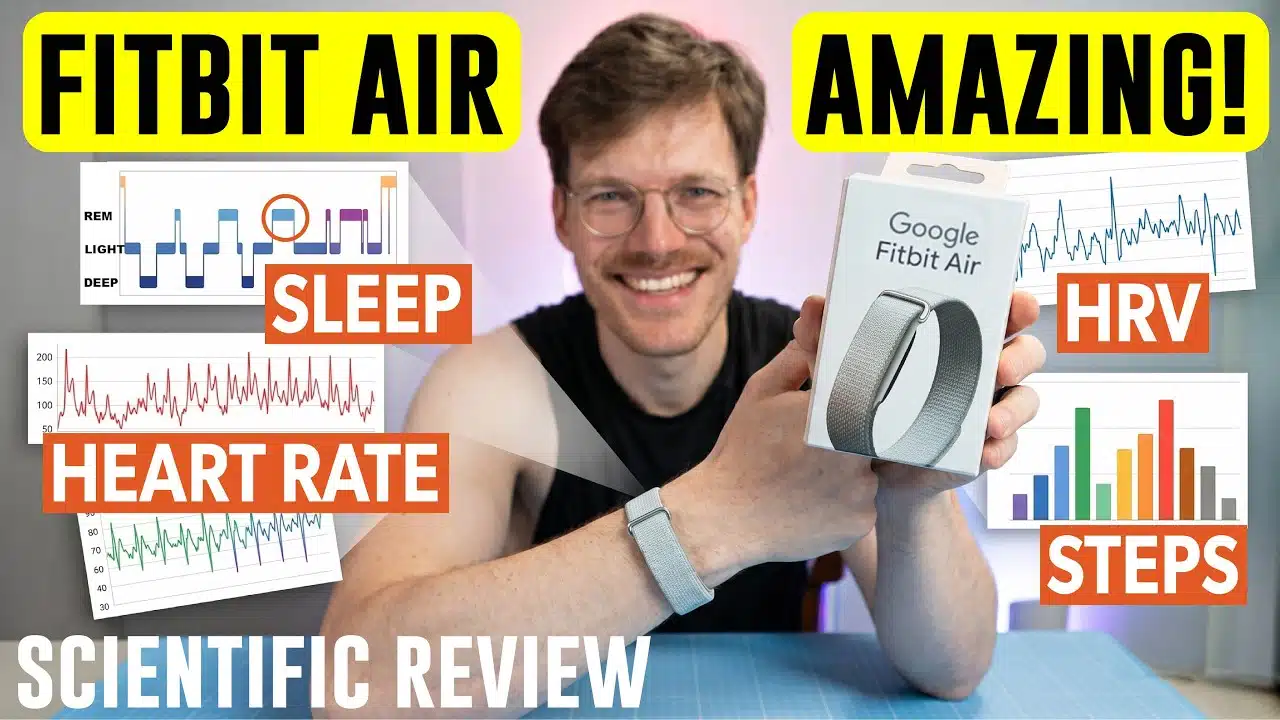
Rob, a postdoctoral scientist specializing in biological data analysis, put the device through rigorous scientific testing to see if Google’s signal processing and AI could overcome outdated sensors.
The results might change how you think about budget fitness trackers.
Jump to:
- Old Sensors, New Tricks
- Automatic Workout Detection That Actually Works
- Free Features vs. Premium Paywall
- Multi-Device Data: Promising But Imperfect
- Step Counting: Slight Overcounting Detected
- Heart Rate Tracking: Competing With Premium Devices
- Nighttime Metrics: Heart Rate and HRV
- Sleep Stage Tracking: Top-Tier Performance
- Fitbit Air vs. Whoop Strap
- Notable Limitations and Missing Features
- Privacy and Data Processing
- The Verdict
Old Sensors, New Tricks
The Fitbit Air uses identical sensor technology to the Inspire 3, Charge 5, and Charge 6—devices from a different era of wearable tech. Google hasn’t tried to hide this fact.
According to the company, the device operates in two heart rate measurement modes depending on activity level. During exercise, it captures readings every 1-2 seconds, regardless of battery level or power mode.

If you want something simple that actually works, this is one of the most effective tools I’ve used to build strength, conditioning, and endurance without needing a full gym setup.
- Full-body training with one weight using swings, squats, and presses
- Solid cast iron build that feels stable and lasts for years
- Comfortable grip that makes high-rep workouts easier to handle
What makes this impressive isn’t the hardware—it’s what Google does with the data.
I’m impressed by what Google was able to do with this old sensor. Probably because of some great signal processing and AI.
Automatic Workout Detection That Actually Works
The Air doesn’t require manual logging for most cardio activities. It begins high-frequency heart rate tracking the moment it detects movement patterns consistent with exercise.
However, there’s a catch: activities only appear in your log after 10-15 minutes of continuous movement.
In testing, the device successfully detected all cycling and running sessions without any input. Weight lifting sessions, however, went unrecognized—a limitation Google confirms is by design.
Supported automatic detection currently includes biking, spinning, running, walking, and other high heart rate activities only.
Free Features vs. Premium Paywall
All core metrics come free with the Fitbit Air. Sleep tracking, heart rate monitoring, step counting, and basic workout logging require no subscription.
If you want something simple that actually works, this is one of the most effective tools I’ve used to build strength, conditioning, and endurance without needing a full gym setup.
- Full-body training with one weight using swings, squats, and presses
- Solid cast iron build that feels stable and lasts for years
- Comfortable grip that makes high-rep workouts easier to handle
Google Health Premium, priced at $100 annually, unlocks Gemini-powered insights, personalized coaching, and an interactive “ask coach” feature. But there’s an important limitation.
Premium features don’t apply retroactively. Sign up today, and the AI coach only analyzes future activities—not your historical data.
If your subscription expires, Google retains your underlying data for viewing and export. Premium analysis features simply become unavailable.
Multi-Device Data: Promising But Imperfect
Many users don’t rely on a single wearable. They might pair an Apple Watch with a smart ring, or switch between a Fitbit and Pixel Watch throughout the day.
Google Health can import data from Apple Health at launch, though only the past three months initially. Writing data back to Apple Health isn’t supported yet but will arrive “over the coming months.”
When multiple devices record simultaneously, the app creates a “reconciled stream” that prioritizes one source over another. Wear both a Pixel Watch and Fitbit Air? The app chooses which device’s steps to display based on preset priorities.
If you want something simple that actually works, this is one of the most effective tools I’ve used to build strength, conditioning, and endurance without needing a full gym setup.
- Full-body training with one weight using swings, squats, and presses
- Solid cast iron build that feels stable and lasts for years
- Comfortable grip that makes high-rep workouts easier to handle
Users can inspect individual data sources by tapping charts and selecting “view sources.” Soon, you’ll be able to reorder source priority manually.
But timestamp conflicts can still create duplicates, particularly for session-based data like workouts or meals.
Step Counting: Slight Overcounting Detected
Testing involved manually counting 5,000 steps with a mechanical counter, broken into five 1,000-step segments.
The Fitbit Air consistently overcounted by small margins:
- Segment 1: +12 steps
- Segment 2: +10 steps
- Segment 3: +3 steps
- Segment 4: +15 steps
- Segment 5: +13 steps
Average overcounting: roughly 1%. Not perfect, but acceptable for most users.
Overall, slight overcounting, but nothing too bad.
False positive testing—counting steps while seated at a desk or gaming—revealed minimal phantom steps. Only 13 false steps registered during one hour of stationary activity. Even extrapolated across 24 hours, that’s just 300 erroneous steps maximum.
If you want something simple that actually works, this is one of the most effective tools I’ve used to build strength, conditioning, and endurance without needing a full gym setup.
- Full-body training with one weight using swings, squats, and presses
- Solid cast iron build that feels stable and lasts for years
- Comfortable grip that makes high-rep workouts easier to handle
Heart Rate Tracking: Competing With Premium Devices
All heart rate tests used a Polar H10 ECG chest strap as reference—one of the most reliable measurement methods available.
Indoor Cycling Performance
Spinning sessions produced outstanding results with a 0.99 correlation coefficient. Values can’t exceed 1.0, making this nearly perfect tracking.
Minor deviations appeared only during warm-up periods. Once heart rate stabilized, the Fitbit Air matched the ECG strap almost exactly.
Compared to 365 days of tested devices, the Air lands solidly in the middle-to-upper tier—alongside far more expensive options.
Running: Among the Best
Four running sessions showed similarly impressive accuracy. Only the first run displayed minor deviations, likely due to positioning or initial calibration.
Subsequent runs—even with breaks—tracked remarkably close to ECG measurements.
If you want something simple that actually works, this is one of the most effective tools I’ve used to build strength, conditioning, and endurance without needing a full gym setup.
- Full-body training with one weight using swings, squats, and presses
- Solid cast iron build that feels stable and lasts for years
- Comfortable grip that makes high-rep workouts easier to handle
When compared to premium devices, the Fitbit Air performed near the top tier, approaching devices like the Amazfit Helios strap worn on the wrist.
Outdoor Cycling: The Weakest Link
Outdoor biking produced the lowest correlation at 0.93—still respectable, but noticeably weaker than indoor activities.
Some rides showed excellent tracking. Others revealed the Air frequently detected lower-than-actual heart rates, missing peaks during intense efforts.
Despite these limitations, performance remained competitive with similarly-priced devices. Apple Watches and Pixel Watches demonstrated superior accuracy, but they also cost significantly more.
Weight Lifting: Better Than Expected
Resistance training poses unique challenges for optical heart rate sensors. Wrist tension during lifts interferes with blood flow measurements.
The Fitbit Air struggled to capture peak heart rates during heavy sets but performed surprisingly well during rest periods and moderate-intensity work.
If you want something simple that actually works, this is one of the most effective tools I’ve used to build strength, conditioning, and endurance without needing a full gym setup.
- Full-body training with one weight using swings, squats, and presses
- Solid cast iron build that feels stable and lasts for years
- Comfortable grip that makes high-rep workouts easier to handle
Performance matched Pixel Watch devices, landing in the middle of the pack compared to specialized fitness trackers.
The Hiking Anomaly
One hiking session produced baffling results. The device detected heart rates around 170 bpm during gentle descents when actual heart rate hovered near 80 bpm.
Basically detected close to double my heart rate. So, maybe it was just poorly positioned. I don’t know what was happening here.
This appeared to be an isolated incident—every other cardio session performed exceptionally well. Poor positioning or environmental factors likely contributed to the error.
Overall Heart Rate Score: 97/100
Averaging the correlation coefficients across three primary cardio exercises (spinning, running, outdoor cycling) and multiplying by 100 yields a score of 97.
Classification: Great heart rate tracking.
For a $99 device using five-year-old sensor technology, this performance borders on remarkable.
If you want something simple that actually works, this is one of the most effective tools I’ve used to build strength, conditioning, and endurance without needing a full gym setup.
- Full-body training with one weight using swings, squats, and presses
- Solid cast iron build that feels stable and lasts for years
- Comfortable grip that makes high-rep workouts easier to handle
Nighttime Metrics: Heart Rate and HRV
Overnight heart rate tracking compared favorably to ECG chest strap measurements. Values overlapped extensively throughout the night, with only minor deviations likely attributable to different measurement definitions.
Heart rate variability (HRV) uses the RMSSD calculation method—the most common metric in consumer wearables. Google calculates this overnight using beat-to-beat intervals, including only high-quality measurements.
The app displays a single morning HRV value, but API access revealed detailed overnight data. Patterns matched reference measurements closely, though absolute values differed slightly.
Without knowing Google’s exact calculation windows and filtering methods, perfect agreement isn’t expected. Pattern consistency matters more than identical numbers.
Both metrics appear reliable enough for tracking personal trends over time.
Sleep Stage Tracking: Top-Tier Performance
Google recently updated their sleep stage algorithm. Testing against the Zeo Max EEG headband—a silver standard reference device that measures actual brain waves—revealed impressive accuracy.
If you want something simple that actually works, this is one of the most effective tools I’ve used to build strength, conditioning, and endurance without needing a full gym setup.
- Full-body training with one weight using swings, squats, and presses
- Solid cast iron build that feels stable and lasts for years
- Comfortable grip that makes high-rep workouts easier to handle
Agreement rates by sleep stage:
- Deep sleep: 87% agreement
- Light sleep: 80% agreement
- REM sleep: 72% agreement
These numbers represent some of the best consumer sleep tracking performance ever tested. Perfect would be 100%, but even professional sleep labs don’t achieve that consistently.
Visual hypnogram comparisons showed near-identical sleep stage transitions throughout the night. The Fitbit Air detected all four major REM periods during one sample night, with only slight timing shifts.
Comparison to Elite Competition
When plotted against hundreds of tested devices, the Fitbit Air joins an exclusive group of top performers:
- Google/Fitbit devices (including the Air)
- Apple Watch
- Whoop Strap
- Oura Ring
- Eight Sleep Pod
Performance nearly matched the Pixel Watch 4 with its newer, more expensive hardware. This confirms a critical insight: algorithms matter more than sensors for sleep tracking.
At $99, the Fitbit Air costs a fraction of its competition while delivering equivalent sleep analysis. No premium subscription required.
If you want something simple that actually works, this is one of the most effective tools I’ve used to build strength, conditioning, and endurance without needing a full gym setup.
- Full-body training with one weight using swings, squats, and presses
- Solid cast iron build that feels stable and lasts for years
- Comfortable grip that makes high-rep workouts easier to handle
Sleep Score: 80/100 (Great)
The average sensitivity across all three sleep stages yields a score of 80, earning a “great” classification.
Fitbit Air vs. Whoop Strap
Both devices target similar markets: screenless trackers focused on health metrics and recovery. But they serve different audiences.
Battery life: Whoop wins with approximately 14 days versus the Air’s 7 days.
Price: Fitbit Air dominates at $99 one-time versus Whoop’s $199 annual basic subscription. Premium features narrow the gap—Google Health Premium costs $100/year while Whoop Peak runs $239/year (device included).
Even with premium subscriptions over two years, the Fitbit remains cheaper.
App experience: Personal preference varies, but Whoop currently offers more upfront data visualization. Google Health leans heavily on text-based insights, which may not suit everyone’s learning style.
If you want something simple that actually works, this is one of the most effective tools I’ve used to build strength, conditioning, and endurance without needing a full gym setup.
- Full-body training with one weight using swings, squats, and presses
- Solid cast iron build that feels stable and lasts for years
- Comfortable grip that makes high-rep workouts easier to handle
The AI coach shows promise but struggles with specialized training plans. Preparing for a marathon? Dedicated apps like Runner still outperform generalized AI for structured programs.
If you stick with the basic app without the coach, the Google Health app plus Fitbit Air is an amazing deal and an instant recommendation.
Notable Limitations and Missing Features
The Fitbit Air isn’t a smartwatch replacement. It doesn’t buzz for notifications, calls, or texts. Haptic feedback exists only for low battery alerts and user-configured alarms.
Heart rate broadcasting works via Bluetooth for compatible equipment, but Garmin and Technogym devices aren’t currently supported—a significant limitation for gym enthusiasts.
Strava integration improved recently. Any activity type now syncs to Strava, not just GPS-based exercises. However, importing Strava workouts into Google Health remains unsupported.
Google doesn’t officially support biceps or upper arm placement, though third-party bands will likely appear. Without official support, data accuracy at non-wrist locations can’t be guaranteed.
Firmware updates continue for at least two years after the last device is sold—not from your purchase date.
If you want something simple that actually works, this is one of the most effective tools I’ve used to build strength, conditioning, and endurance without needing a full gym setup.
- Full-body training with one weight using swings, squats, and presses
- Solid cast iron build that feels stable and lasts for years
- Comfortable grip that makes high-rep workouts easier to handle
Privacy and Data Processing
Several important metrics rely on cloud processing, including sleep stages and sleep scores. An internet connection is required for final calculations.
The smart alarm uses a smaller, on-device model to determine optimal wake times. This local algorithm differs from the cloud-based sleep analysis you see in the app and likely provides less accurate staging.
Google Health Coach conversations are saved in your history and can be exported. Importantly, chat data isn’t used to train AI models by default. Training only occurs if you explicitly opt in through separate consent.
The Verdict
The Fitbit Air achieves something rare in consumer electronics: premium performance at budget pricing.
Heart rate tracking scored 97/100 across cardio exercises. Sleep stage tracking earned 80/100, placing it among the top five brands tested. Step counting showed minor overcounting but remained within acceptable margins.
Five-year-old sensor hardware performs on par with devices costing three times as much. Google’s signal processing and AI algorithms deserve credit for extracting maximum value from aging components.
If you want something simple that actually works, this is one of the most effective tools I’ve used to build strength, conditioning, and endurance without needing a full gym setup.
- Full-body training with one weight using swings, squats, and presses
- Solid cast iron build that feels stable and lasts for years
- Comfortable grip that makes high-rep workouts easier to handle
For $99 with no subscription required for core features, the Fitbit Air represents exceptional value. Serious athletes seeking specialized training plans may prefer Whoop or dedicated platforms, but for health-conscious individuals wanting reliable tracking, this device delivers.
The real question isn’t whether the old sensor can compete—it’s whether more expensive devices can justify their premium pricing.