Kettlebells aren’t just another piece of gym equipment—they’re a complete strength, endurance, mobility, and resilience system in one compact package.
Legendary strength coach Pavel Tsatsouline, often credited with popularizing kettlebells in the West, explains why this tool stands apart and why it might be the best starting point for anyone looking to build lasting fitness.
Jump to:
The Language of Strength—Made Simple
According to Tsatsouline, one of the kettlebell’s greatest advantages is how quickly it teaches the “body language of strength.” While bodyweight training can be effective, it often requires more technical skill and muscle awareness—something beginners may lack.
“With a kettlebell, the feedback is immediate,” Tsatsouline says.
For example:
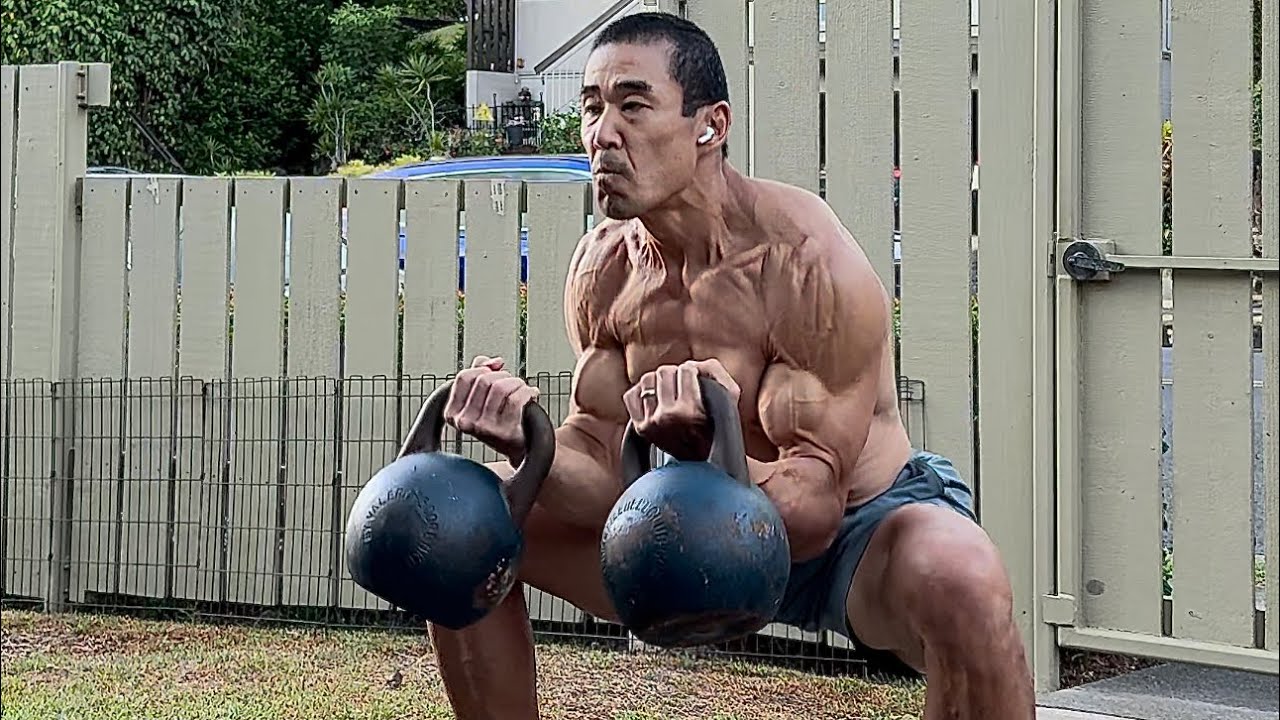
- Double front squats light up the abdominal wall, teaching instant core engagement.
- Goblet squats help beginners feel what a proper squat should be.
By integrating multiple muscle groups in each lift, kettlebells make total-body tension easier to learn and apply—an essential foundation for all other strength work.
Big Jumps, Big Gains
Modern dumbbells often increase in tiny weight increments. Kettlebells, on the other hand, traditionally jump in larger steps—for example, from 53 lbs (24 kg) to 70 lbs (32 kg).
This forces two things:
- High training volume with the lighter bell, building the “base of the pyramid” before moving up.
- Perfect form and total-body tension to successfully handle the heavier weight.
When the weight increase is significant, every detail—breathing, posture, grip—must be “just so.” This creates what educational psychologist Robert Bjork calls a desirable difficulty, a challenge that accelerates skill acquisition and long-term progress.
Swing for Power and Safety
Not everyone can—or should—learn Olympic lifts or sprinting to develop power. Kettlebell swings, Tsatsouline notes, are a safer alternative that still deliver explosive strength and endurance.
Key benefits:
- Low injury risk compared to sprinting or barbell cleans.
- Power endurance development without excessive load.
- Over speed eccentric training: accelerating the bell downward to increase force production. Tsatsouline recalls force plate tests showing over 10 g’s of acceleration with just a 53 lb bell, momentarily creating forces equivalent to 500 lbs—handled safely by the body’s passive tissues.
Swings also scale easily: from short, powerful sets to high-volume challenges like the Guinness World Record set by UK instructor Megan Kelly-Vonabo, who performed an extraordinary number of swings in an hour.
The “What the Hell” Effect
In kettlebell circles, the What the Hell effect refers to unexpected improvements in unrelated areas—faster runs, better endurance, or surprising strength gains.
Examples include:
- Tactical teams reducing hamstring injuries by adding swings, snatches, and single-leg deadlifts.
- Athletes maintaining high performance into their 60s and beyond.
These benefits often come from kettlebells’ ability to combine eccentric loading, cardiovascular work, and strength training in one session.
Longevity Through Power
Even non-athletes benefit from power training. Research shows that maintaining the ability to generate force quickly supports longevity, balance, and independence.
Tsatsouline emphasizes that kettlebell swings allow people of all ages—even those who can’t sprint—to reap these “youth-promoting” benefits safely.
Mobility Without Contortion
Beyond strength and power, kettlebells can dramatically improve mobility. Tsatsouline cites the bent press as an example, enhancing thoracic spine and shoulder flexibility.
Dr. Pope Mosley, a 70-year-old physician and kettlebell instructor, demonstrates deep, healthy ranges of motion most younger people struggle to achieve—proof that kettlebells can help maintain mobility for life.
The Best Entry Point for Strength
For beginners wondering where to start, Tsatsouline’s advice is clear:
“Start with the kettlebell. It’s the best entry point.”
Kettlebell training builds a foundation that makes later transitions to powerlifting, Olympic lifting, or advanced bodyweight training much smoother. Once someone has learned the “language of strength” through kettlebells, more complex skills come faster and safer.
Bottom line: Kettlebells deliver a rare combination of simplicity, versatility, and effectiveness. They teach proper movement patterns, build total-body tension, enhance power safely, improve mobility, and produce carryover into virtually every other athletic and life activity. Whether your goal is peak performance, injury prevention, or simply staying strong and mobile for decades, they offer a proven, efficient path forward.