After more than a decade in the fitness industry, one workout program continues to prove its worth time and again.
It’s a full-body routine that targets every major muscle group while maximizing efficiency.
The secret isn’t just exercise selection—it’s personalization based on individual body structure, experience level, and specific goals.
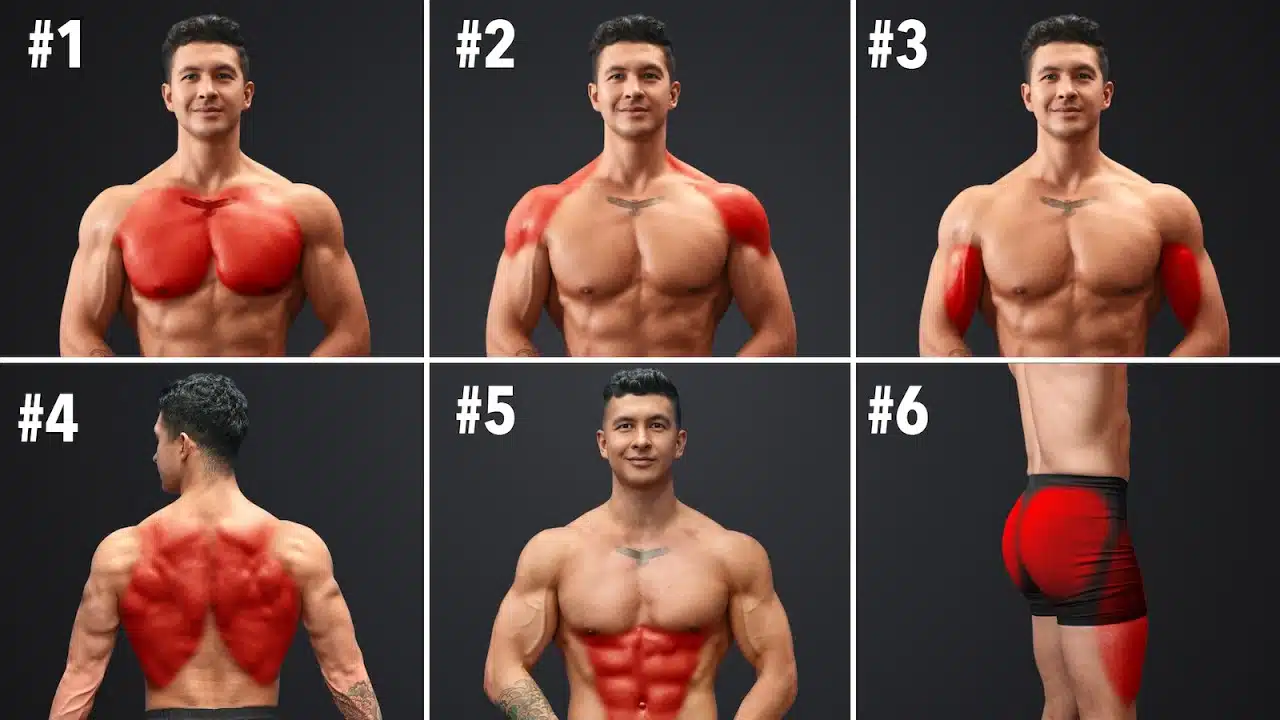
This proven approach combines six fundamental exercises with optional accessory movements designed to address weak points and accelerate results.
Jump to:
- The Low Incline Dumbbell Press: Chest Development Reimagined
- Barbell Squats: The Ultimate Lower Body Compound Movement
- Pull-Ups: Building Elite Back Development
- Romanian Deadlifts: Posterior Chain Protection and Development
- Wide-Grip Rows: Building Back Thickness and Postural Strength
- Lateral Raise Superset: Complete Shoulder Development
- Customization Through Strategic Accessory Selection
- Programming and Frequency Recommendations
The Low Incline Dumbbell Press: Chest Development Reimagined
Research demonstrates that low incline presses match flat bench performance for overall chest growth. However, they deliver superior upper chest activation while simultaneously strengthening shoulders and triceps.
Finding optimal incline angle requires understanding individual anatomy. A simple wall test using a smartphone reveals sternum orientation—the key factor determining proper bench positioning.
Place your phone against your chest. If it points straight up, you have a flat sternum requiring one notch above the lowest setting. If it angles backward, indicating a steep sternum, position the bench two notches up from bottom.
Avoiding the T-Shape Pressing Mistake
Most lifters press with arms perpendicular to their torso—a T-shape pattern that limits depth and increases shoulder injury risk.
Tucking shoulders into an arrow configuration creates deeper chest stretch while protecting shoulder joints. Beginners should expect initial instability, making higher repetition ranges (10-15 reps) ideal for motor pattern development.
Women possess greater tolerance for higher repetitions, making 10-15 rep ranges particularly effective. Advanced lifters benefit from heavier loads and lower rep ranges (6-8 reps) to maximize strength gains.
Barbell Squats: The Ultimate Lower Body Compound Movement
Few exercises deliver comparable total-body development. Squats build glutes as effectively as hip thrusts, strengthen lower back comparable to deadlift variations, develop quads like leg extensions, and even target adductors—all simultaneously.
Before loading a barbell, mastering goblet squats proves invaluable. Front-loading weight forces core engagement, enabling safer depth progression.
I’d recommend stick with this until you can do 50% of your body weight for 10 reps.
Once achieving this benchmark—an 80-pound dumbbell for someone weighing 160 pounds—transitioning to barbells becomes more practical for progressive overload.
Customizing Squats for Specific Muscle Emphasis
Heel elevation maintains upright torso positioning and allows forward knee travel, preferentially targeting quadriceps over glutes and lower back.
Box squats shift emphasis toward glutes. Sitting back onto a bench while maintaining vertical shins increases hip hinge component and posterior chain activation.
Hip structure dictates optimal stance width. Testing three positions reveals individual preference:
- Slightly wider than shoulder width with toes angled outward (approximately 50% of lifters)
- Hip width with toes forward (roughly 25% of lifters)
- Wide stance with significant toe outward rotation (remaining 25%)
Pull-Ups: Building Elite Back Development
Mastering pull-ups transforms back musculature while demonstrating impressive relative strength. Performance benchmarks establish clear progression targets.
For men: 0-1 reps (beginner), 2-5 (average), 6-12 (fit), 13-20 (advanced), 20+ (elite). Women follow similar categories with adjusted numbers reflecting physiological differences.
I can currently do 24 in a row.
Beginners unable to perform full pull-ups should start with inverted rows. This horizontal pulling variation builds foundational back and core strength necessary for vertical pulling.
Progressive Pull-Up Protocol
After achieving 15-rep sets of inverted rows, transition to neutral-grip pull-ups. Most individuals demonstrate greater strength with palms facing each other compared to overhand positioning.
Assistance bands or machines provide initial support until completing sets of 10 unassisted repetitions. Then progress to overhand grip, expecting approximately 50% reduction in repetition capacity initially.
Target 5-8 strict reps per set. Once exceeding eight repetitions, add external loading and rebuild capacity to eight reps before increasing weight again.
Romanian Deadlifts: Posterior Chain Protection and Development
Romanian deadlifts strengthen lower back musculature, develop hamstrings, and provide injury prevention benefits through eccentric loading patterns.
Unlike squats requiring individualized stance width, most lifters perform optimally with hip-width foot placement and forward-facing toes. A simple jump-and-stick test reveals natural landing position—typically ideal for hinge movements.
Learning proper hip hinge mechanics prevents lower back compensation. Starting with a single dumbbell held by its ends facilitates movement pattern acquisition.
Brace core musculature and push hips backward until reaching end range. Return to starting position by driving hips forward.
Targeting Glutes Versus Hamstrings
Knee angle determines muscle emphasis. Increased knee flexion shifts tension toward glutes, while straighter legs preferentially load hamstrings.
Range of motion varies dramatically between individuals. Some lifters safely reach the floor; others must stop below knee level. Both represent correct execution provided spinal neutrality is maintained and hamstring tension is felt throughout.
Moderate repetition ranges (6-10 reps) prove most sustainable. Higher repetitions combined with heavy loading create excessive systemic fatigue.
Wide-Grip Rows: Building Back Thickness and Postural Strength
While pull-ups develop latissimus dorsi effectively, mid-back thickness requires targeted rhomboid and middle trapezius training. Neglecting these muscles produces flat-looking backs and compromised posture.
Lat pulldown machines with wide overhand grips provide optimal positioning. Elevate feet, brace core, and visualize hands as hooks rather than primary movers.
Pull elbows behind torso in arrow configuration while squeezing shoulder blades together. Aim for lower chest level rather than chin or upper chest.
Lighter loads and higher repetitions (10-15 reps) prevent compensatory muscle recruitment. Difficulty achieving mind-muscle connection requires scapular isolation drills.
Practice shoulder blade protraction (spreading apart) and retraction (squeezing together) with straight arms. Once feeling mid-back engagement, incorporate full rowing motion while maintaining that same squeeze.
Advanced lifters should perform standard sets to failure, then complete 3-5 additional scapular-only squeezes ensuring complete mid-back fatigue.
Lateral Raise Superset: Complete Shoulder Development
Shoulder musculature consists of seven distinct regions requiring multi-angle stimulation. Lateral raise supersets efficiently target multiple heads within single training sessions.
Set an incline bench and lie back-first. Raise dumbbells in Y-pattern slightly forward, targeting lateral and anterior deltoid fibers for shoulder width development.
Continue to muscular failure, then immediately flip chest-down. Raise weights laterally and slightly behind torso, emphasizing posterior deltoid for three-dimensional shoulder appearance.
Don’t let your ego take over. I can only use 25 lbs here, and that is more than enough.
Women may experience chest discomfort against bench padding. Placing a folded sweatshirt or pad creates necessary space without compromising positioning.
Customization Through Strategic Accessory Selection
Selecting one or two accessory movements addresses individual weak points and accelerates overall development.
- Beginners: Dead bugs build essential core stability transferring to all compound movements
- Glute emphasis: Hip abduction exercises develop upper glute shelf frequently undertrained
- Calf development: Standing variations (leg press or standing raises) outperform seated options according to research
- Arm growth: Incline dumbbell curls supersetted with overhead tricep extensions target previously unstimulated fibers
- Upper back thickness: Kelso shrugs on incline bench isolate upper trapezius
- Upper chest definition: Forward-leaning cable flies or pec deck variations emphasize clavicular pectoralis fibers
Programming and Frequency Recommendations
Performing this full-body routine two to three times weekly produces significant results across experience levels. Beginners prioritize movement quality and moderate loads. Advanced lifters emphasize progressive overload and strategic weak point targeting.
Pairing intelligent training with appropriate nutrition creates optimal conditions for transformation. Individualized programming accounting for body structure, recovery capacity, and specific goals maximizes adaptation while minimizing injury risk.
This time-tested approach continues delivering results because it respects fundamental training principles while allowing personalization based on individual needs and anatomical variations.