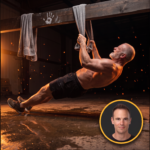
Reaching 25 pull-ups sounds like a straightforward goal.
Train hard, add reps, repeat.

But thousands of dedicated athletes plateau at 8, 10, maybe 12 reps—despite doing everything “right.”
In a recent video, hybrid athlete and endurance specialist behind Built Simple breaks down why traditional training advice fails when chasing high-rep pull-up goals, and shares the exact two-session weekly protocol that’s helped clients break through into 20+ rep territory.
Jump to:
Why Bodybuilding Rules Won’t Get You to 25 Pull-Ups
Most pull-up advice comes straight from bodybuilding: three to four sets, eight to 12 reps, train to failure, rest 48 hours.
That system builds bigger muscles. It works beautifully for hypertrophy.
But high-rep pull-ups aren’t a size test—they’re an endurance skill.
Almost everything you have been told about training comes from bodybuilding. That system is built to make the muscle bigger, and it works for that. But the thing is, you’re not testing size.
Research backs up this distinction. A 2021 systematic review in Sports Medicine confirmed that training programs optimized for muscular endurance require fundamentally different parameters than hypertrophy-focused protocols.
Repeating one movement 25 times demands work capacity, neuromuscular efficiency, and rapid recovery between efforts—not just bigger lats.
The Endurance Athlete’s Approach
The coach behind this protocol spent 20 years competing in endurance sports, including time on a national cycling team and professional hybrid competitions.
Endurance athletes don’t train like bodybuilders because they train for what they’re tested in.
Nobody there trains like a bodybuilder because they train for the thing they’re getting tested in.
That means prioritizing volume and teaching your body to sustain high output repeatedly—not chasing the pump with four sets to failure.
Two Things You Need Every Week
Getting to 25 pull-ups requires exactly two training stimuli each week: big sets and volume.
Big sets teach your nervous system to hold high output in one continuous effort.
Volume trains rapid recovery so you can repeat that effort again and again.
Four weekly sets won’t cut it. Instead, structure two focused sessions.
Session One: Big Set Training
Before starting, test your current max reps to establish a baseline.
Session one revolves around submaximal big sets—not grinding to failure every round.
- Set 1: 90% of current max (if max is 10 reps, do 9)
- Sets 2-4: Step down one rep each set (8, 7, 6)
- Rest: 3 to 5 minutes between sets
Here we are training, we are not testing.
This approach aligns with recent findings. A 2022 meta-analysis in Sports Medicine found that training to failure isn’t necessary for strength gains and may actually impair recovery—supporting the value of submaximal work for skill-based rep goals.
Finishing with energy left ensures you can train again within days, not weeks.
Session Two: Overreaching and Volume
This session has two distinct halves and delivers the real magic.
Part one: Overreaching set
- One max-effort set at bodyweight to total failure
- Immediately grab a resistance band and continue for additional reps
The band reduces effective bodyweight, allowing extra reps beyond your current ceiling.
It’s basically the set that is teaching your body that your current ceiling isn’t high enough, and your body has to adapt.
This builds real work capacity and extends time under tension—key for endurance adaptations.
Part two: EMOM volume work
Start a timer for an “Every Minute On the Minute” (EMOM) workout.
- Perform a small number of reps at the start of each minute
- Rest whatever time remains before the next minute begins
- Begin with 20% of max reps for 10 minutes (if max is 10, do 2 reps per minute)
- Never approach failure on any single round
Long-term, work toward completing 500% of your max set across the EMOM. If your max is 10 reps, aim for 50 total reps spread across small, manageable chunks.
A 2017 study in Journal of Strength and Conditioning Research found that higher weekly training volume correlated with greater strength-endurance improvements in calisthenics movements, supporting this high-volume approach.
What the Research Actually Shows
While the principle of training endurance differently than hypertrophy is well-established, it’s worth noting what science has—and hasn’t—validated about this specific protocol.
The broad framework is sound. Training programs optimized for muscular endurance use different parameters than size-focused work, according to that 2021 Sports Medicine review.
Higher volume improves calisthenics endurance, per the 2017 Journal of Strength and Conditioning Research study.
But the exact prescription—90% max for four descending sets, then EMOM at 20% building to 500% total—hasn’t been tested in peer-reviewed research. This is a coaching method built on endurance training principles, not a lab-validated protocol.
The banded overreaching technique also lacks specific studies, though progressive overload principles supporting it are well-established.
Progression and Testing
Retest max reps every four to eight weeks to track progress and recalibrate training percentages.
As max reps increase, adjust both session one percentages and session two EMOM volume accordingly.
Patience matters here. Building work capacity takes consistent exposure over months, not weeks.
Use this program, test your max set every 4 to 8 weeks and let the magic happen.
Recovery needs vary dramatically based on training intensity, volume, and individual factors, according to a 2018 review in Sports Medicine. Listen to your body and adjust rest days as needed—the old 48-hour rule is oversimplified.
Why Four Sets Per Week Fails
Traditional advice keeps weekly pull-up volume laughably low.
Four sets weekly might maintain strength or add slight size, but it won’t build the neuromuscular efficiency and fatigue resistance needed for 25 continuous reps.
Endurance is a skill. Skills require frequent, varied practice—not occasional max efforts.
This two-session approach dramatically increases weekly volume while strategically varying intensity and rest periods.
The Bigger Picture
This protocol represents a fundamental shift in how many athletes think about bodyweight training.
Rather than obsessing over rep ranges and muscle groups, focus on what you’re testing.
If your goal is 25 pull-ups, train repeated high-output efforts with smart volume accumulation.
If your goal is bigger lats, stick with bodybuilding protocols.
Different goals demand different tools.
The endurance world figured this out decades ago. Cyclists don’t train like powerlifters. Runners don’t program like bodybuilders.
Maybe it’s time pull-up training caught up.
Sources
- Grgic et al., 2021 systematic review – Sports Medicine
- 2017 study on training volume and calisthenics – Journal of Strength and Conditioning Research
- Vieira et al., 2022 meta-analysis on training to failure – Sports Medicine
- 2018 review on recovery needs – Sports Medicine