Waking up stiff isn’t just part of getting older—it’s actually a signal your body needs movement.
Popular fitness expert and physical therapist Jeff Cavaliere recently broke down why mornings feel so rigid and what you can do about it in under 10 minutes.
The solution isn’t complicated stretches or expensive treatments.
It’s a simple understanding of what happens inside your joints while you sleep—and how to reverse it before your feet even hit the floor.
Jump to:
The Real Reason You Wake Up Stiff
Morning stiffness starts deep inside your joints, in a substance called synovial fluid.
This fluid acts like oil in your joints, keeping everything moving smoothly. But when you stay still for hours—like during sleep—it thickens up.
Think of your synovial fluid like a jar of honey that’s been sitting for a while. It is thick and almost solid at the bottom. But if you stir it or you warm it up, it flows again.
Medical professionals refer to this phenomenon as “morning gel,” and it’s the primary culprit behind that first-thing stiffness.
The fix? Movement. Targeted, purposeful movement that gets fluid circulating again.
Why Random Stretching Doesn’t Work
Not all movement is created equal when it comes to morning stiffness.
As we age, certain areas lose range of motion faster than others—and they create a domino effect throughout the entire body.
Ankles are the first to go. When ankle mobility decreases, it forces compensations up the chain: hips tighten, the spine loses flexibility, and shoulders become restricted.
That’s why targeted exercises focusing on these specific problem areas produce dramatically better results than generic stretching routines.
The 13-Exercise Morning Routine That Changes Everything
This sequence moves through your body systematically, addressing each critical mobility zone in order.
Ankle Mobility: The Foundation
Toe Stand Rock: Rise onto your toes (use yoga blocks for support if needed), then rock your weight back toward your heels. This simple movement stretches neglected toe joints and wakes up ankle flexors.
Perform 10 reps, holding the final position for 10 seconds.
Ankle Flex and Circles: Sit down, extend one leg, and manually pull your toes back toward you, then point them forward. Follow with 10 circles in each direction, working every small ligament around the ankle.
Half Lunge Ankle Rock: Step into a skater squat position and roll forward, driving your knee toward the ground, then back. You’ll feel this through your hip, ankle, and knee simultaneously.
Toe Raise Bounce: Come into a half squat on your toes and bounce gently, then alternate driving one foot up while the other goes down. Complete 10 reps per side.
Spine and Shoulder Release
Cat Cow: On hands and knees, push through your hands to round your back (spreading shoulder blades), then reverse by dropping your belly and lifting your chest (squeezing shoulder blades together).
You’re going to move through this slowly, following your breath rather than rushing through it.
Continue for about one minute, letting each rep connect upper back and shoulders.
Downward Dog Extensions: Plant your hands flat and press away as far as possible, keeping feet flat on the floor. Rise onto your toes, touch knees to the floor, then lift back up for 10 reps.
At the top position, shift your hips side to side for another 10 reps, stretching your entire posterior chain.
Dynamic Bounces: From the same position, add controlled bouncing. If your range is limited today, stay small. If you have more available, drive your arms back and bounce deeper.
Finish by holding the stretch for a few seconds, reaching toward your ankles.
Deep Hip and Lower Back Opening
Squat Warm Up: Perform five full-depth squats, keeping your spine tall. Hold onto something for support if needed, or elevate your heels slightly.
After five reps, drop down and spend time in the bottom position, lubricating the joints.
Seated Spinal Twists: Grab your left hand to your right ankle, dig your left shoulder into the opposite knee, and use your body as resistance to open your thoracic spine.
Complete 10 reps, reaching higher with each one, then hold the final position for 10 seconds.
The reason why we hold this position in the extended last rep is because this is where your end range of motion is. And this is the isometric position that we want to hold and get stronger in.
Don’t worry about popping or cracking—it’s completely normal. If you struggle, reduce to five reps or decrease range of motion.
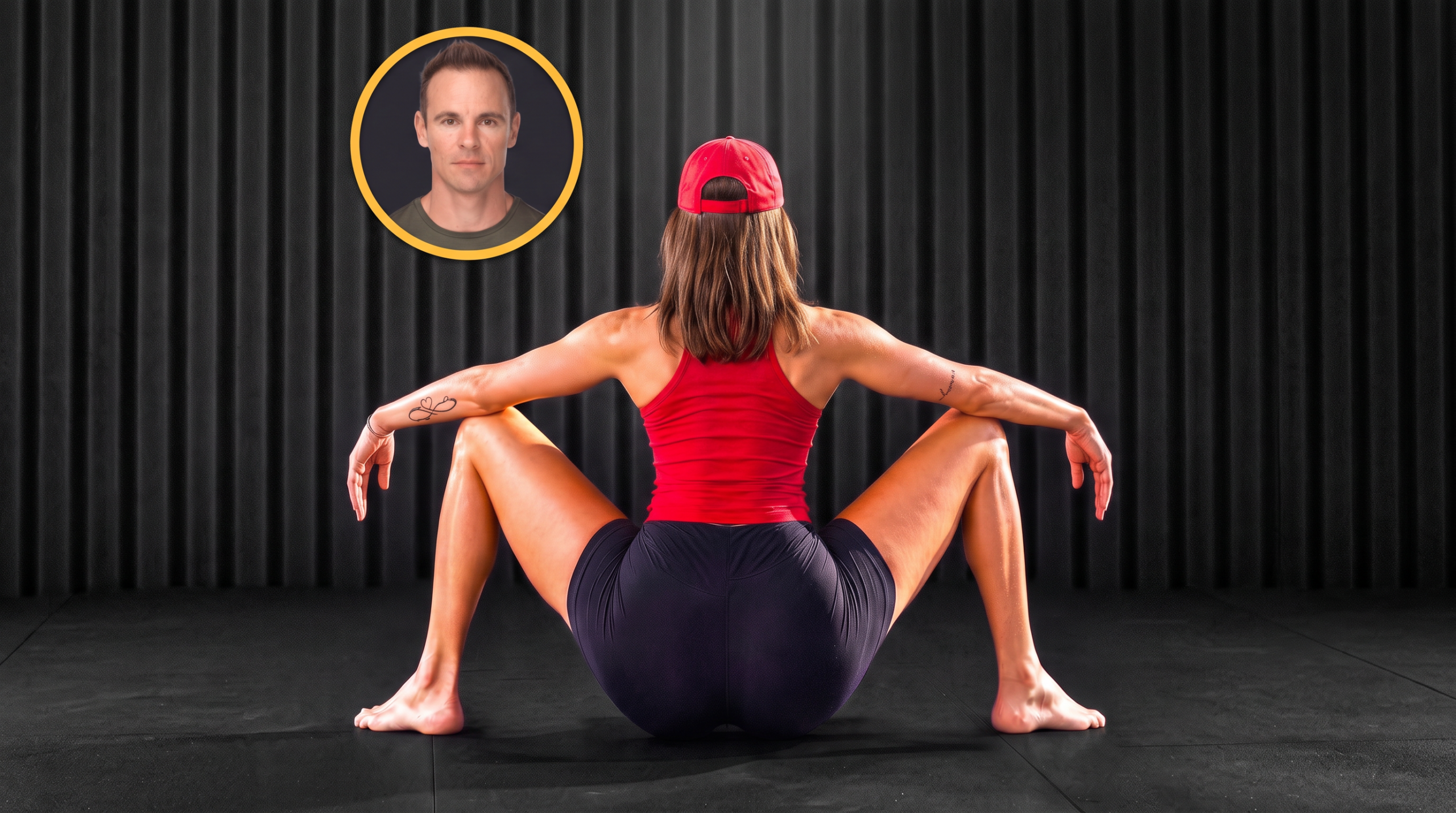
Knee Press: After your twists, bring elbows into knees and press outward against them for 10 reps, holding the last position for 10 seconds.
Wall Push Away: Place hands on knees and press yourself away, straightening through the elbows. This simultaneously opens shoulders, back, and hips. Ten reps, hold the final press for 10 seconds, then switch directions.
Squat Spinal Flexion: From your squat, reach for your ankles behind you and roll your spine forward, aiming to touch the ground. Complete 10 reps, holding the last one for 10 seconds to let your spine soften.
The Hip Mobility Game-Changer
90/90 Hip Switch: Sit down with your front leg bent to 90 degrees and your back leg at 90 degrees behind you. Rotate through your hips, bringing the back leg around to the front and vice versa.
If you put this leg right here and your other leg like this, and then you switch back and forth like this, something amazing starts to happen.
If your back knee bothers you, slide a block or rolled towel under that hip to relieve pressure while still unlocking hip mobility.
This single exercise addresses hip capsule restrictions that build up overnight, creating the “stuck” feeling many people experience when trying to get out of bed.
When to Do This Routine (Timing Matters)
The best time to perform this routine is immediately upon waking—before you’ve been vertical long enough for compensatory movement patterns to kick in.
That synovial fluid begins thinning out only once you start moving. The longer you wait, the longer you remain stuck in that stiff state.
Many practitioners report that doing this sequence first thing prevents the stiffness from ever fully settling in throughout the day.
Real Results From Simple Movements
Thousands of people in their 30s, 40s, and 50s have reported dramatic improvements from routines like this one.
One of my clients, Michelle, couldn’t even bend down to feed her dogs without pain. After working through movements like the ones that I’m about to show you, she sent me a video of herself bending forwards with ease, something that she hadn’t been able to do in years.
The key is consistency. These aren’t exercises you do once and forget—they work because they address the daily cycle of fluid thickening that happens every single night.
Modifications for Every Level
Not everyone will be able to perform every movement at full range immediately, and that’s perfectly fine.
- Use yoga blocks for balance support during standing exercises
- Elevate your heels on books or a slim board during squats if ankle mobility is limited
- Reduce repetitions from 10 to 5 if needed
- Decrease range of motion and work within your current capacity
- Take breaks between exercises if spending time in deep positions becomes uncomfortable
Anything that you would do is better than doing nothing at all. So work with what you currently have.
The goal is progressive improvement, not perfect execution on day one.
The Science Behind Movement and Joint Health
Synovial fluid isn’t just about comfort—it’s essential for cartilage nutrition.
Cartilage has no blood supply, so it depends entirely on movement to pump nutrients in and waste products out through synovial fluid circulation.
When you remain sedentary for extended periods, this nutrition cycle slows dramatically. Morning movement literally feeds your joints.
Research on morning stiffness shows that dynamic movement—not static stretching—produces the fastest reduction in joint resistance and the greatest improvement in functional mobility.
Building Your Morning Habit
The entire routine takes less than 10 minutes once you know the sequence.
Here’s how to make it stick:
- Keep yoga blocks or support props next to your bed
- Perform the routine in the same spot each morning
- Start with just the ankle exercises if 13 movements feels overwhelming
- Add one new exercise every few days until you’ve mastered the full sequence
- Track how you feel throughout the day to notice improvements
Morning stiffness doesn’t have to be your new normal. Your joints are designed to move fluidly at any age—they just need the right stimulus to remember how.
These 13 exercises provide exactly that stimulus, targeting the specific areas that lock up overnight and creating a cascade of mobility that carries through your entire day.
The difference between waking up stiff and jumping out of bed with energy often comes down to those first 10 minutes—and what you choose to do with them.