Popular fitness YouTuber decided to trade his dumbbells for gymnastics rings.
For an entire month.
What happened next wasn’t just unexpected—it was transformative in ways traditional weight training hadn’t delivered in years.
The experiment started with humility and ended with visible chest gains that seemed to defy his recent plateau.
Jump to:
- Finding Foundation: Setting Up Gymnastics Rings at Home
- Week One: Reality Hits Hard
- Week Two: Adaptation Begins
- Week Three: Adding Resistance
- Week Four: The Muscle-Up Mission
- The Results: Visible Transformation
- Why Rings Work: The Science of Instability
- Practical Applications and Limitations
- Who Should Try Ring Training?
- Safety Considerations
- The Verdict: Rings as Primary Training Tool
- Sources
Finding Foundation: Setting Up Gymnastics Rings at Home
Equipment wasn’t the barrier. This particular ring set cost approximately $32 at the time of filming—a modest investment compared to most gym equipment.
The real challenge? Finding somewhere solid to hang them.
No products found.
After carefully checking he wasn’t positioning straps over any sewer pipes, he secured both straps over exposed I-beams in his basement. Starting with rings positioned about shoulder-width apart, he prepared for what would become a humbling first workout.
Week One: Reality Hits Hard
The Stabilizer Shock
Even a simple incline push-up revealed something profound immediately.
Yep, there’s those stabilizers. Like see the shakes? That is that secret sauce that is with ring training those stabilizing muscles.
The instability factor transformed basic movements into completely different exercises. Muscles that had been dormant during years of barbell and dumbbell work suddenly fired up to maintain control.
Moving to deep push-ups with feet elevated on a bench amplified the difficulty exponentially. Despite not even supporting full bodyweight over the rings initially, the movement proved incredibly challenging.
Pull-Ups That Humbled
After completing five sets of 10 deep push-ups, he transitioned to upper body pulling movements. Incline rows burned after about 10 reps, prompting a shift to ring pull-ups for more intensity.
What happened next was shocking.
No products found.
Pull-ups on rings felt dramatically harder than standard bar pull-ups. Whether from fatigue, instability, or the way rings gripped differently, he managed only three sets of five reps—a significant drop from his normal capacity.
The Muscle-Up Dream
One major goal drove this entire experiment: achieving a muscle-up on rings for the first time ever. Despite having performed muscle-ups on straight bars before, rings presented an entirely different challenge.
Dude, how do they do those muscle ups? Oh, dude, no way. That’s No.
After struggling with pull-ups, discouragement set in. Still, he pressed forward to work the top portion of the movement—ring dips.
These proved even more brutal. Starting with three reps, dropping to two on the second set, then barely managing one rep on the final set, the fatigue felt completely different from traditional weight training.
Leg Day Experimentation
Day two focused on lower body training, taking the rings outside to demonstrate their portability. Initial attempts at ring squats didn’t translate well—the movement pattern just didn’t work right.
What did work were Bulgarian split squats with the rear foot in a ring, adding instability that made the exercise slightly more challenging than normal lunges. Turning these into plyometric movements increased difficulty further, allowing several sets of 10 reps per leg.
No products found.
Still, something felt off. The leg training wasn’t pushing limits the same way upper body movements were.
I felt like the only thing I could really do that really I could get like in the zone with was the the jumping lunges. So, I just did a lot of volume.
While upper body remained screaming sore, legs felt undertrained. This prompted research into additional ring-based leg exercises for a second leg session the very next day.
Discovering Effective Leg Movements
Hack pistol squats using rings for stabilization proved far more effective. By adjusting body angle, different muscle groups could be emphasized—leaning back targeted quads more, while leaning forward over the working leg hit glutes harder.
Single-leg glute bridges using rings for the elevated foot created an athletically beneficial movement pattern that hammered hamstrings and glutes while challenging grip strength.
I could see how this could be like great for building base and like sprinting and other forms of athletics.
A final attempt at some kind of ring leg press didn’t feel quite right, but the session overall left lower body genuinely sore.
Core-Focused Finish
With upper body still excruciatingly sore but lower body recovering, the final day of week one targeted core directly through challenging isometric holds.
No products found.
L-hangs and tucked front levers proved extremely difficult. Performing tucked levers for controlled reps created another level of core activation beyond what he’d experienced earlier in the week.
The hope? These core-specific adaptations would carry over into achieving the coveted muscle-up and improving basic movement patterns.
Week Two: Adaptation Begins
Taking Rings to the Gym
After finally recovering in the upper body, week two started with rings packed for the gym. Despite being “that guy” with unconventional equipment, progress mattered more than appearance.
Ring dips—the movement that crushed him week one—now allowed three sets of four slow, controlled reps. Small progress, but definite improvement.
Three sets of seven underhand pull-ups followed, then five sets of 10 decline push-ups targeting upper chest completely exhausted the upper body.
Outdoor Leg Training and Muscle-Up Attempts
Despite planning another leg day outside, temptation struck to test muscle-up progress again.
No products found.
Yeah, I couldn’t help but at least try to do a muscle up again. See if I got any closer, but dude, not even close.
Pushing through disappointment, he worked through plyometric lunges and created a new combination movement—jumping squat depth landings transitioning into pistol squats.
This variation challenged explosive power while doubling the difficulty of pistol squats, provided knee stability could handle the impact. Fortunately, it could.
Simple But Brutally Effective
After a rest day, he returned to the gym for an upper body session consisting of just two exercises performed for significant volume.
10 sets of 10 deep push-ups.
10 sets of 10 horizontal bodyweight rows.
That’s it. 100 reps of each movement.
No products found.
100, 100, no joke. That is so simple, but so challenging.
The minimalist approach delivered a serious upper body workout without complex programming or equipment variation.
Isolation Experimentation
Forty-eight hours later, he realized training had focused almost exclusively on compound movements. Could rings replicate bodybuilding-style isolation exercises?
Overhead tricep extensions using bodyweight as resistance felt decent. Positioning hands differently—resting inner forearms slightly on rings—helped isolate triceps better during push-down variations.
Decline bicep curls targeted arms similarly to the bicep portion of underhand pull-ups without heavily recruiting lats.
After hammering 10 sets of 10 for each isolation movement, arms looked notably pumped. Forearms particularly showed development without direct forearm training.
Week Three: Adding Resistance
Muscle-up attempts still looked sloppy but showed genuine improvement. Feeling ready to push harder, he added a weighted vest to basic movements.
No products found.
Running through another 100-100 workout—10 sets of 10 deep push-ups followed by 10 sets of 10 deep recline rows—with added resistance created an unreal pump.
I feel like I was making chest gains beyond that which I’ve made with weights over the past couple of years. Like I am telling you, if there was one thing to highlight, it was the chest gains with the rings.
This observation proved significant. After years of traditional weight training creating diminishing returns for chest development, rings somehow broke through the plateau.
Prioritizing Upper Body
Admittedly, leg training took a backseat during this period. Focus remained on developing upper body strength and skill needed for the muscle-up.
Continuing weighted vest training showed promising results—ring dips and pull-ups improved even with extra resistance, indicating rapid strength development.
After hammering upper body in the gym and working on explosiveness and stability, he took two full rest days leading into week four.
Week Four: The Muscle-Up Mission
Week four began with singular focus: achieve the muscle-up.
No products found.
After warming up, practice reps used feet for assistance past the sticking point, gradually reducing foot involvement until ready for pure attempts.
OH, DANG IT. I DON’T CARE. OH, COME ON.
Close attempts bred confidence. One more try…
Then something went wrong. Coming out of proper groove, his chest stretched in a way that felt dangerously close to injury. While only residual tightness lingered for 24 hours, the scare prompted caution.
No more muscle-up attempts that session. Time to focus on legs instead.
Tapering and Return
Chest uneasiness lingered for several days, prompting a mid-week taper. Returning at week’s end with renewed determination, muscle-up attempts resumed.
Attempts looked closer and more consistent than ever, though admittedly still sloppy by gymnastics standards.
No products found.
Rather than obsessing solely over muscle-ups, wisdom prevailed. Finishing week four with substantial upper body work using the weighted vest built continued strength foundation.
Ring dips—once brutally difficult—now performed dramatically better than just weeks prior.
The Results: Visible Transformation
After one month of replacing all weight training with rings training, how did physique change?
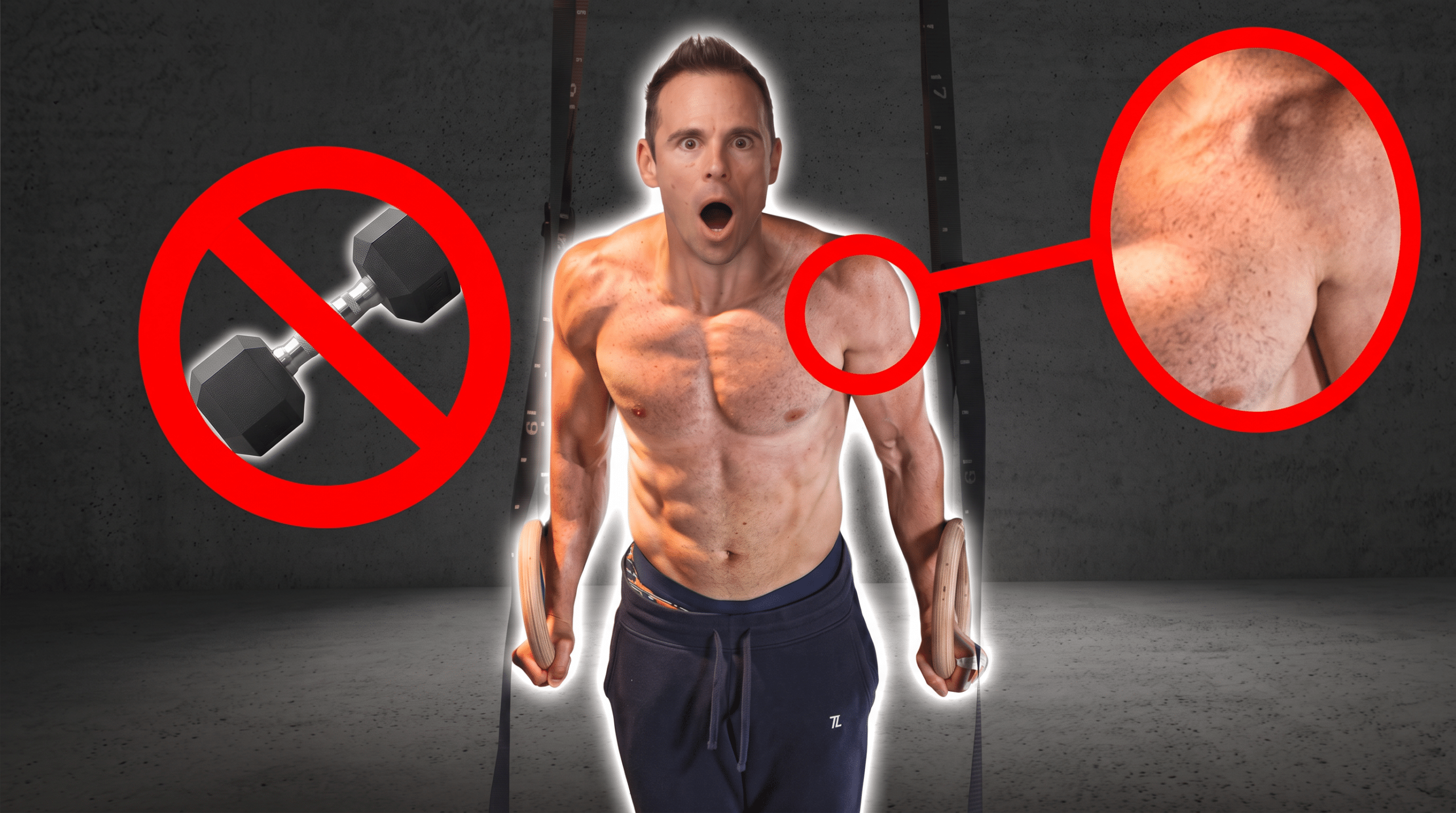
Comparing before and after photos (accounting for slightly more tan in after shots), chest development appeared dramatically improved. Front deltoids also showed noticeable growth.
Dude, my chest This just seems so much bigger than when I started this. I really think I made some chest gains.
While he’d experimented with rings previously, this month of consistent, focused training created entirely different results.
Why Rings Work: The Science of Instability
What makes gymnastics rings so effective compared to traditional resistance training?
No products found.
Constant stabilization demands activate supporting muscle groups that remain relatively dormant during fixed-path movements like barbell pressing or cable exercises.
Research does support that unstable surface training can increase muscle activation. A 2014 study in the Journal of Strength and Conditioning Research found that push-ups performed on suspension devices activated core musculature significantly more than standard push-ups, though the research is mixed on whether this always translates to superior strength or hypertrophy gains compared to traditional progressive overload.
The freedom of movement rings provide allows natural joint positioning throughout exercises. Hands can rotate and adjust continuously rather than forcing shoulders, elbows, and wrists into predetermined positions.
For someone experiencing plateau with traditional training, this variation in muscle activation patterns and movement freedom can provide novel stimulus that drives adaptation.
Practical Applications and Limitations
Upper Body Excellence
Ring training clearly excelled for upper body development in this experiment. Chest gains proved particularly notable, with pressing movements creating deep stretches and continuous tension throughout ranges of motion.
Pull-up and row variations effectively trained back musculature while heavily engaging grip and core stabilizers.
No products found.
Lower Body Challenges
Leg training presented more challenges. While movements like pistol squat variations and single-leg glute bridges provided value, they couldn’t replicate the loading capacity of barbell squats or deadlifts.
For athletes prioritizing maximum lower body strength or muscle mass, rings alone likely won’t suffice. They work better as supplementary tools for balance, stability, and unilateral strength.
Progressive Overload Considerations
Traditional weight training allows precise, measurable progressive overload—add 5 pounds to the bar each week.
Ring training requires more creative progression:
- Leverage changes (incline to decline variations)
- Movement tempo (slower eccentrics, pauses)
- Volume increases (more sets and reps)
- Added resistance (weighted vests, ankle weights)
- Skill progressions (working toward advanced movements like muscle-ups, front levers)
This requires more programming creativity but offers significant benefits for movement quality and body control.
Who Should Try Ring Training?
Gymnastics rings offer particular value for several populations:
No products found.
- Experienced lifters hitting plateaus with traditional training
- Home gym enthusiasts seeking affordable, portable equipment
- Athletes prioritizing relative strength and body control over absolute strength
- Those with joint issues who benefit from self-adjusting movement paths
- Travelers wanting effective workouts anywhere with overhead anchor points
The minimal investment—quality rings cost $30-50—makes them accessible for nearly anyone curious about calisthenics training.
Safety Considerations
This experiment highlighted important safety factors:
Proper anchor points matter critically. Securing rings over structurally sound overhead supports (I-beams, thick tree branches, dedicated pull-up bars) prevents dangerous equipment failure.
Progress gradually. The dramatic difficulty increase from stable to unstable surfaces means starting conservative prevents injury. Even experienced lifters should begin with basic progressions.
Listen to warning signs. That near-injury during muscle-up attempts demonstrated the importance of respecting unfamiliar movement patterns and backing off when something feels wrong.
Expect significant soreness initially. Activating dormant stabilizer muscles creates intense delayed-onset muscle soreness that can last longer than typical training soreness.
No products found.
The Verdict: Rings as Primary Training Tool
Can gymnastics rings completely replace weight training for an entire month?
For upper body development, this experiment suggests absolutely yes—at least for breaking through plateaus and building functional strength. The visible chest gains and strength improvements across multiple movement patterns proved rings’ effectiveness.
For lower body training, rings work better as supplementary tools rather than complete replacements for loaded barbell work, particularly for those seeking maximum strength and muscle mass.
The challenge, humility, and novel stimulus rings provided clearly disrupted adaptation patterns that had grown stale after years of conventional training.
Perhaps most importantly, the journey wasn’t finished. Despite not achieving a clean muscle-up during the initial month, progress was undeniable—closer attempts, better stability, significantly improved strength in component movements.
Continued ring training would likely deliver that achievement and further development.
No products found.
Sometimes the simplest tools—two wooden rings and some straps—provide exactly what advanced training needs: challenge, instability, and complete engagement that forces adaptation.
For $32 and some creative anchor point solutions, that’s remarkably accessible.
Sources
- Journal of Strength and Conditioning Research (2014) – suspension device push-up muscle activation study