Ultrarunning isn’t just a test of endurance—it’s a reckoning with discomfort, both physical and mental. In one of her most grueling efforts to date, elite ultrarunner Sally McRae demonstrated what it truly means to persevere.
Her Tahoe 200-mile race wasn’t smooth. She battled an unrelenting cough, extreme heat, nausea, vomiting, and hallucinations—but she never stopped moving.
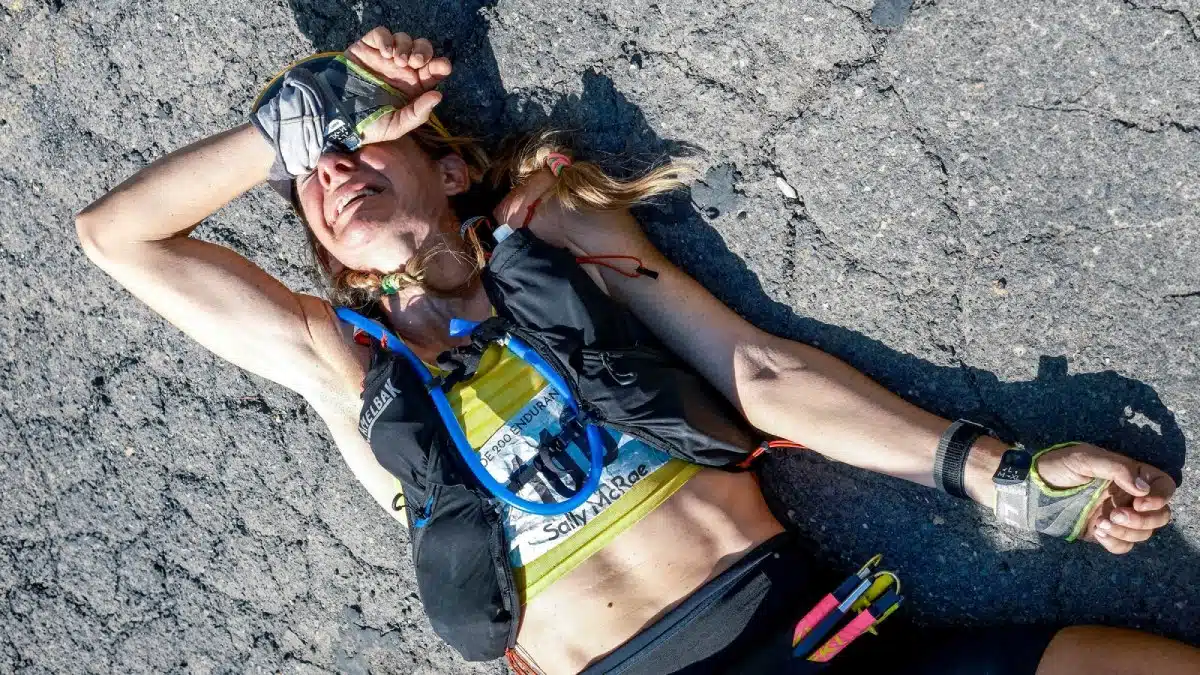
The journey didn’t just test her fitness, it challenged her identity as a competitor and tested the limits of her willpower.
In the end, through sheer grit and mental toughness, McRae clawed her way to a third-place finish.
And perhaps most inspiring of all—she did it while learning how to let go of expectations and embrace the messiness of the journey.
Jump to:
A Goal-Driven Start—and an Immediate Setback
“I wanted to get on that podium, and I was prepared to do whatever it would take,” McRae said prior to the race. From the starting line, her intention was clear: race hard, push boundaries, and leave no doubt she gave her all.
For the first 30 miles, everything was going according to plan. She was locked into a competitive back-and-forth with another female runner, her spirits were high, and her pace was strong. But things quickly began to shift.
By the 50K mark (about 31 miles in), nausea, dizziness, and shortness of breath began to creep in. “This wasn’t just nerves,” she recalled. “It felt like the energy was being sucked from me.”
Dealing with the Body’s Breakdown
As she crossed into the 100K mark (62 miles), her condition had worsened. She could no longer keep food or water down—the hallmark of a gastrointestinal shutdown that strikes fear in the hearts of all endurance runners.
“I hadn’t eaten in eight hours,” she admitted. “I’m throwing up water. I can’t keep anything down.” And yet, quitting never seriously crossed her mind. “It’s not a question of whether I’ll finish—it’s how I’ll figure out the problem.”
Her crew became critical during this phase. Her pacer Billy, a calming and focused presence, stuck by her side. “What do you mean? This is what you do,” he told Sally during one of her darkest moments. “You know how to suffer. You know how to overcome.”
Small Wins and Mental Shifts
Reclaiming momentum came slowly. Between mile 63 and 100, it was all about limiting damage. McRae grappled with sleep-deprivation, relentless heat, and the mental toll of seeing racer after racer pass by. “Lying in the cot watching runners come in and out was mentally brutal,” she admitted.
Every small choice—treating blisters, cooling off, or attempting to eat—was deliberate. The breakthroughs came in internal conversations: “If I want to finish strong, I have to be patient,” she said. “I had to let go of my expectations.”
Fueling a Comeback
At a pivotal aid station, nearly 130 miles in, something shifted. With night setting in and temperatures dropping, conditions began to favor McRae. A new idea took root: she wasn’t out of podium contention yet. A female runner ahead was only about 30–40 minutes away.
Fueled by the possibility of redemption and bolstered by her crew’s support, McRae ramped up the intensity. “I thought, let’s go for it, no matter the cost,” she said. “It wasn’t that my feet stopped hurting or that my lungs cleared—it was just mindset.”
“Use anger for passion.”
In moments of fatigue and frustration, McRae’s crew reminded her to channel emotion into drive. “Be pissed—you can use that,” Billy urged. The two hammered through the night with focus and audacity, racing runners ahead instead of time cutoffs behind.
The Final Push—and Complete Exhaustion
With only 15 miles left to go, McRae made the pass that bumped her into third place. But she had little left to give. Her body, pushed past limit after limit, finally gave out.
Alone on the trail, she began hallucinating. “I remember talking to a tree,” she said. “I had to slap myself out of it. I had nothing left to give—and I was still asking my body for more.”
Despite the pain, despite blacking out on the trail, she kept moving forward, one step at a time. “I spent 100 miles thinking I was failing,” she admitted. “But the moment I thought about giving up was also when the greatest shift happened.”
Redefining Success
Sally McRae did make it to the finish line—and onto that podium. “Third place, baby,” she beamed amidst cheers. “I’ve never been prouder of third place in my life.”
Her finish wasn’t shaped by ideal splits or perfect nutrition. It was defined by tenacity. By being willing to suffer, reevaluate, adapt, and believe—long after her body had stopped cooperating.
Lessons for Every Athlete
McRae’s story is a vivid reminder that success in endurance sports—and life—rarely comes in the form we expect. Some key takeaways from her experience:
- Be comfortable being uncomfortable. True growth often requires stepping into the pain and staying there long enough to adapt.
- Let go of expectations. Races, goals, and timelines may not go to plan. Adapting with grace can open the door to surprising success.
- Mental toughness is trainable. Like the body, the mind can be strengthened. Practice perseverance—even in training runs.
- Your crew matters deeply. A trusted support system can bring critical perspective and motivation when you’ve lost your own.
- Don’t quit early. As McRae said, “It’s usually right when we want to give up that the greatest changes happen.”
The Power of Resilience
For McRae, this race wasn’t just about speed, strategy, or strength—it was about heart. “Maybe this wasn’t how I dreamed it to be, but it was exactly what I needed,” she said after crossing the finish line.
Her third-place finish wasn’t just a position—it was a triumph of resilience, proving that even when the race feels lost, it never truly is until you choose to stop trying.
And Sally McRae? She never stopped trying.