Nordic hamstring curls have earned their reputation as one of the most effective exercises for strengthening the back of the thighs.
But despite their popularity among athletes and fitness enthusiasts, there’s more nuance to this movement than most people realize.
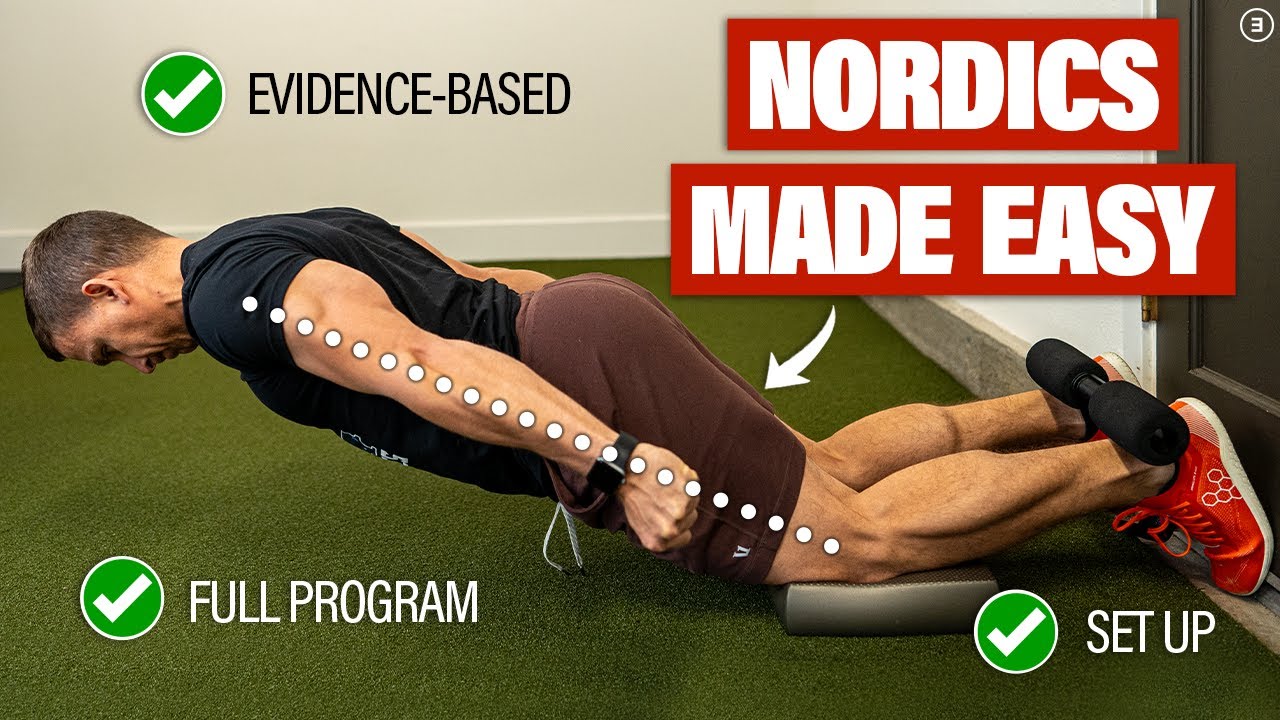
From proper setup to the latest research on injury prevention, understanding how to execute and program this exercise correctly can make all the difference in achieving results.
Whether the goal is preventing hamstring strains, improving sprint performance, or simply building stronger legs, Nordic hamstring curls offer a unique training stimulus worth exploring.
Jump to:
- Understanding Hamstring Anatomy and Function
- Setup Requirements: Keeping It Simple
- Proper Execution Technique
- Regressions and Progressions
- Research on Injury Prevention: Mixed Results
- Complementing a Comprehensive Program
- Programming Guidelines Based on Goals
- Sample Training Split
- Setting Realistic Expectations
Understanding Hamstring Anatomy and Function
The hamstrings consist of four distinct muscles working together on the back of the thigh. Three muscles—the semimembranosus, semitendinosus, and long head of the biceps femoris—attach from the pelvis to the lower leg bones.
These three muscles perform two primary actions: hip extension and knee flexion. Additionally, the short head of the biceps femoris only acts to flex the knee.
Nordic hamstring curls specifically challenge the knee flexion action, making them particularly valuable for injury prevention and performance enhancement.
Setup Requirements: Keeping It Simple
Setting up for Nordic hamstring curls requires minimal equipment. Only two things are necessary: a soft surface to kneel on and a place to anchor your feet.
A pad, pillow, or towel works perfectly for knee comfort. Anchoring options, however, vary widely in effectiveness.
Foot Anchoring Options
Using a partner requires another person strong enough to hold legs appropriately, though some find the pressure uncomfortable. Lap pull-down machines work but force knees closer together than ideal and occupy upper body equipment.
Other effective options include:
- Barbell with plates on either side to prevent rolling
- Flat bench with belt or strap to firmly secure legs
- Squat rack attachments designed for leg anchoring
- Adjustable door straps for home workouts
- Specialized Nordic curl equipment (more expensive)
- Smith machines or metal stall bars at commercial gyms
With creativity and setup time, Nordic hamstring curls can be performed almost anywhere.
Proper Execution Technique
Maintaining a straight line between knees, hips, and shoulders is crucial during execution. Slowly lower toward the floor or object placed in front while controlling the descent.
Catch yourself with hands at the bottom, then push back up to starting position. Squeezing glutes helps maintain hip and trunk position throughout the movement.
Dig heels into whatever holds legs in place, essentially imagining bringing heels toward glutes while falling forward.
Regressions and Progressions
Making the exercise easier involves two primary strategies. First, allowing hips to bend is perfectly acceptable and still provides benefits while working toward straightening out over time.
Second, decreasing range of motion by placing or stacking objects in front reduces difficulty.
Progression Strategies
Increasing difficulty comes through two main approaches: expanding range of motion by removing objects or holding light weights and gradually increasing load over time.
Starting with shortened range of motion and gradually lowering stacked object height represents one of the best progression methods for achieving full repetitions.
For assistance, placing a band around the chest and anchoring it to a sturdy object above and behind provides support. Tools like balls, dowels, and ab wheels exist but often significantly reduce effort, which defeats the purpose—the exercise is meant to be hard.
Research on Injury Prevention: Mixed Results
A 2019 systematic review by Van Dyke concluded that programs including Nordic hamstring exercises reduce hamstring injuries by up to 51 percent.
However, a 2021 paper by Impellizzeri reported methodological concerns suggesting the review likely overestimated benefits. Disagreements between authors followed, creating ongoing debate.
Nordic hamstring curls have potential to reduce hamstring strain injury risk, but more uncertainty exists than often stated. They maintain strong theoretical basis since they promote improvements in eccentric knee flexor strength and muscle fascicle length—known risk factors for hamstring strains.
Think of them as causing the hamstrings to get stronger and longer.
They also have potential to improve sprint performance, though uncertainty remains here as well.
Complementing a Comprehensive Program
Implementation of Nordic hamstring curls should complement comprehensive training rather than serve as a standalone solution. Since hamstrings function to flex knees and extend hips, well-rounded routines should incorporate exercises challenging hip extension from stretched positions.
Hip Extension Exercise Options
- Romanian or stiff-legged deadlifts
- Roman chair hip extensions (double leg, single leg, or weighted)
- Glute ham raise machine hip extensions (double leg, single leg, or weighted)
Alternative Knee Flexion Exercises
To replace Nordic hamstring curls, build strength for them, or perform additional knee flexion work, several options exist:
- Glute ham raise machine (double leg, body weight, or weighted)
- Prone hamstring curls (double leg, single leg, or eccentric only)
- Seated hamstring curls (double leg, single leg, or eccentric only)
- Hamstring sliders (double leg eccentric, single leg eccentric, or single leg)
For those playing sports or engaging in high-speed running activities, including sprinting in training routines remains necessary.
Programming Guidelines Based on Goals
Programming depends entirely on specific objectives. If performing a full repetition is the only goal, higher frequency with lower repetitions works best—three sets of three to five reps, two to three times weekly.
Building Toward Full Repetitions
Three execution strategies exist for this goal. First, build strength to lower all the way down before attempting to pull back up.
Second, start with full repetitions through shortened range of motion, increasing range over time by gradually lowering stacked object height.
Third, combine both approaches: do a few repetitions weekly lowering as far as possible, while remaining repetitions use full shortened range of motion. During three sets of five repetitions three times weekly, for example, each set’s first repetition focuses on maximum lowering distance, then practice lowering and raising with objects placed as needed.
Programming for Injury Prevention
For eliciting adaptations that might reduce hamstring strain injury risk, focus only on the lowering (eccentric) portion. Researchers typically ensure participants cannot bring themselves back up.
Participants were observed to have sufficient strength to completely control the movement in the final 10 to 20 degrees of the Nordic hamstring exercise. They were then required to hold a weight plate ranging from 5 to 25 kilograms to ensure super maximal exercise intensity was maintained.
Super maximal means greater than one repetition maximum. Individuals are stronger eccentrically (lowering) than concentrically (pulling back up), and most researchers want Nordics too difficult for returning to starting position.
Minimum Effective Dose
A 2020 systematic review by Cuthbert and a 2022 study by Bihan inform minimum effective doses for increasing eccentric knee flexor strength and muscle fascicle length.
Research shows that four sets of six repetitions twice weekly for two weeks, followed by two sets of four repetitions once weekly for four weeks, sufficiently elicits these adaptations.
Either start with higher volume and taper off, or gradually progress volume over six weeks.
Sample Training Split
For general training without specific goals, Nordic hamstring curls simply need to fit within overall routine context. Training legs twice weekly might look like this:
Monday: Rear-foot elevated split squats, Romanian deadlifts, seated leg extensions, prone hamstring curls, standing single leg heel raises
Thursday: Squats, single leg Roman chair hip extensions, Nordic hamstring curls, reverse Nordics, seated heel raises
This represents just one example among infinite possibilities regarding exercise selection, sets, reps, and frequency.
Setting Realistic Expectations
Before becoming proficient at Nordic hamstring curls, creating a plan, maintaining consistency, and setting realistic expectations proves essential. They are difficult exercises that can cause significant soreness, especially for less trained individuals.
Mastering them overnight isn’t necessary—or realistic. Focus on gradual progression, proper form, and patience for best results.