What happens when you slash your workout volume in half for over three months straight?
Most fitness experts would tell you that’s a recipe for losing muscle.
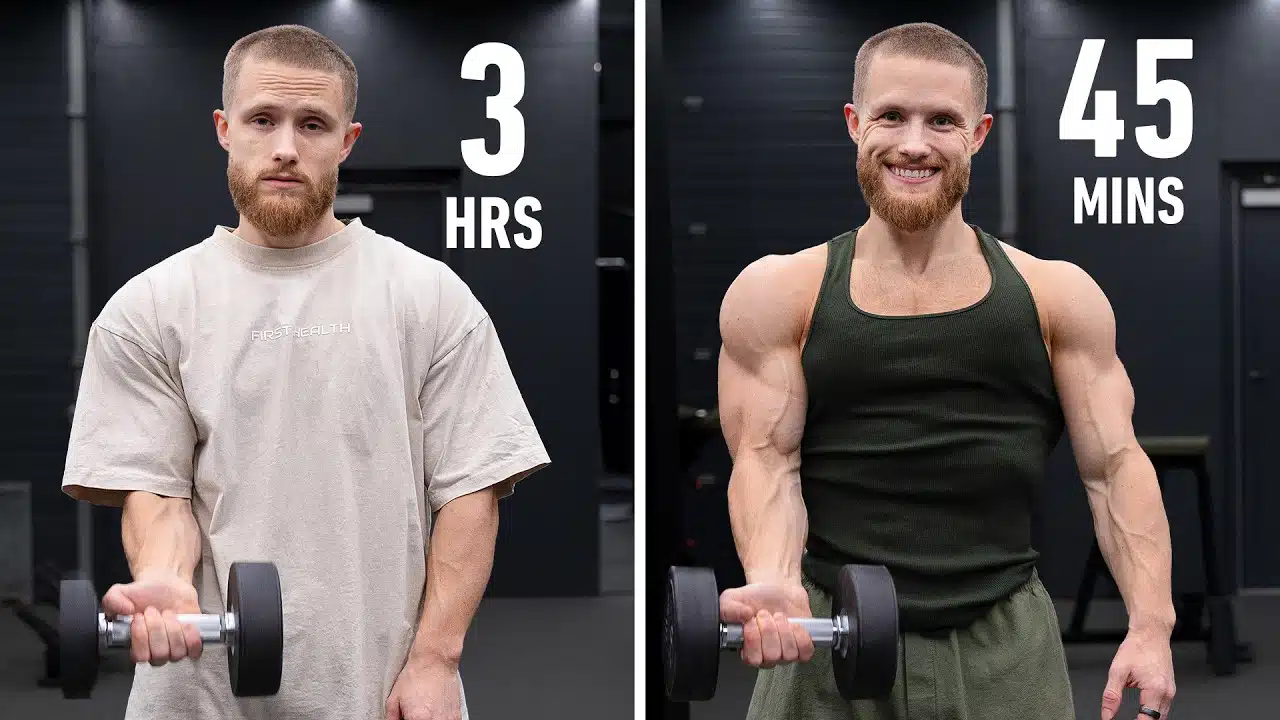
But fitness coach and content creator Jeff Nippard decided to find out for himself, documenting every detail of his 100-day low-volume training experiment.
In a recent YouTube video, Nippard shared the surprising results of dropping from his usual three to four sets per exercise down to just one or two—and the science behind why it actually worked.
Jump to:
- The Standard Science-Based Approach to Volume
- Why Nippard Questioned the High-Volume Gospel
- The 100-Day Low-Volume Protocol
- The Unexpected “Focus Effect”
- The Remarkable Results After 100 Days
- Scientific Support for Low-Volume Training
- Nippard’s Updated Training Recommendations
- Key Takeaways for Your Training
The Standard Science-Based Approach to Volume
For years, Nippard followed what research suggested was optimal: 10 to 20 sets per muscle per week. This guideline emerged from multiple meta-analyses showing a clear dose-response relationship between training volume and muscle growth.
Back in 2010, researcher James Krieger published findings showing that doing two to three sets per exercise was about 40% more effective than just one set. By 2016, another meta-analysis reinforced this message: more volume meant more gains.
Then in 2023, Pelland and colleagues dropped what Nippard calls “the biggest, most detailed meta-analysis on training volume that’s ever been published.” Analyzing 35 studies, researchers found the dose-response relationship held from as low as four sets per week all the way up to 43 sets per week.
For the last decade or so, the standard science-based guideline for sets per muscle per week was about 10 to 20 sets per muscle per week. That’s quite a lot.
Why Nippard Questioned the High-Volume Gospel
Despite the overwhelming research support, Nippard identified several practical limitations that made him question whether high volume was really necessary—especially during a cut.
The Studies Had Serious Gaps
Most volume studies only blasted one or two muscles with high volume, not the entire body. Training every muscle group with 20+ sets per week could create serious recovery issues that research hasn’t adequately addressed.
Nearly all studies were conducted at maintenance calories, but Nippard was cutting. A caloric deficit means less energy and reduced recovery capacity—factors that dramatically change the equation.
Perhaps most importantly, these studies typically lasted only 6 to 12 weeks. What happens over longer periods? Do higher volumes keep pulling you ahead forever, or do they just provide short-term boosts?
The Real-World Experience Factor
After years of high-volume training, Nippard noticed something crucial: he was starting to dread his workouts, especially leg days while cutting.
I actually think it was holding me back in some ways because training is supposed to be fun. And I’ll tell you, I used to dread doing some of those super high volume workouts, especially leg days, and especially when cutting.
The 100-Day Low-Volume Protocol
Nippard designed what he calls “the most effective low volume split I could think of.” His weekly schedule followed this pattern: Upper, Lower, Rest, Upper, Lower, Arms and Delts, Rest.
Here’s how dramatically he slashed his volume across major muscle groups:
- Chest: Six sets per week (down from 10-20)
- Most muscles: Four to six sets per week
- Shoulders: Ten sets per week
- Back: Nine sets per week
- Glutes: Nine sets per week
- Quads: Eight sets per week
On average, he performed only 6.5 sets per muscle per week—well below the “optimal” range suggested by research.
The Critical Intensity Component
Nippard knew that slashing volume required one crucial compensation: ultra-high intensity. Almost every single set was taken to complete muscular failure.
A 2023 meta-analysis from Robinson and colleagues showed that the closer you train to failure, the more muscle you gain. With low volume, pushing nearly every set to failure becomes sustainable without destroying recovery.
It’s so insane how much better you lock in when you only have two sets to do. If I knew I had like four sets on that, I would be driving my feet 100%. The fact I know I’ve only got two, bro, I lock in and go crazy.
The Unexpected “Focus Effect”
One of Nippard’s biggest discoveries was what he termed the focus effect.
During high-volume workouts, his focus would consistently taper off around the middle. He’d check his phone more, rest longer between sets, and socialize. Already-long workouts would drag on even more.
With low volume, knowing he only had one or two sets to nail each exercise created laser focus. Before every set, he reminded himself of the need for perfect execution and maximum effort.
I don’t think there’s been a single set where I didn’t bring the intensity for this entire challenge.
The Remarkable Results After 100 Days
Nippard tracked his progress using multiple objective measures: DEXA scans for body composition, standardized strength tests, and progress photos under identical lighting.
Body Composition Changes
From day one to day 100, Nippard’s DEXA results showed:
- 5.5 pounds of fat mass lost
- 1.8 pounds of lean mass lost
- Total weight: Down 7 pounds
That’s already an impressive fat-to-lean-mass ratio, especially considering lean mass includes water weight, which naturally decreases during cuts.
But the results get even better. From day 30 to day 100, across 70 days of low-volume training, Nippard actually gained half a pound of lean mass while losing another 2.3 pounds of fat.
Strength Gains While Cutting
Perhaps most impressively, Nippard didn’t just maintain strength—he got stronger on several lifts:
- Pendulum squat: Progressive rep PRs in final weeks (5 reps, then 6, then 7 with same weight)
- Chest press machine: Four reps more than previous PR in final workout
- Smith machine bench press: Matched baseline strength despite 7-pound weight loss
- Leg extension: Added 15 pounds to one-rep max
And my weight is going down. It’s so insane how much better you lock in when you only have two sets to do.
Physique Improvements
Side-by-side progress photos revealed clear improvements. Despite being 7 pounds lighter, Nippard appeared more muscular, particularly in his legs and shoulders. He maintained muscle fullness, size, and density while achieving significantly more definition.
Scientific Support for Low-Volume Training
While Nippard’s personal results are compelling, they’re supported by research showing that low volume can be highly effective—especially for muscle maintenance and when training to failure.
The Muscle Maintenance Studies
Classic research from Bickel and colleagues provides striking evidence. Subjects first performed a high-volume phase: three leg workouts weekly with three sets each of squats, leg press, and leg extensions—27 sets per week for 16 weeks.
Then half dropped to one set per exercise once weekly—just three total sets per week. The result? They maintained 100% of their size and strength gains for another 32 weeks. That’s 224 days on minimal volume with 70 subjects, some even making additional gains.
Brand New Low-Volume Research
A September 2024 study from Herman and colleagues had 42 resistance-trained subjects follow a low-volume program: two full-body workouts weekly with just one set per exercise. Each 30-minute workout was split between a failure group and a non-failure group (leaving two reps in reserve).
After eight weeks, both groups made significant gains, though the failure group tended to grow better overall.
This demonstrates two critical points: experienced trainees can make gains on low volume, and training to failure matters more on low-volume programs.
Nippard’s Updated Training Recommendations
Based on his experiment, Nippard significantly revised his previous stance that training volume shouldn’t change during cuts.
When Cutting: Go Low Volume
For fat-loss phases, Nippard now strongly recommends low-volume training. Your recovery capacity drops in a caloric deficit, making high volume harder to sustain. Low volume retains muscle effectively—as long as you train hard.
When Bulking: Strategic High Volume
For muscle-building phases, Nippard suggests keeping volume relatively low for most muscles while blasting one muscle group with 10 to 30 sets per week. Every few months, rotate which muscle receives the high-volume treatment.
This approach makes particular sense for advanced trainees who need greater stimulus for specific lagging body parts but can’t recover from system-wide high volume.
Key Takeaways for Your Training
Nippard’s experiment reveals several practical lessons that challenge conventional wisdom:
- Volume isn’t everything: Training intensity (proximity to failure) may be more important than total set count
- Context matters tremendously: What works during a bulk may not be optimal during a cut
- Workout enjoyment counts: Sustainable training you look forward to beats theoretically optimal training you dread
- Focus quality matters: Fewer sets with maximum effort may outperform more sets with divided attention
- Individual response varies: Research shows averages; your personal results require experimentation
The research showing volume drives muscle growth isn’t wrong—it’s just incomplete. Those studies measure short-term responses in specific contexts, not long-term results across all training phases and individual circumstances.
Nippard’s 100-day experiment demonstrates that with sufficient intensity, dramatically lower volume can maintain and even build muscle while cutting—all while making training more enjoyable and sustainable.
This variable is becoming more and more important to me at 34 and almost two decades deep into training. Instead of dreading long workouts, now I actually can’t wait to train each day.
For most lifters, especially those cutting or struggling with workout adherence, the evidence suggests one clear conclusion: you probably don’t need as much volume as you think—you just need to train really hard.